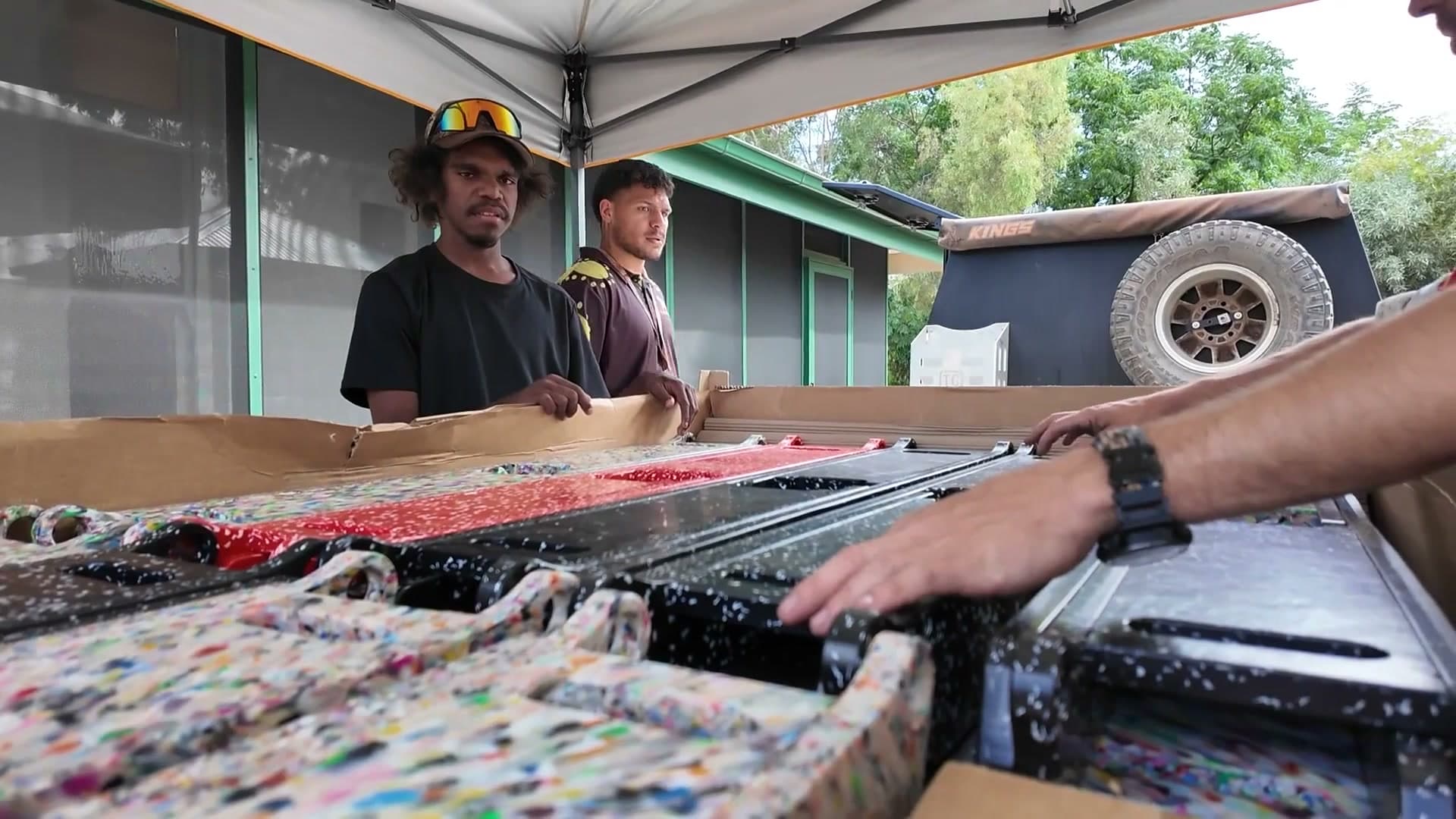
Growing community-led manufacturing and economic ownership.
Using beds as the first proven product. Supporting community-owned enterprises.
- 0
- beds in community
- 0
- communities
- 0
- washing machines
- 0
- beds bought and paid for
- 0
- community enterprises trading. That is what this year changes
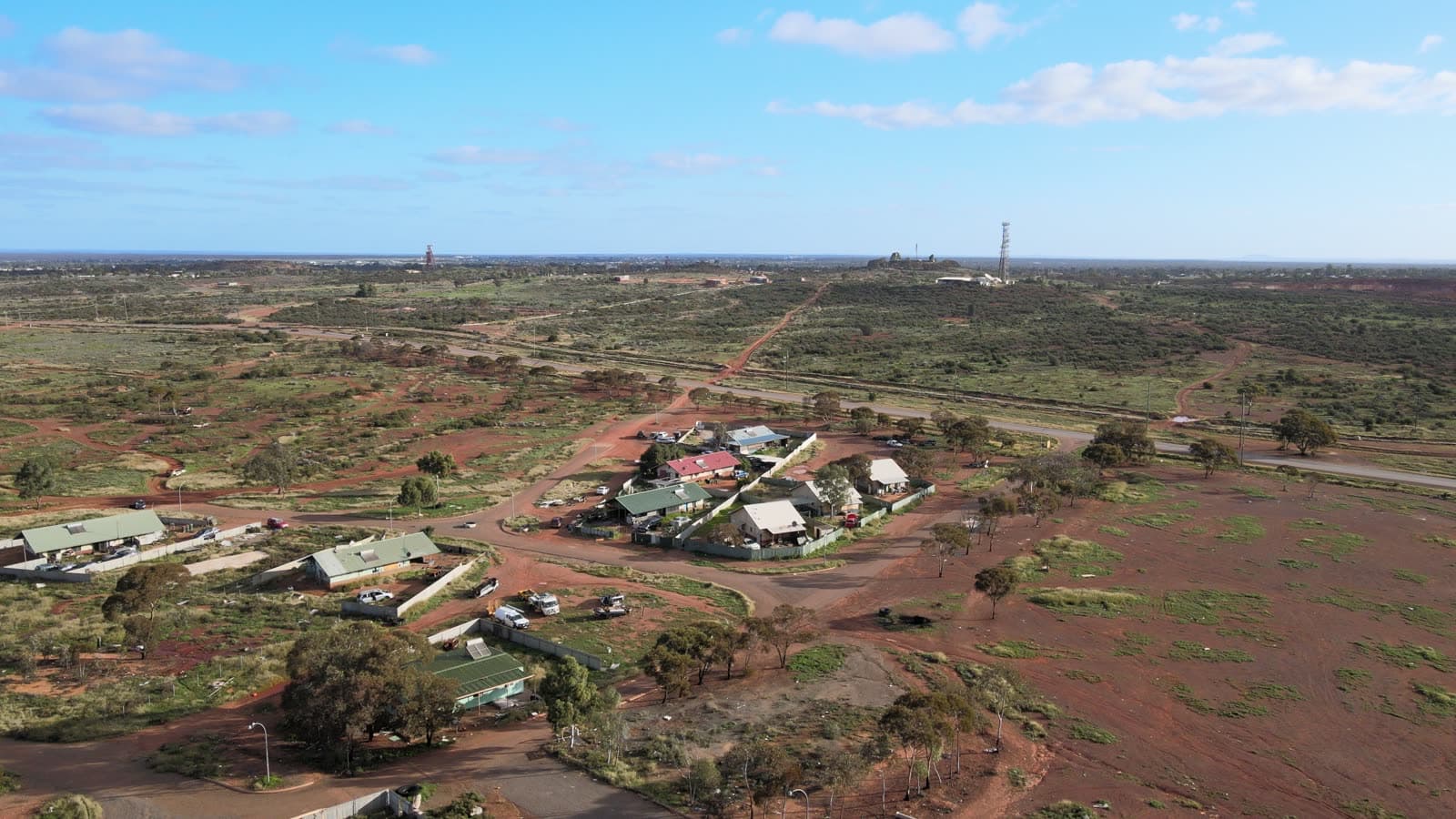
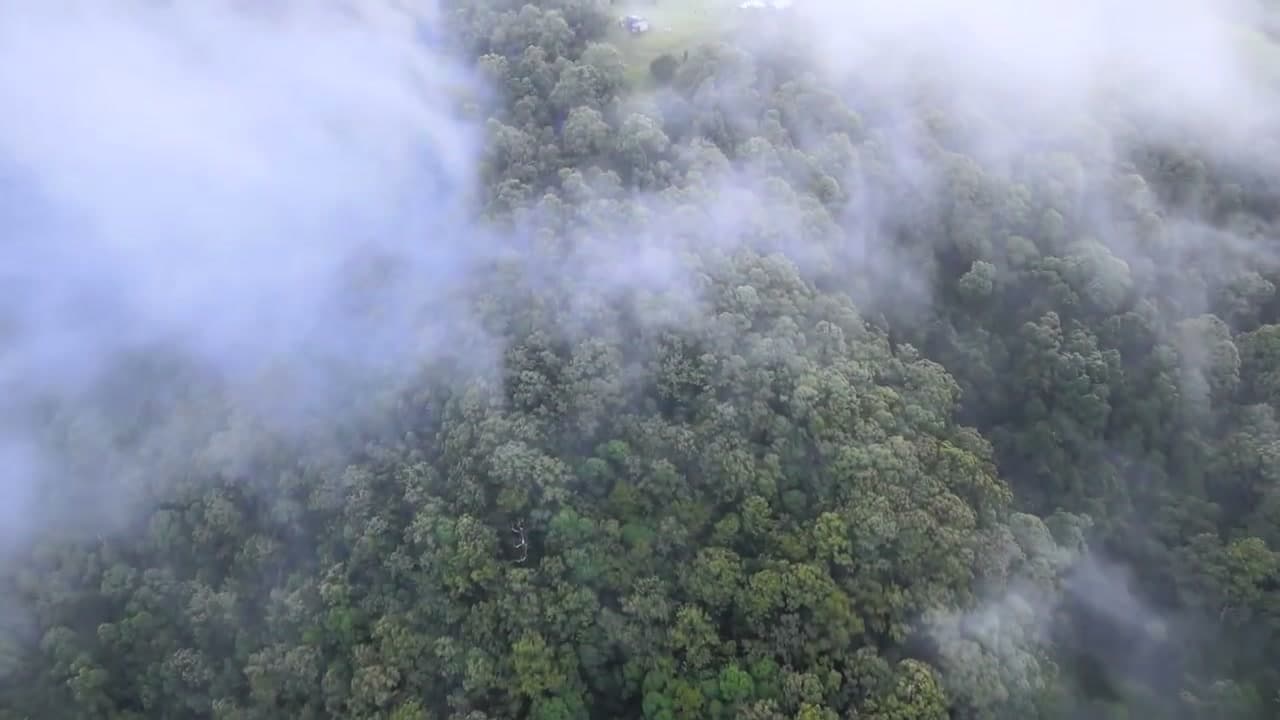
Ninga Mia, Kalgoorlie. Drone footage, 2024.
2
Remote communities import the goods and export the value.
Products travel farther, cost more, fail early and are difficult to repair locally.
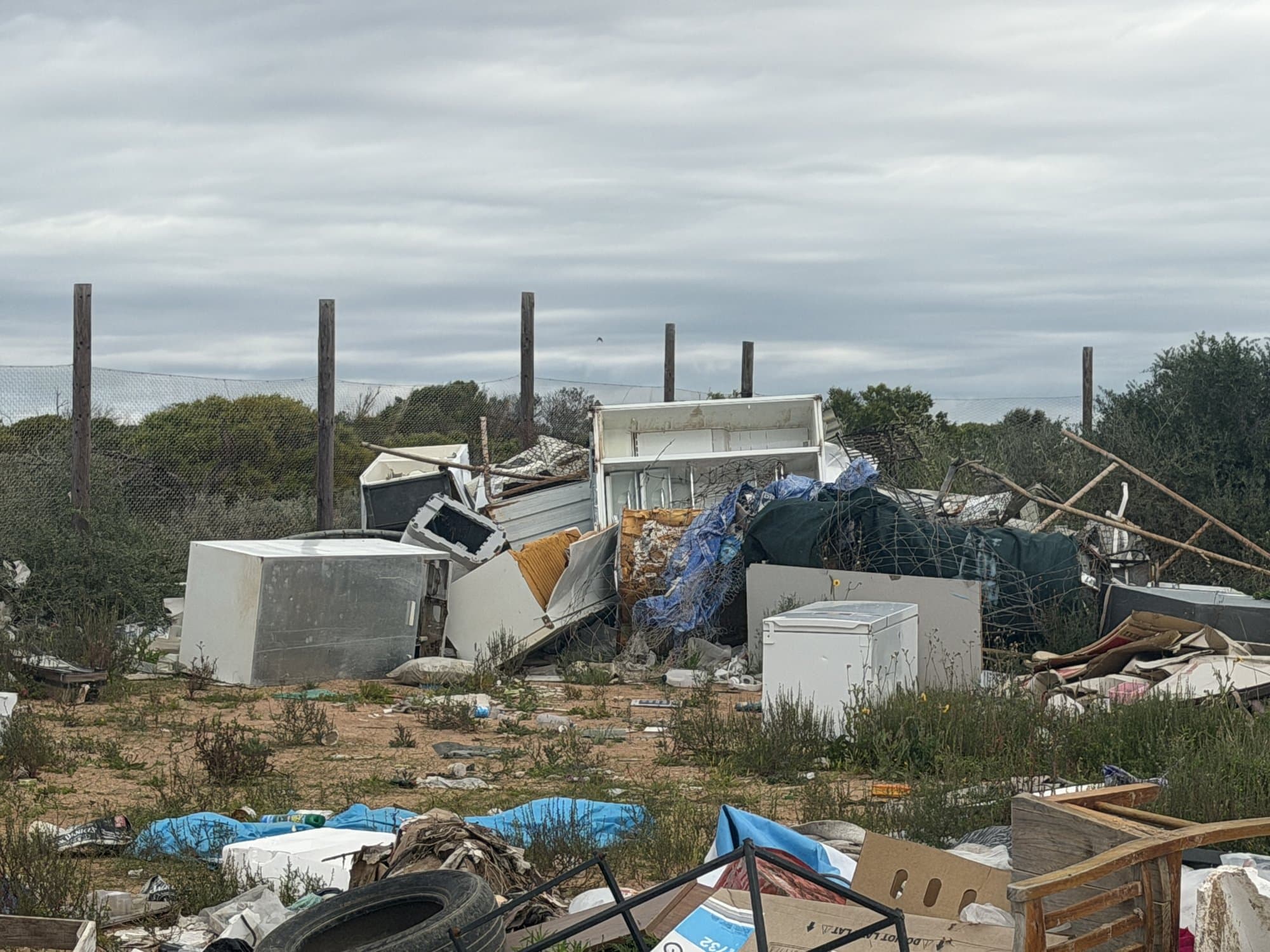
A mattress cannot be washed.
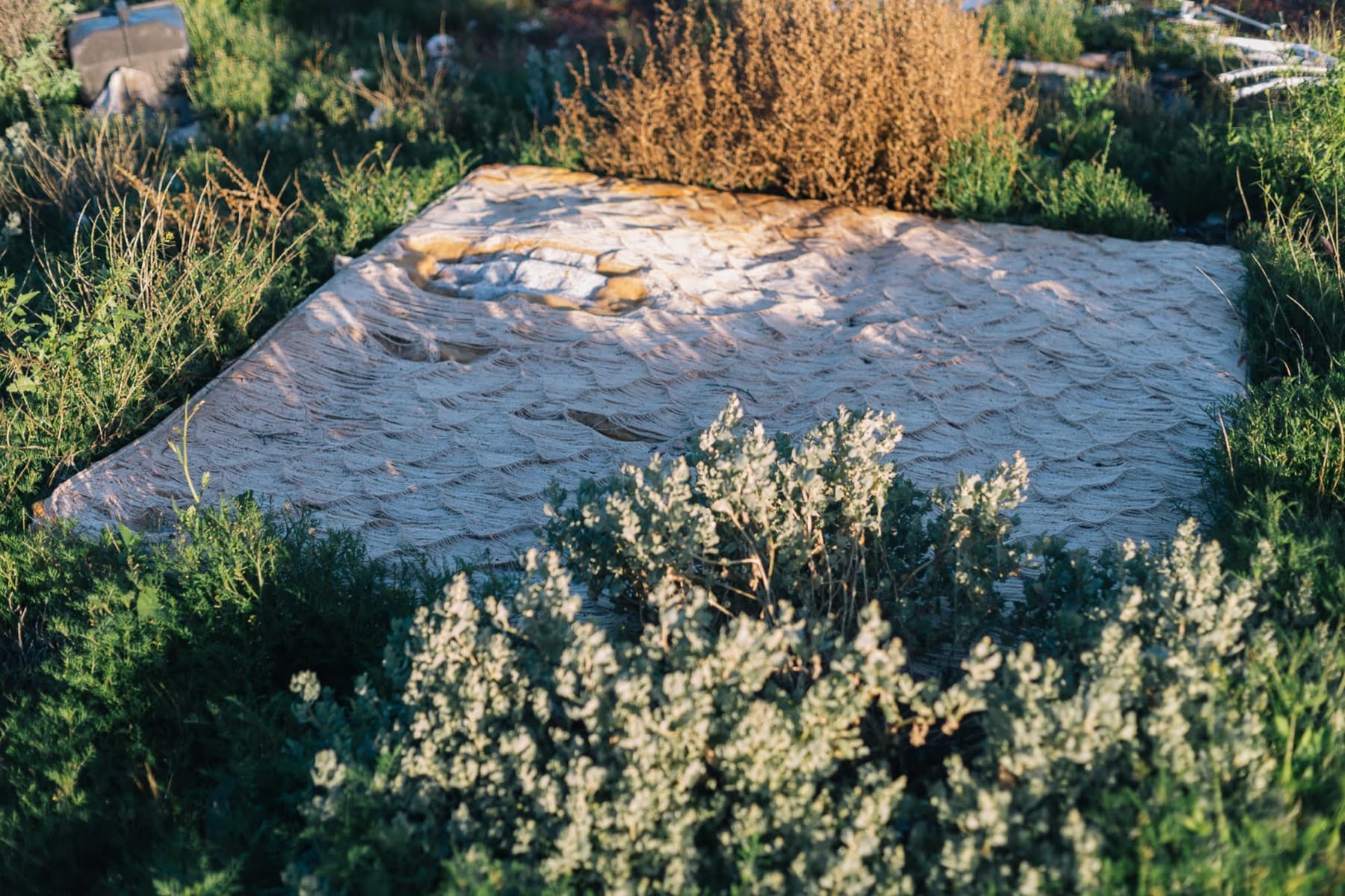
Bulky replacements carry long-distance freight.
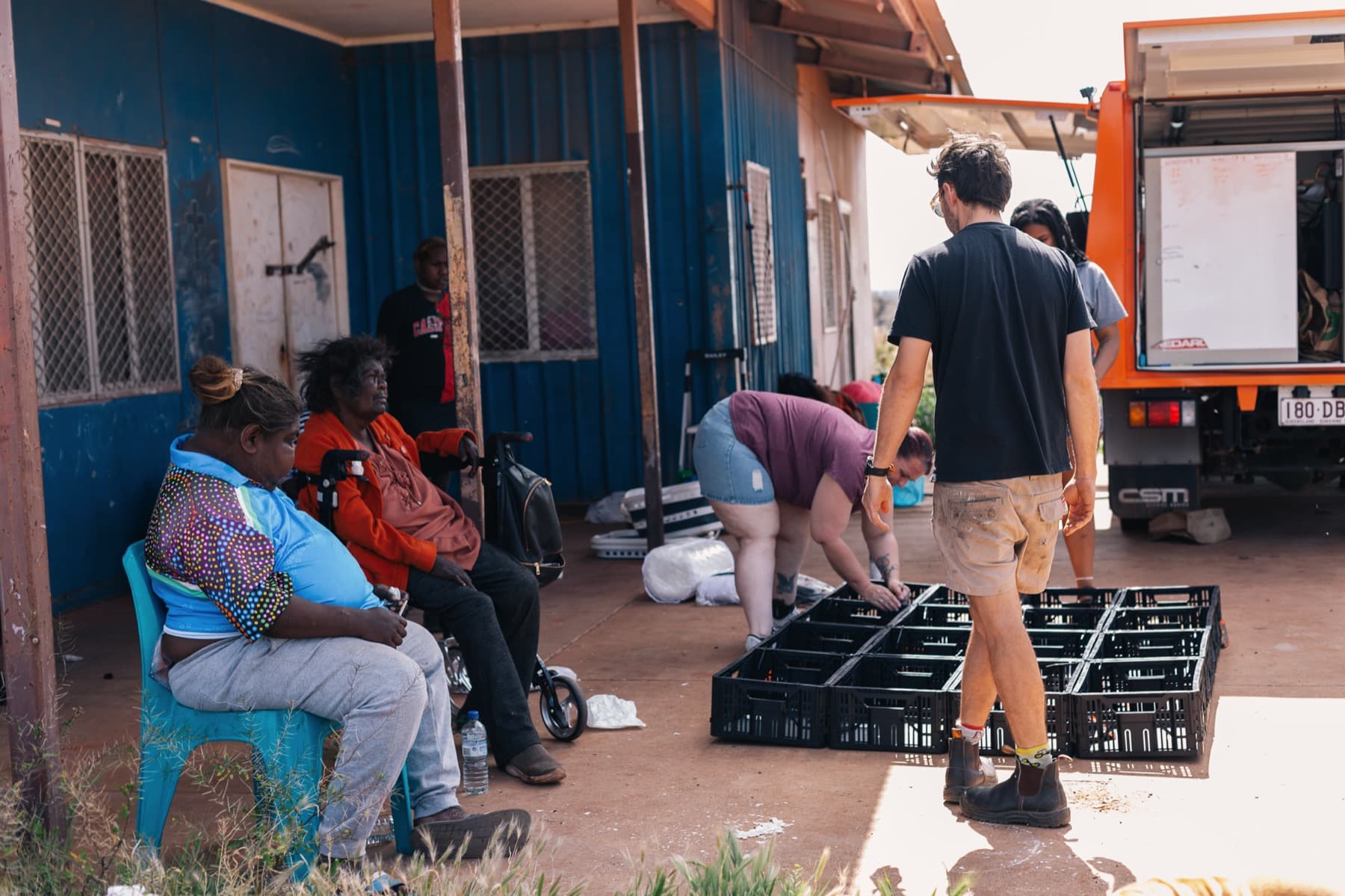
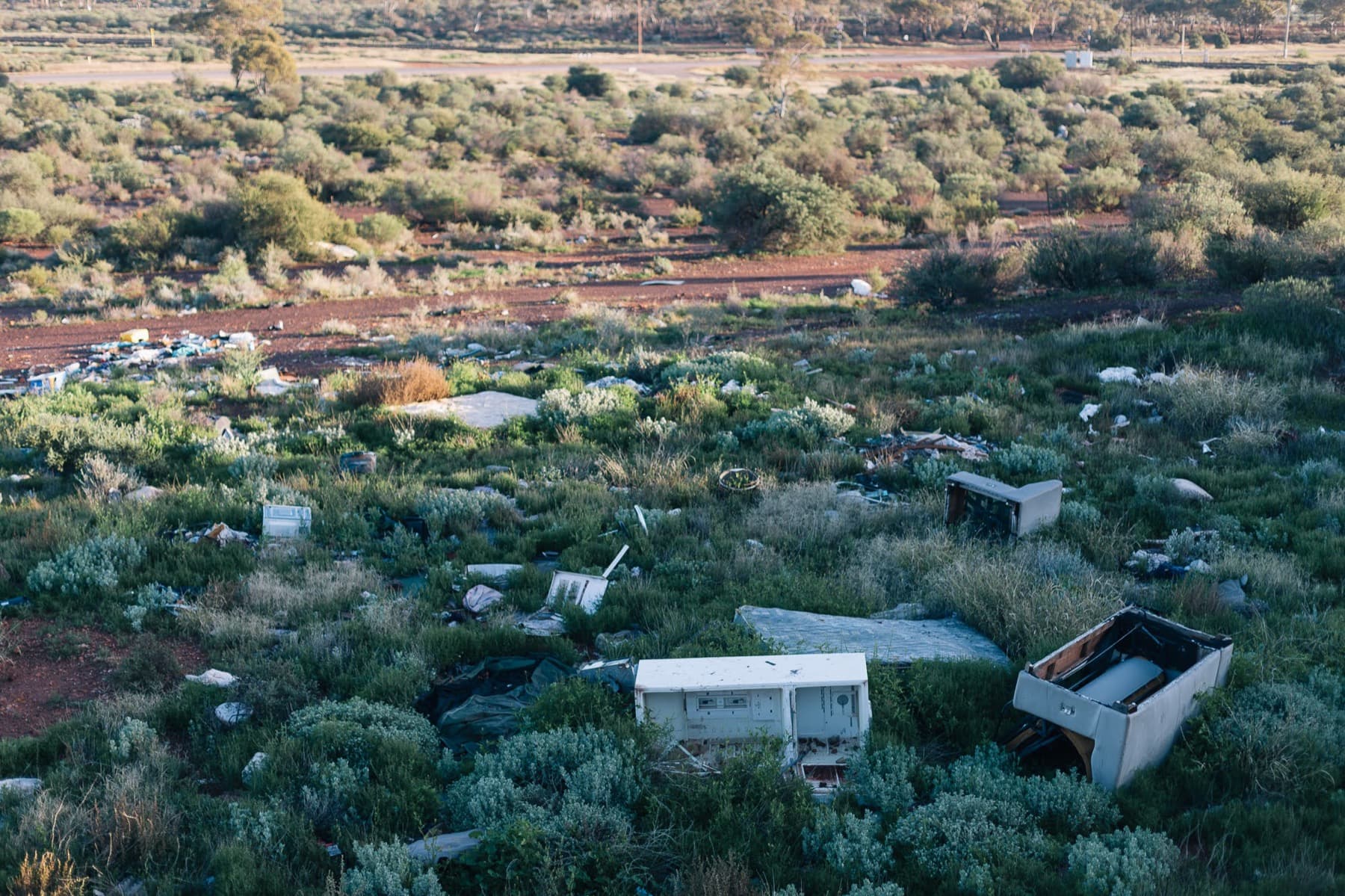
When products fail, the waste stays.
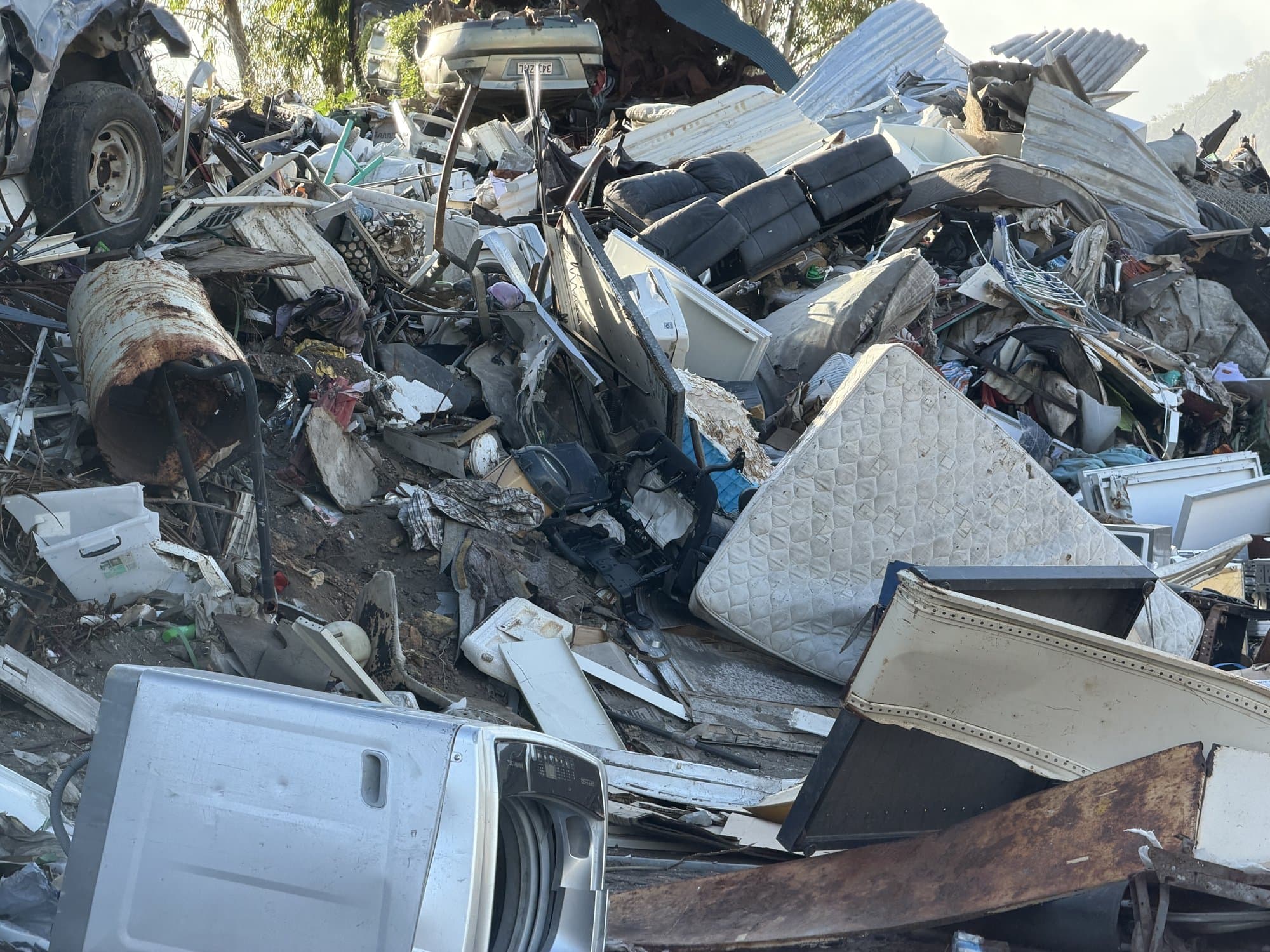
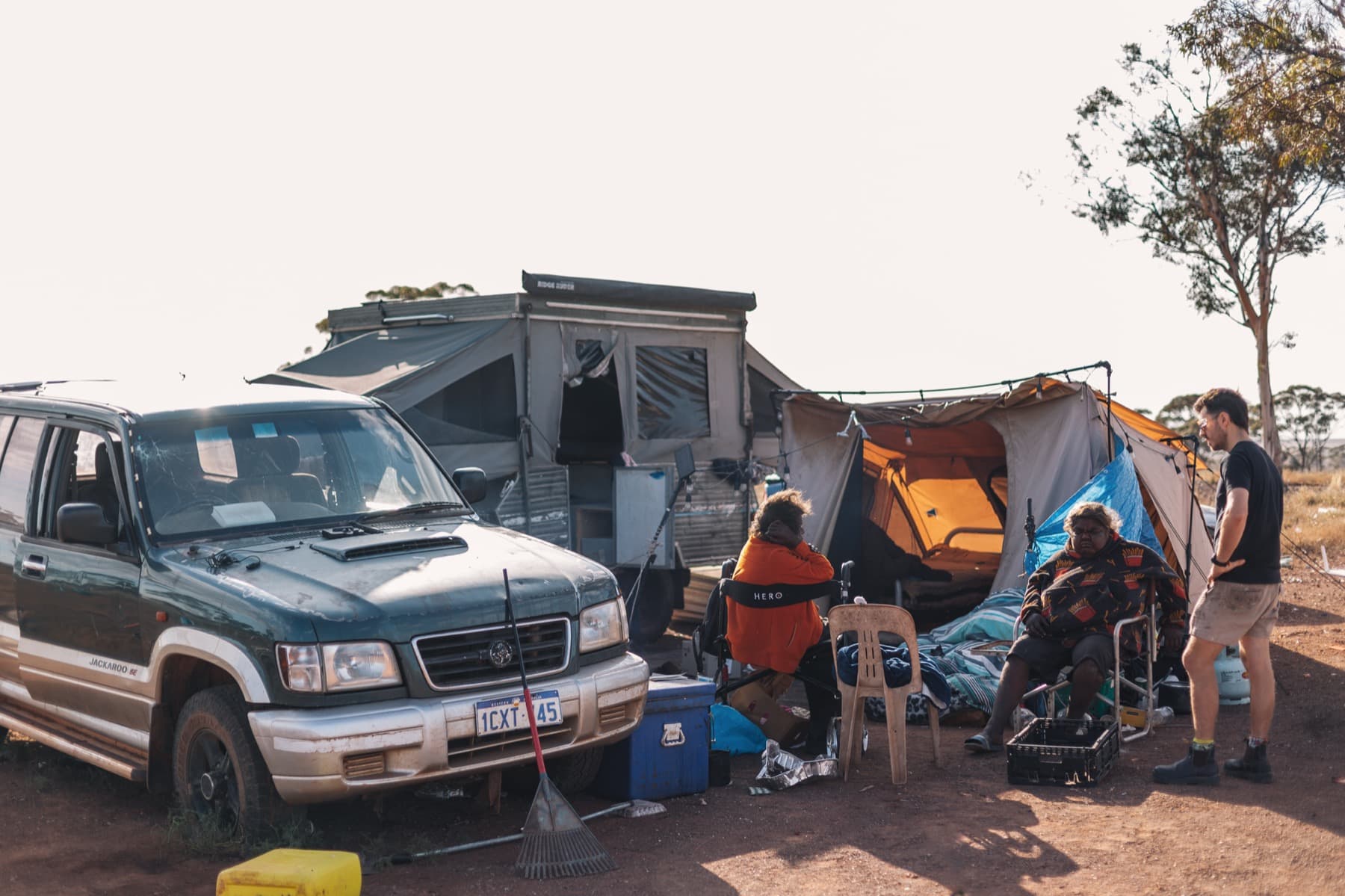
Ninga Mia, Kalgoorlie
This is where the Goods on Country story began.
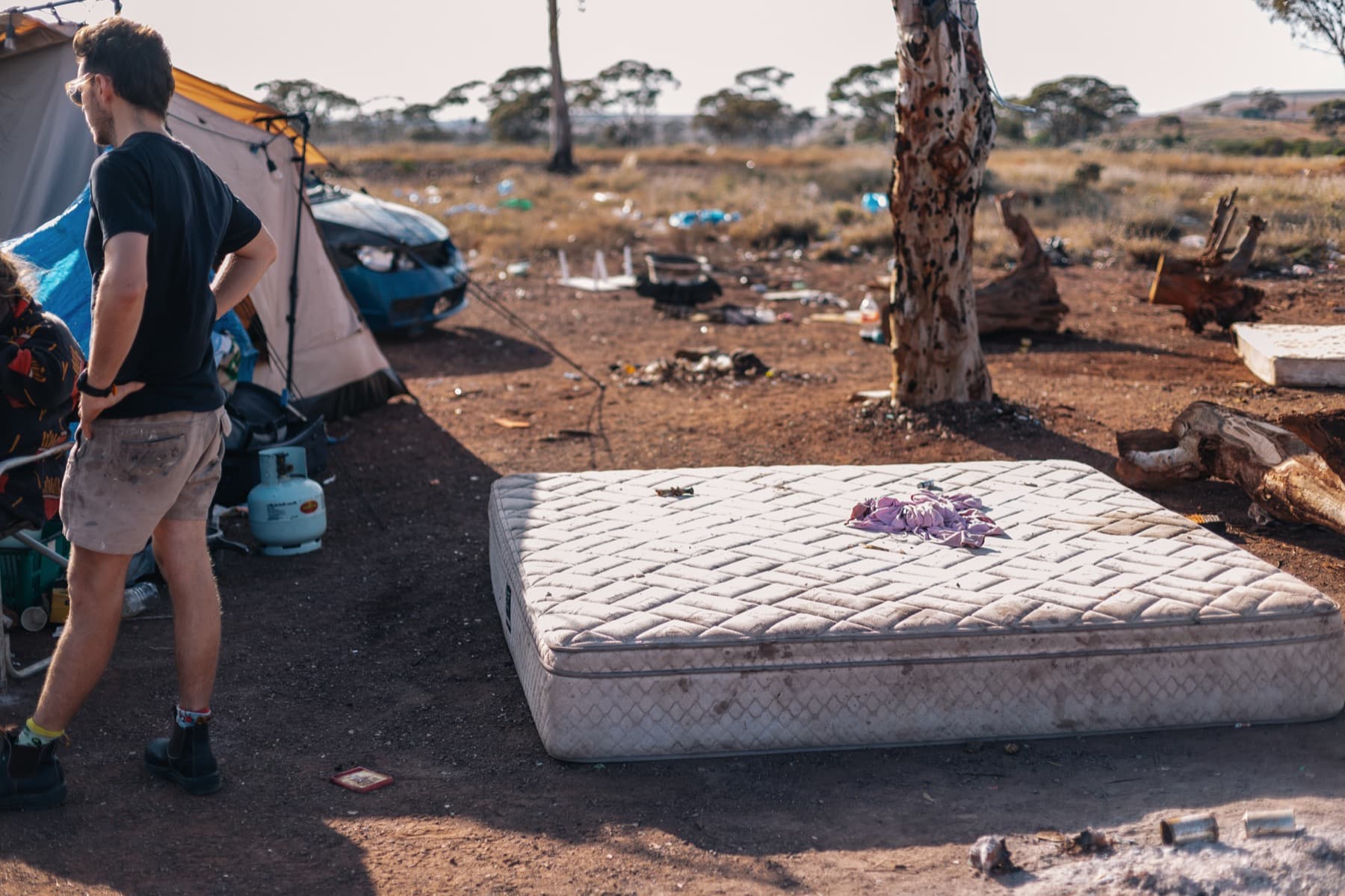
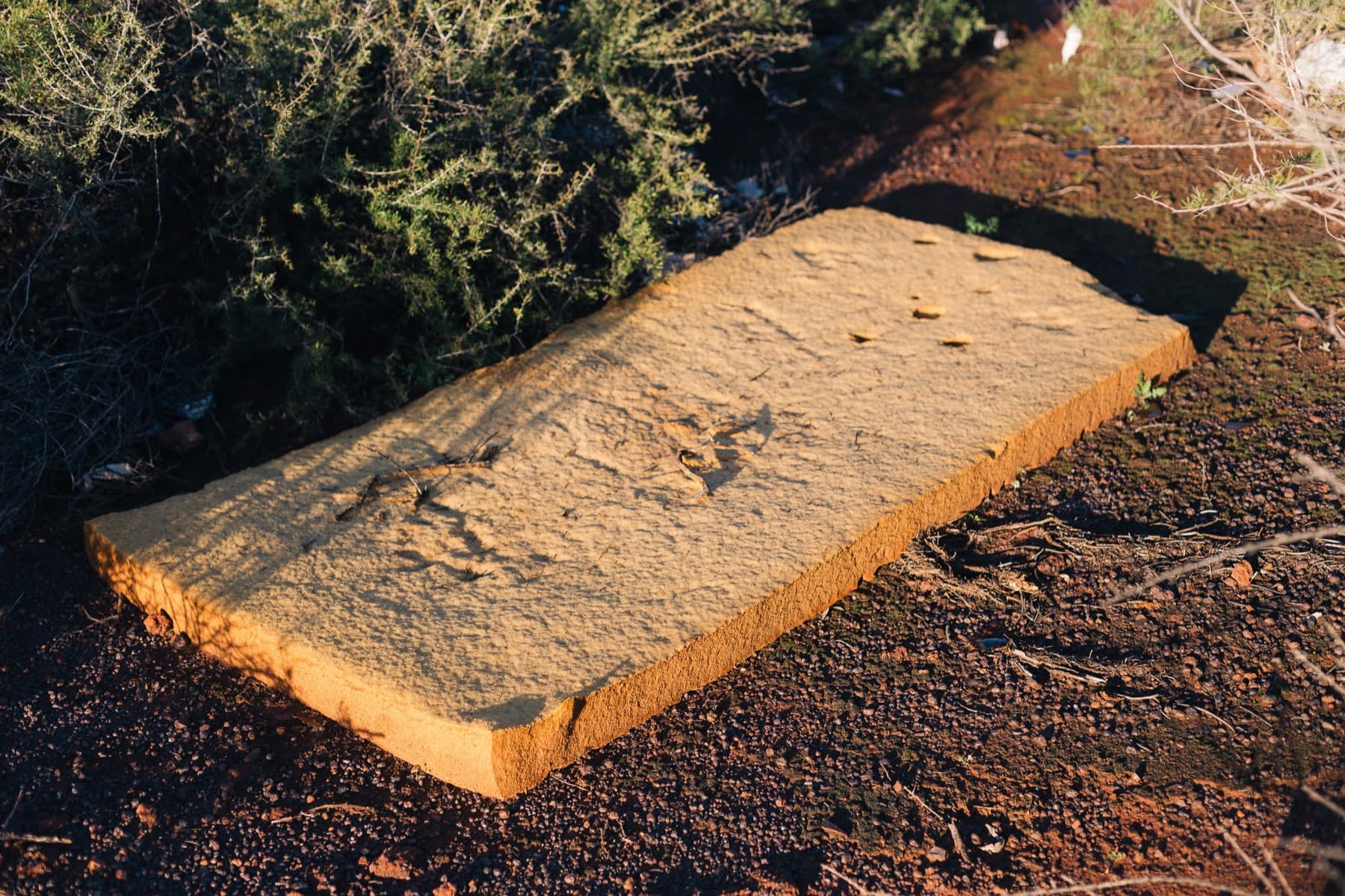
A mattress that cannot be washed ends up here, and so does everything that came a long way and broke. We came to listen, and left with the first question the beds had to answer.
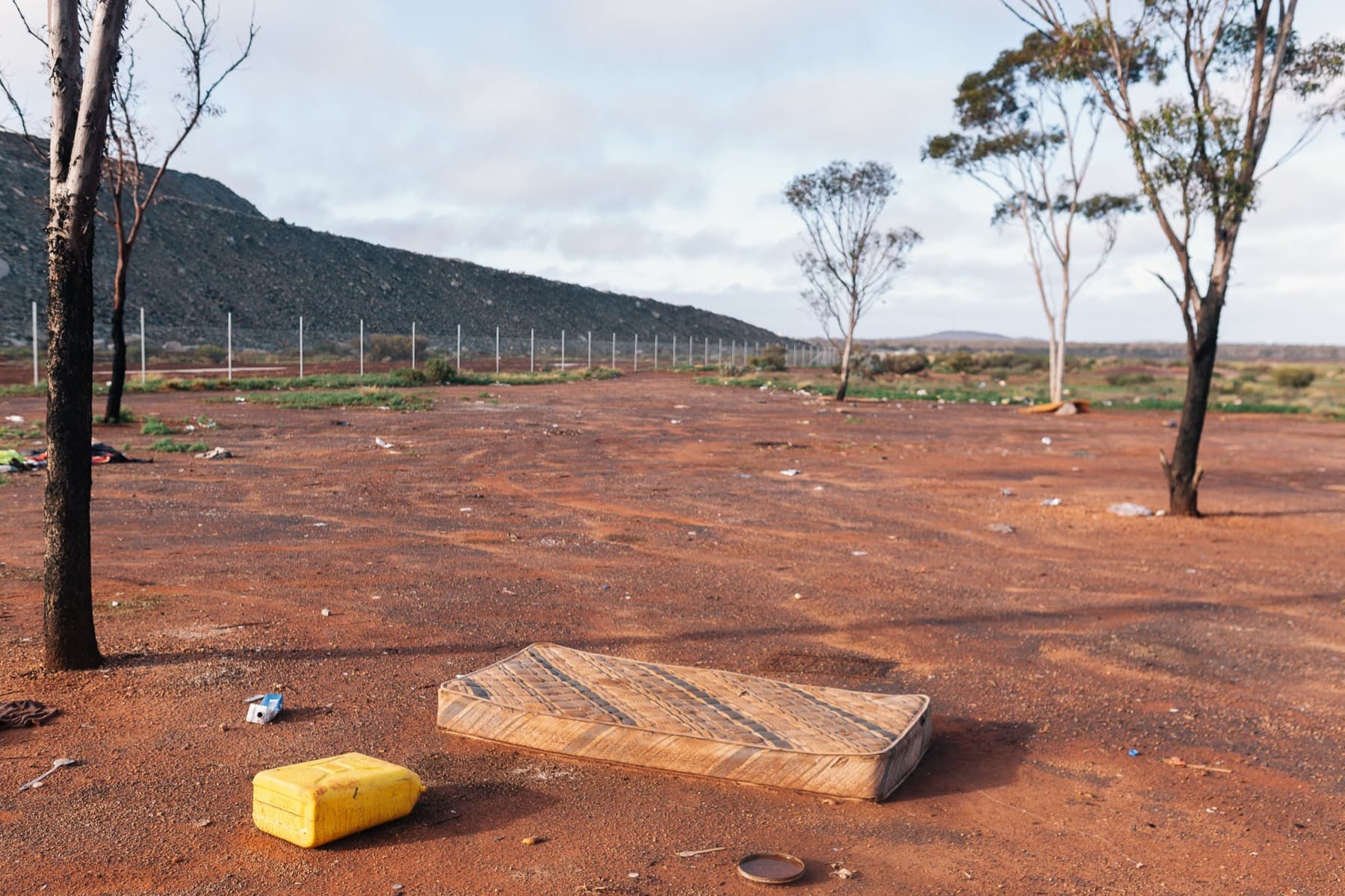
Where the road here started.
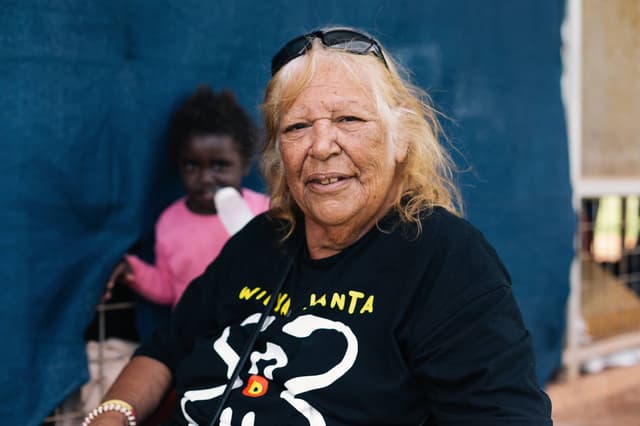
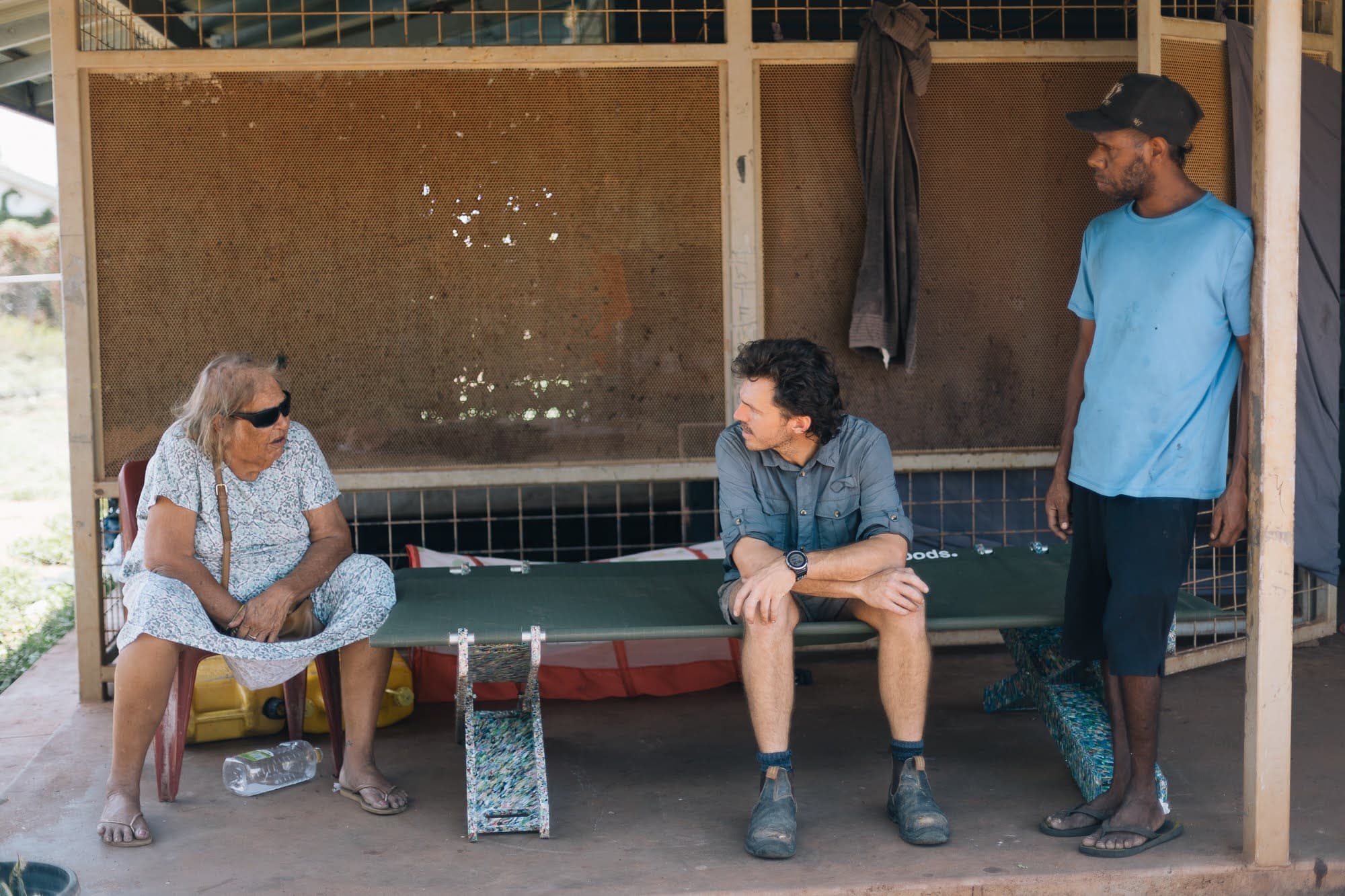
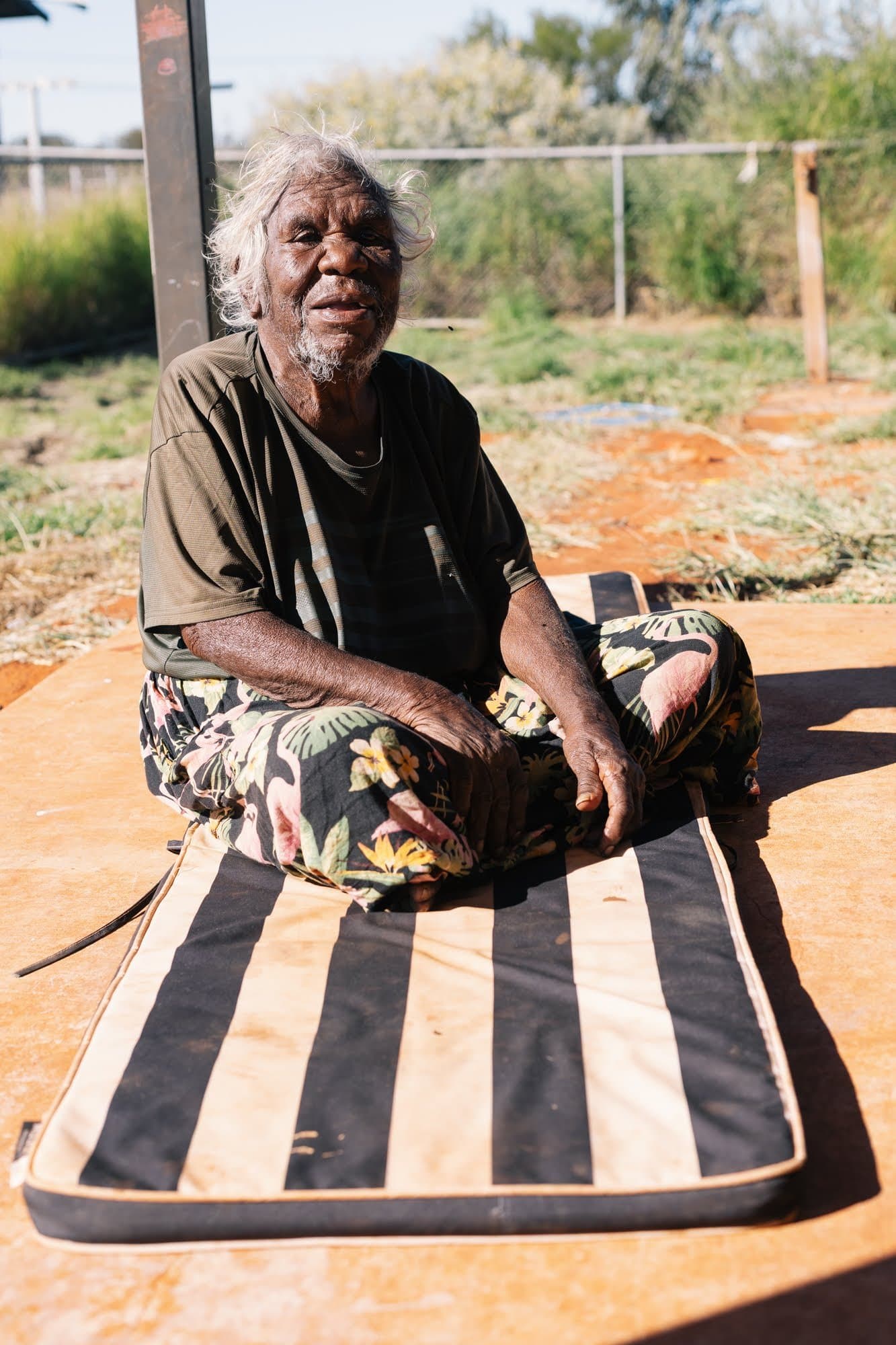
Gloria was the first person to sleep on a Goods bed. What she told us shaped what we make today, as the hundreds of stories since have shaped it, right across Australia.
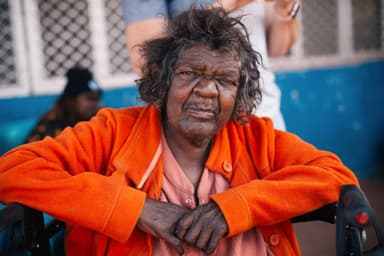
“Sleep on a good mattress. For the back, the legs, the muscles.”
3
One broken system. Four consequences.
Health
51.3%
of First Nations households in very remote NT needed at least one more bedroom.
The NT also carries Australia’s highest recorded ARF and RHD prevalence. Crowding is the reason for the work. We claim no outcome from it.
ABS Census 2021, Aboriginal and Torres Strait Islander QuickStats, Very Remote Australia (NT)
Enterprise
3.1%
of employed First Nations people in the NT managed their own business, the lowest share of any state or territory.
A proxy for how little enterprise is locally owned. Official data does not isolate community-led production.
ABS, Aboriginal and Torres Strait Islander people who managed their own business, 2021 Census
Employment
38%
of First Nations people aged 15 to 64 in very remote Australia were employed, against 68% in major cities.
Whole numbers, as the publisher prints them. The 2021 Census, a different instrument, returns a lower very-remote rate.
Waste
275,190 tonnes
of NT waste went to landfill in the year to June 2024, more than half of everything processed.
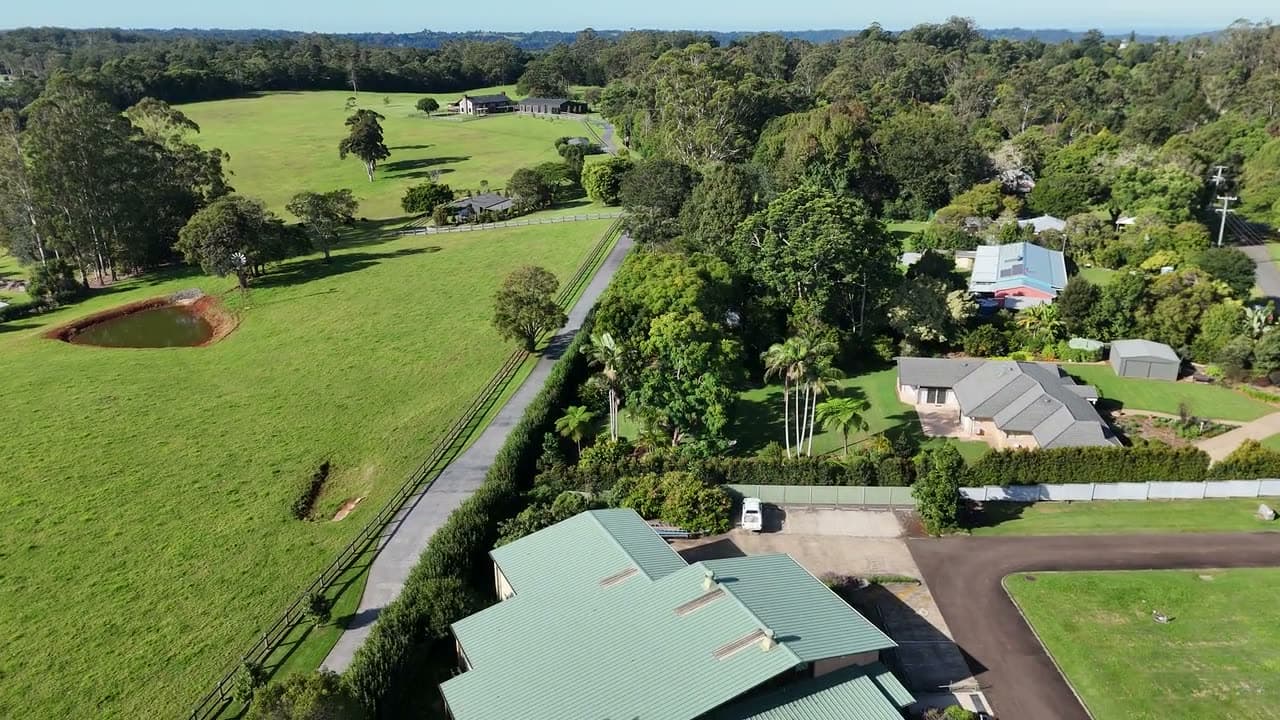

A Curious Tractor, where Goods on Country started
4
Goods on Country began as an experiment. It is now a DGR1 charity with a 100% Indigenous board.
A regenerative innovation studio stewarding a farm on Jinibara Country. Places, story systems, and public works you can step into.
A Curious Tractor is the studio Ben Knight and Nic Marchesi run. Goods on Country came out of its loop. In August 2026 the products, the making and the sales moved into the charity trading as Goods on Country, under an Indigenous board. A Curious Tractor keeps doing the research and development.
The loop every project runs on
ACT uses Listen, Curiosity, Action, Art as a working loop for regenerative innovation. We listen deeply, stay curious, build with people, and translate learning into art that can travel further.
01
Listen
Start with place, people, and histories that are often ignored. Deep listening comes before design.
02
Curiosity
Ask better questions, test assumptions, and let emerging insight shape the next move.
03
Action
Build useful things with communities. Prototype carefully and stay accountable.
04
Art
Translate learning into culture, meaning, and public pressure. Art returns the loop back to listening.
Shared promise: we build with communities and design to hand over the keys.
The projects, and what each gave Goods on Country
01
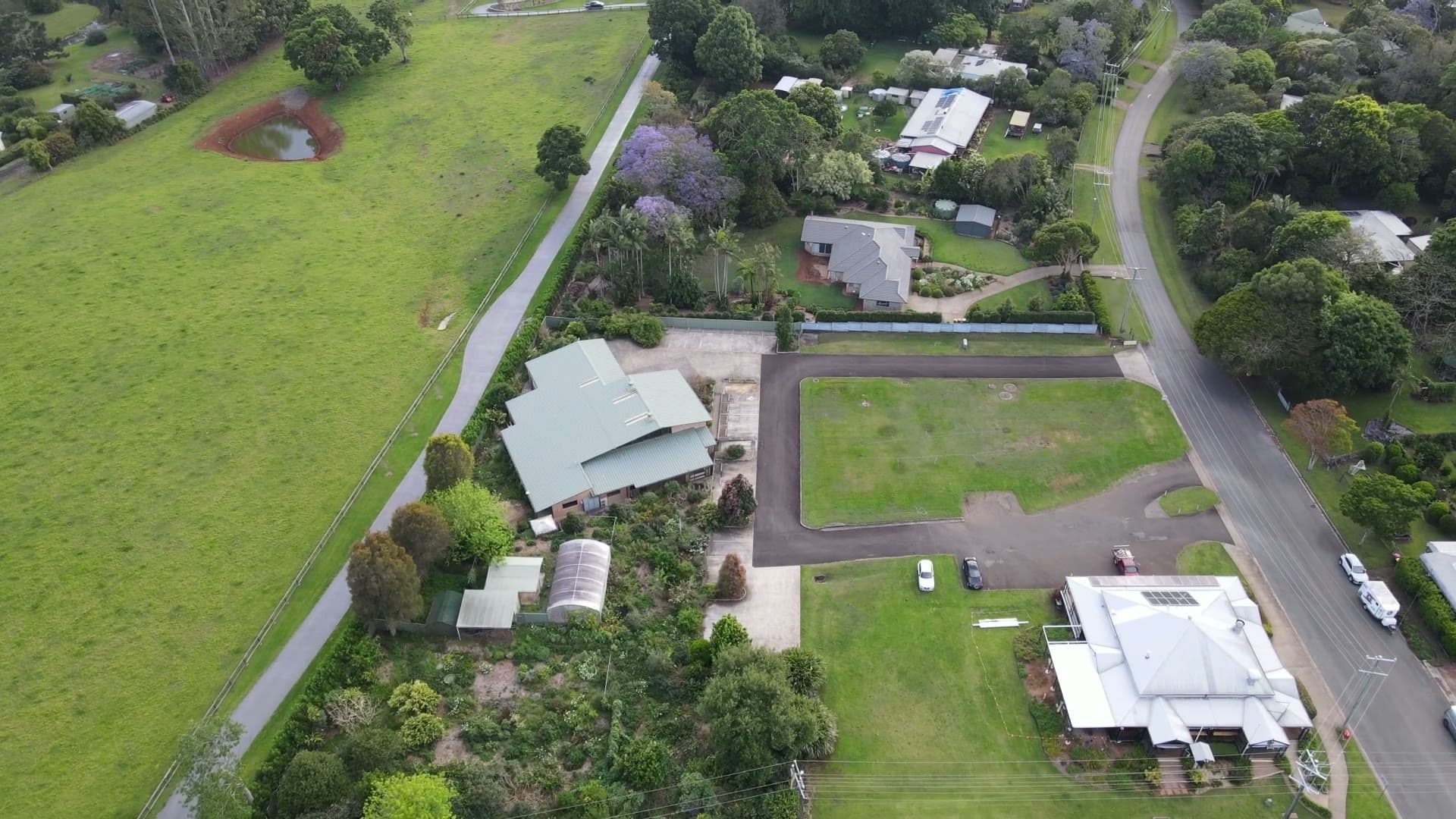
The Harvest
Where people grow food, share meals, and belong
At The Harvest, neighbours gather to grow food, cook seasonal meals together, and tend therapeutic gardens that hold space for healing. Belonging is built slowly here, through shared work and good conversation.
To Goods: The farm at Witta where the container factory sits. Goods on Country's beds are pressed and packed here.
Visit The Harvest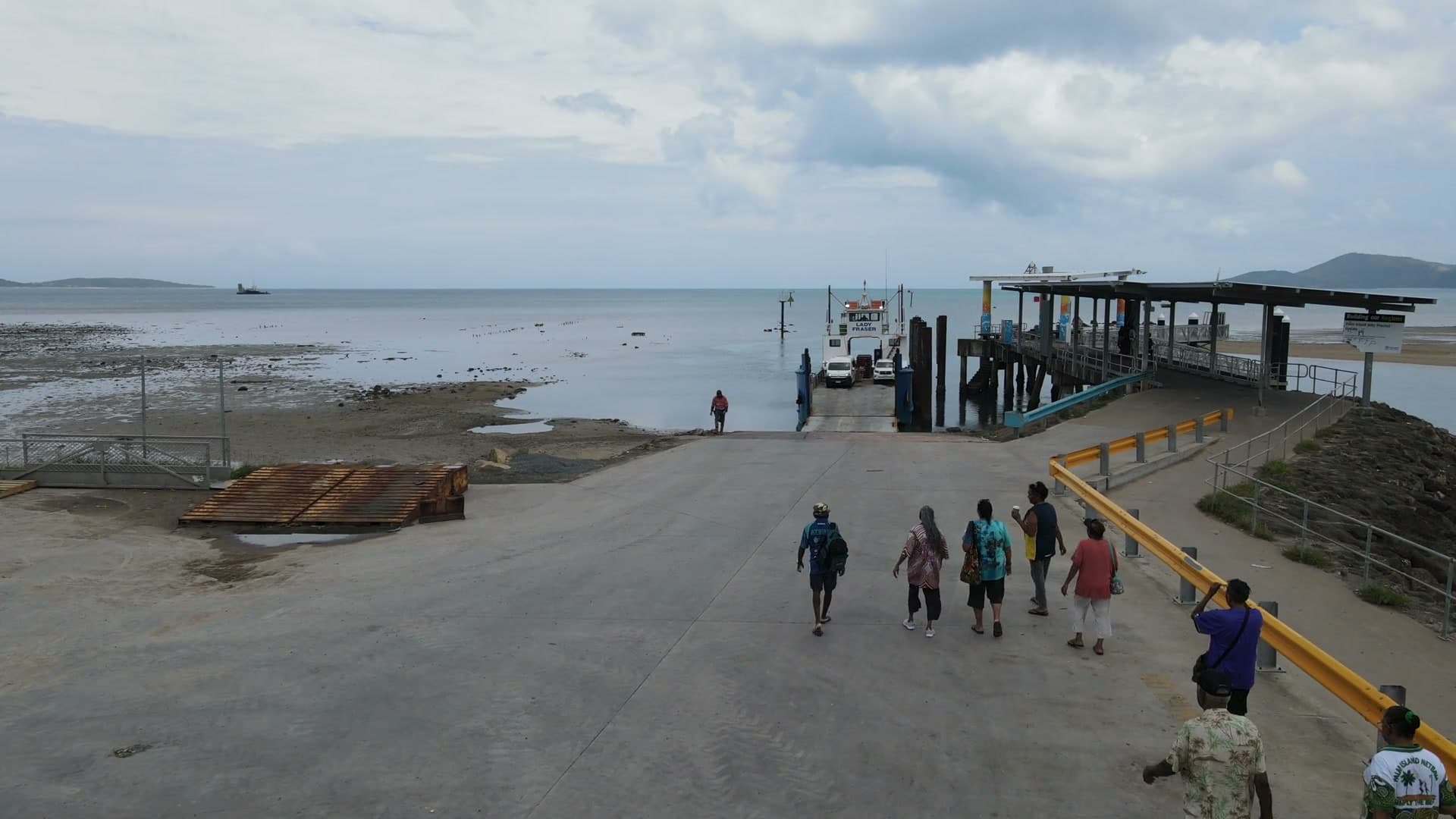
02
Empathy Ledger
Stories kept on community's terms
Built with Elders and First Nations technologists, Empathy Ledger is a consent-first storytelling platform grounded in Indigenous data sovereignty and OCAP principles. Communities decide what is shared, how, and with whom.
To Goods: Every Goods story and quote lives here, with consent held per person.
Visit Empathy Ledger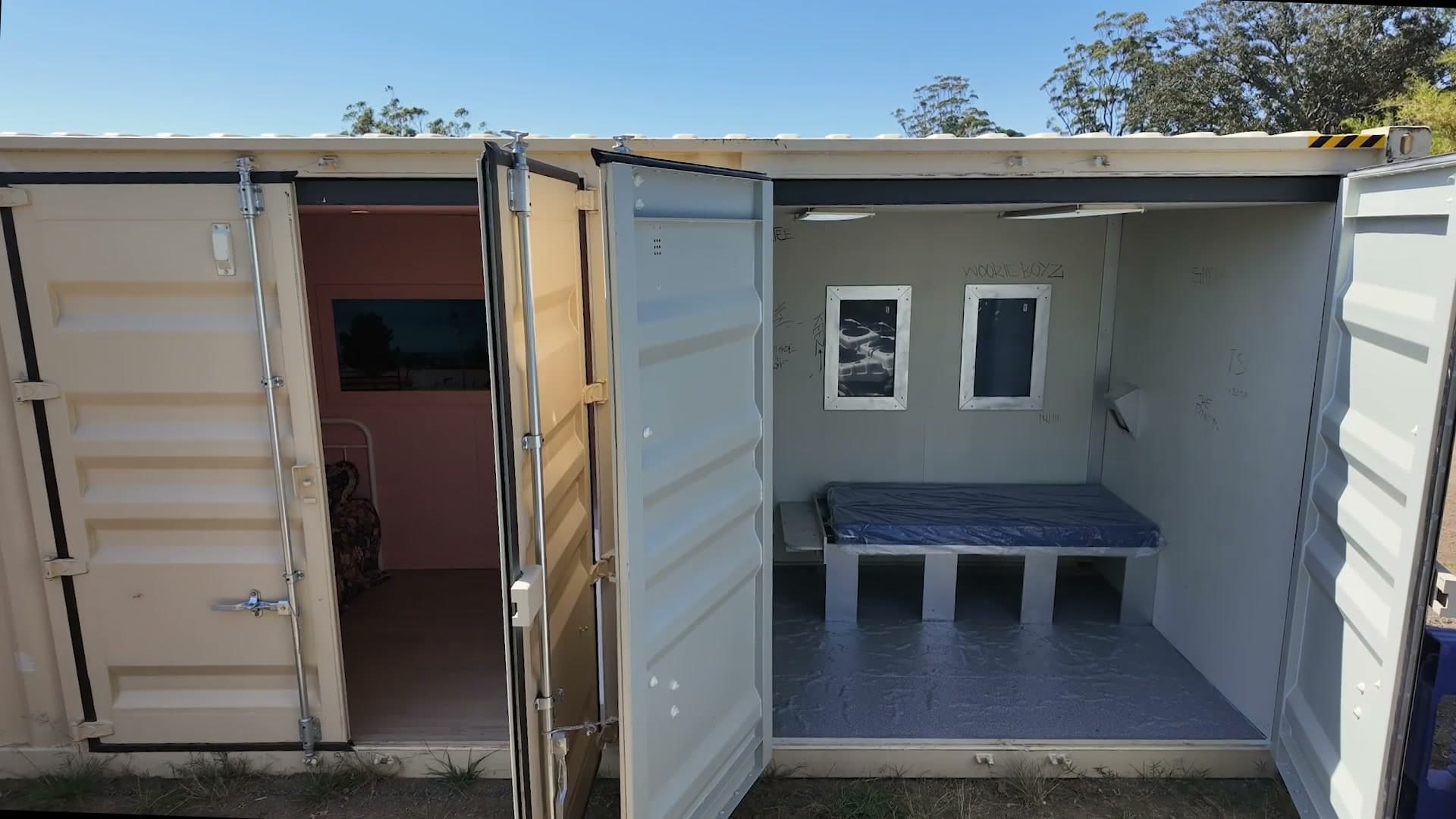
03
JusticeHub
Communities have the cure for locking up kids
Across Australia, grassroots programs are keeping First Nations young people out of detention and on Country, yet the money still flows to cells. JusticeHub documents what works and connects families to it in one search.
To Goods: The same open, hand-over approach Goods takes with the Basket Bed plans.
Visit JusticeHub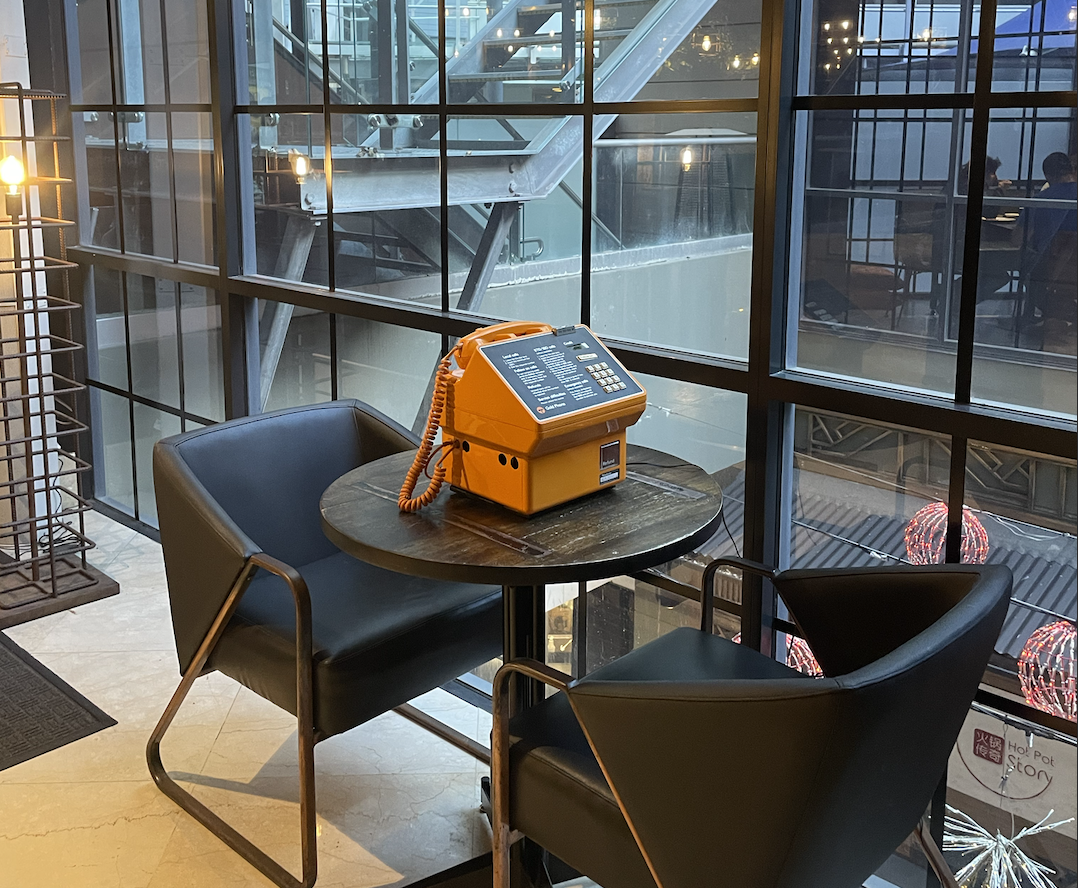
04
Gold.Phone
A payphone reborn for community stories
Gold.Phone is a remodelled payphone given a second life as a place to leave a story, a thought, or a message for the community. Pick up the handset and the past meets the present.
To Goods: The art practice that shapes how Goods tells its story.
05
The Confessional
A room built for the truth we carry
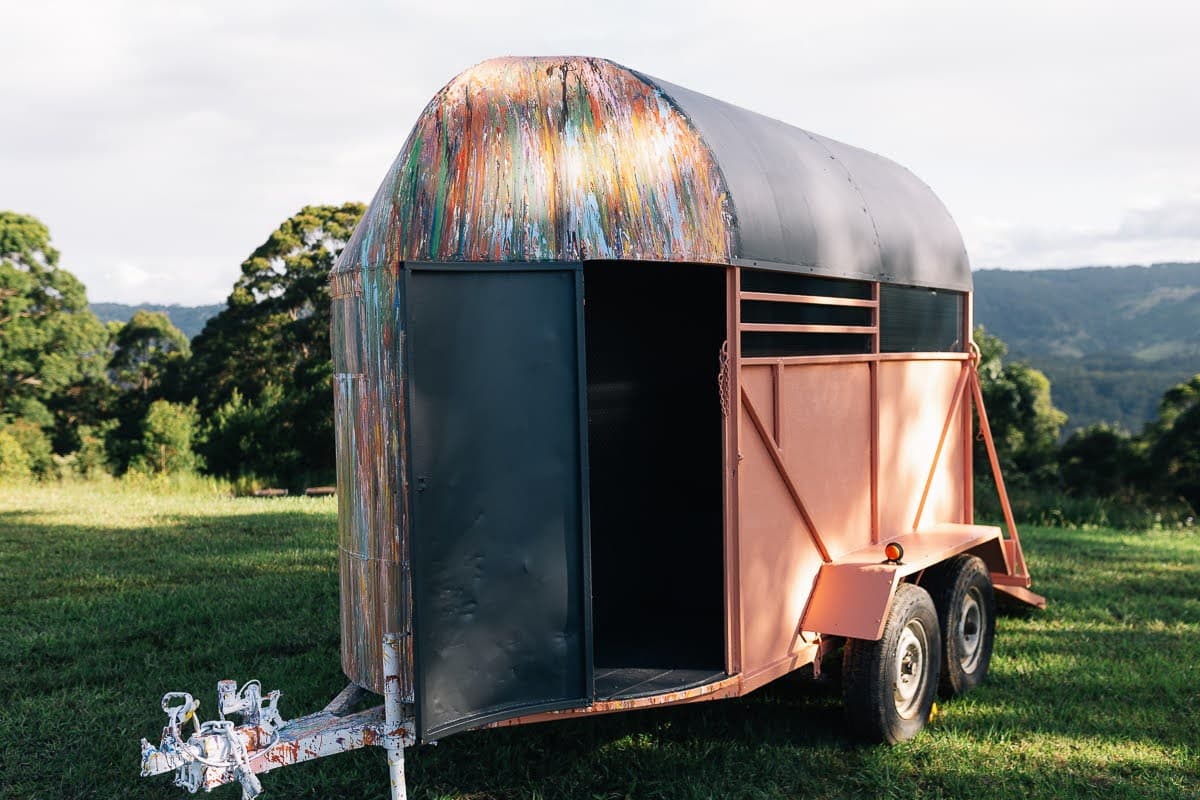
Most people rarely get a moment to say what weighs on them out loud. The Confessional builds that moment: a designed space and a careful ritual where people name hard truths on their own terms.
To Goods: Listening before designing, which is where the beds came from.
06
Black Cockatoo Valley
Stewardship and restoration on Jinibara Country
On Jinibara Country, Black Cockatoo Valley is given back the time it needs: land under restoration, conservation taken seriously, and residencies that let cultural practice and new ways of working take root. The valley is the ground that makes the projects possible.
To Goods: The ground the studio stands on, and the patience the beds were designed with.
A Curious Tractor
A Curious Tractor graduated Goods on Country in August 2026.
5
Local decisions. Shared capability.
Goods on Country is a DGR1 charity led by 100% Indigenous Directors.
Board
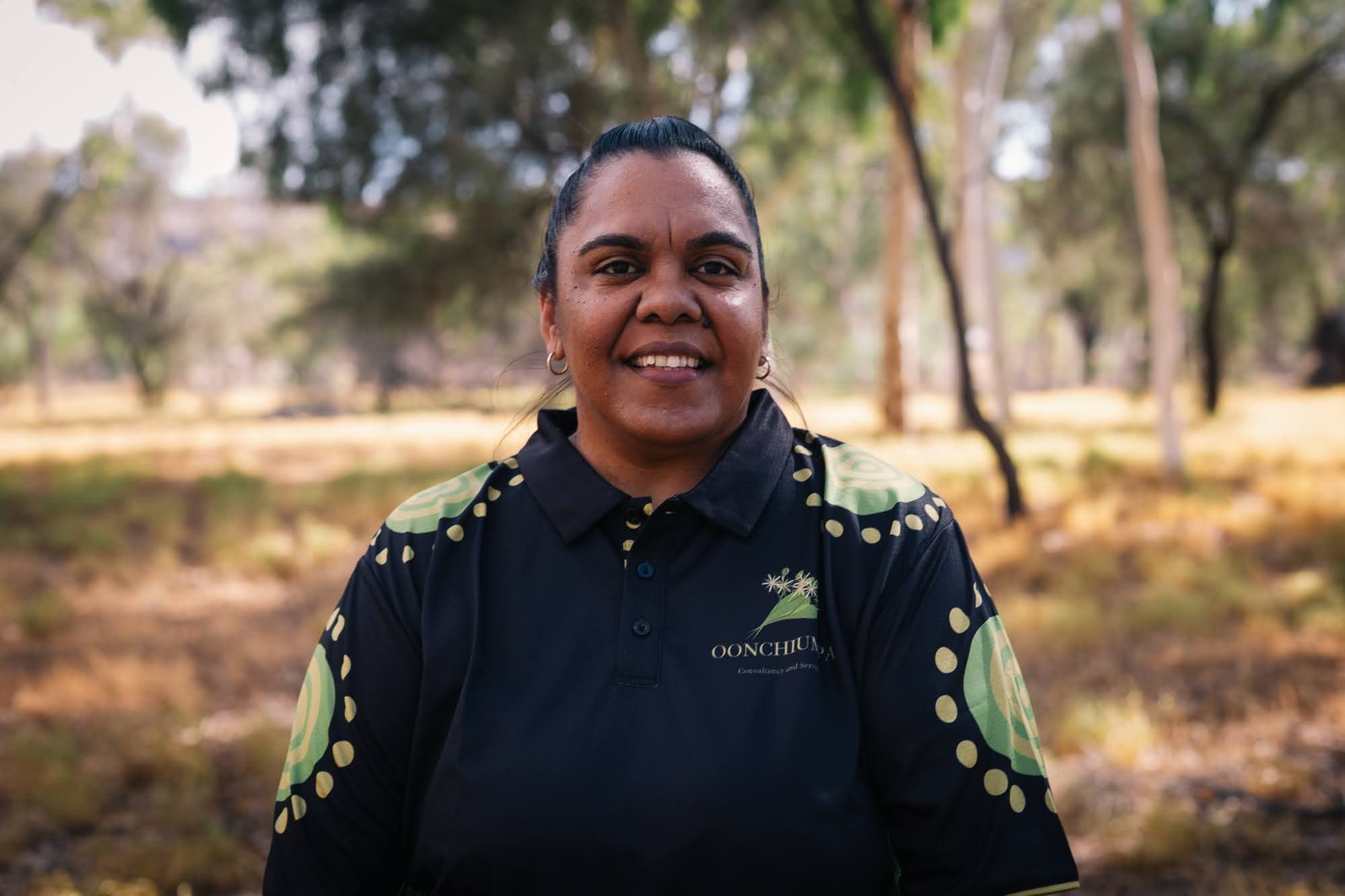
Kristy Bloomfield
Director · Arrernte Country
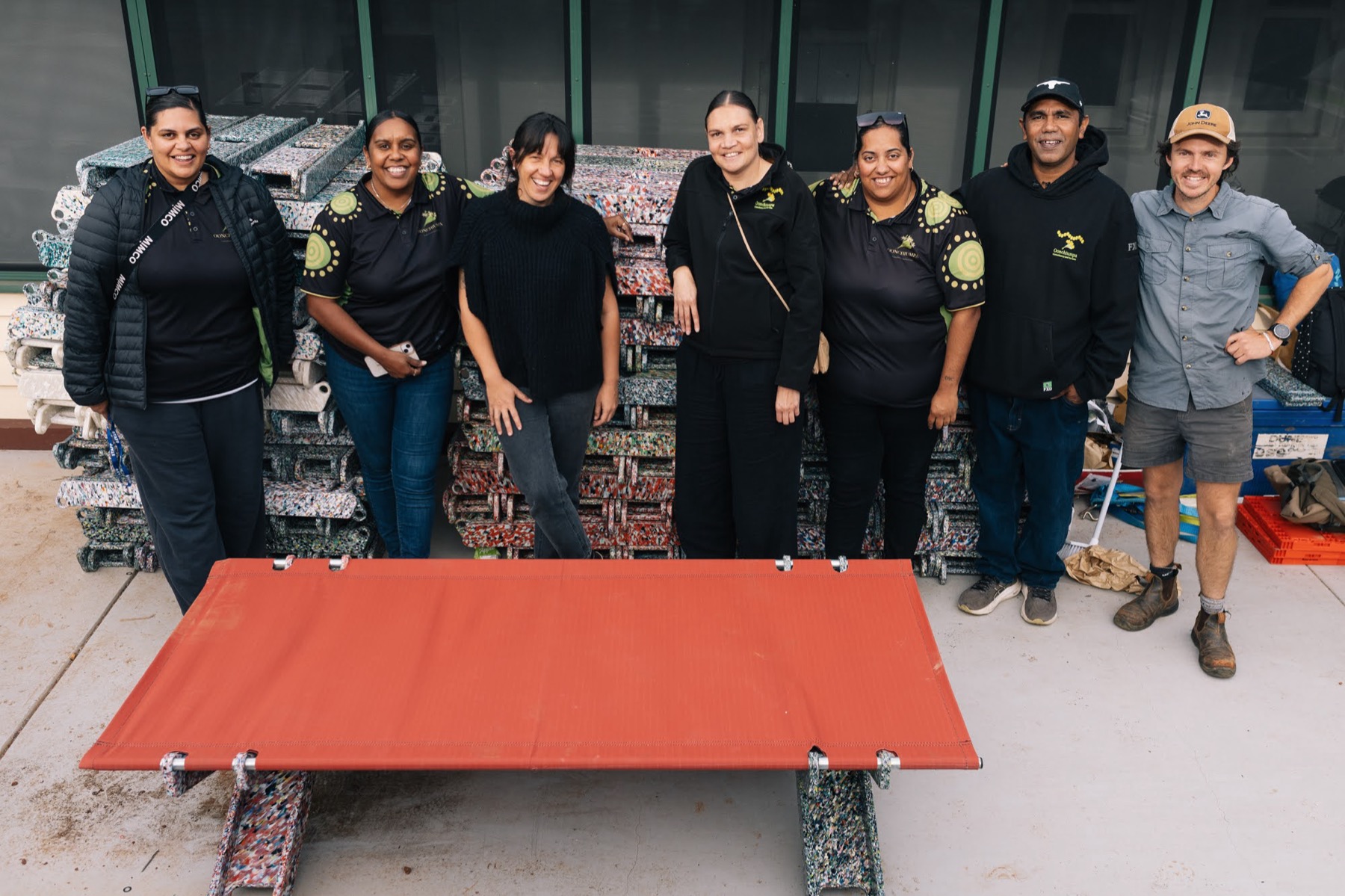
Alongside her board role, Kristy leads the Oonchiumpa relationship: designing products in community and developing the Alice Springs production and youth training pathway.
Photograph: Goods on Country portrait library
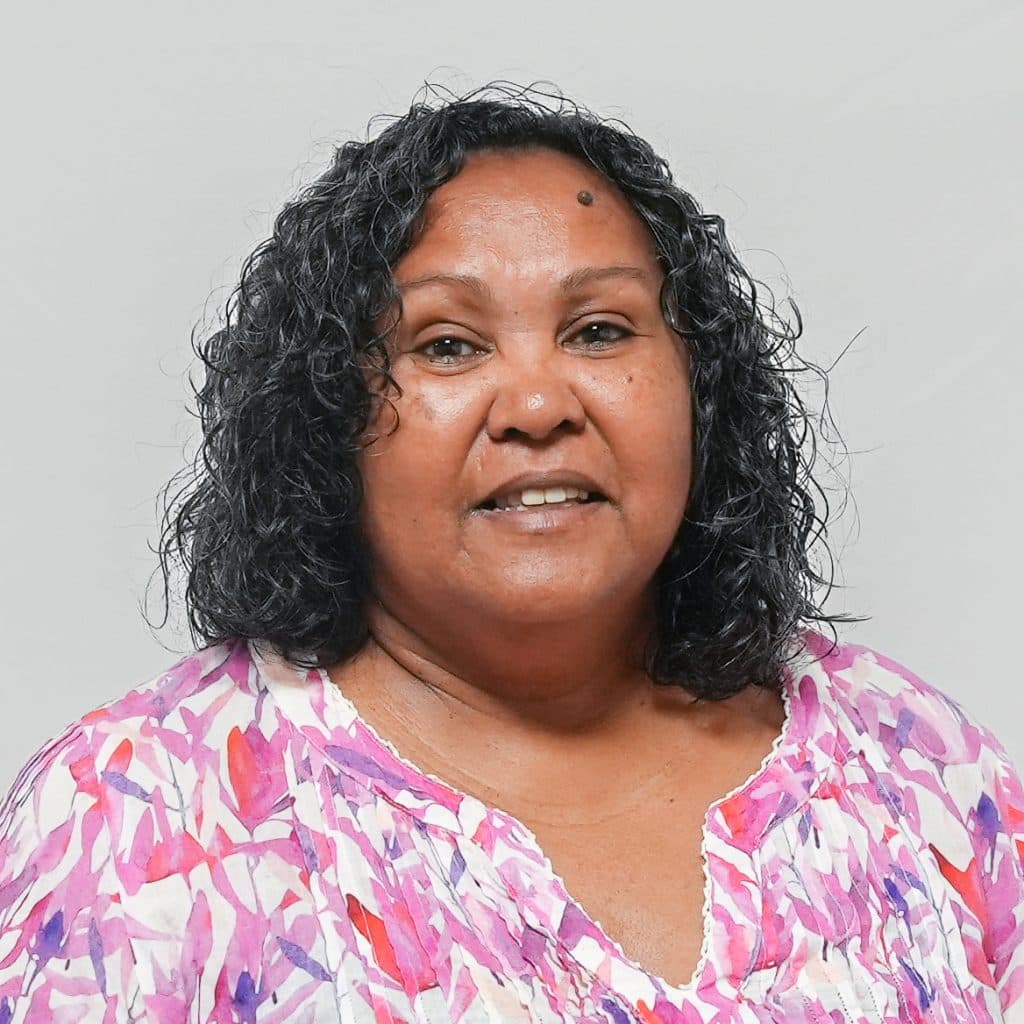
Audrey Deemal
Director · Dhirrtharr Warra woman from Hope Vale
Director of Goods on Country’s legal entity, sharing responsibility for its purpose, assets and decisions. A separate operational portfolio has not been recorded.
Photograph: Cape York Partnership
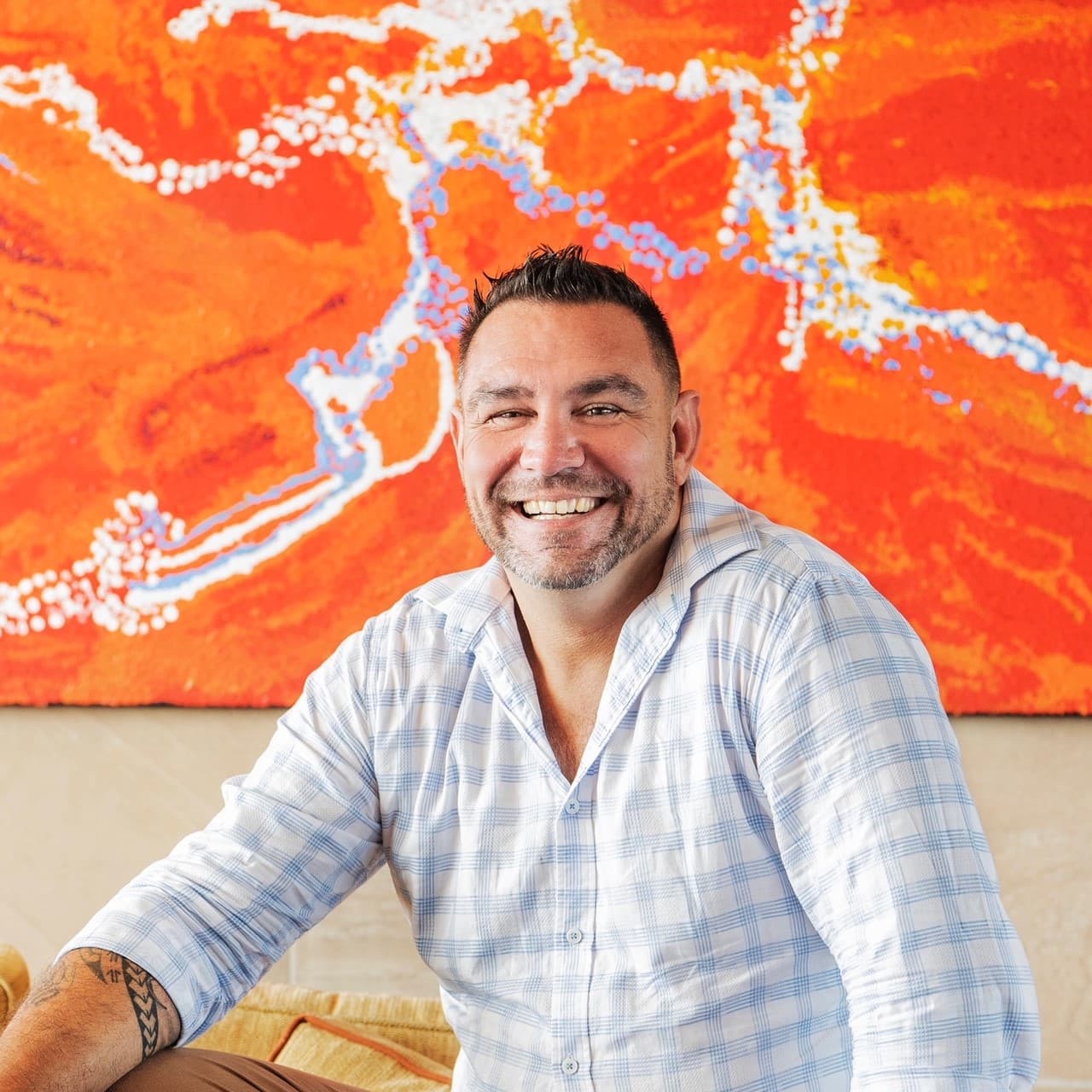
Jeremy Donovan
Director · Kuku-Yalanji and Gumbaynggirr
Director of Goods on Country’s legal entity, sharing responsibility for its purpose, assets and decisions. A separate operational portfolio has not been recorded.
Photograph: Jeremy Donovan, official website
The board carries responsibility for purpose, assets and organisational decisions.
Staff
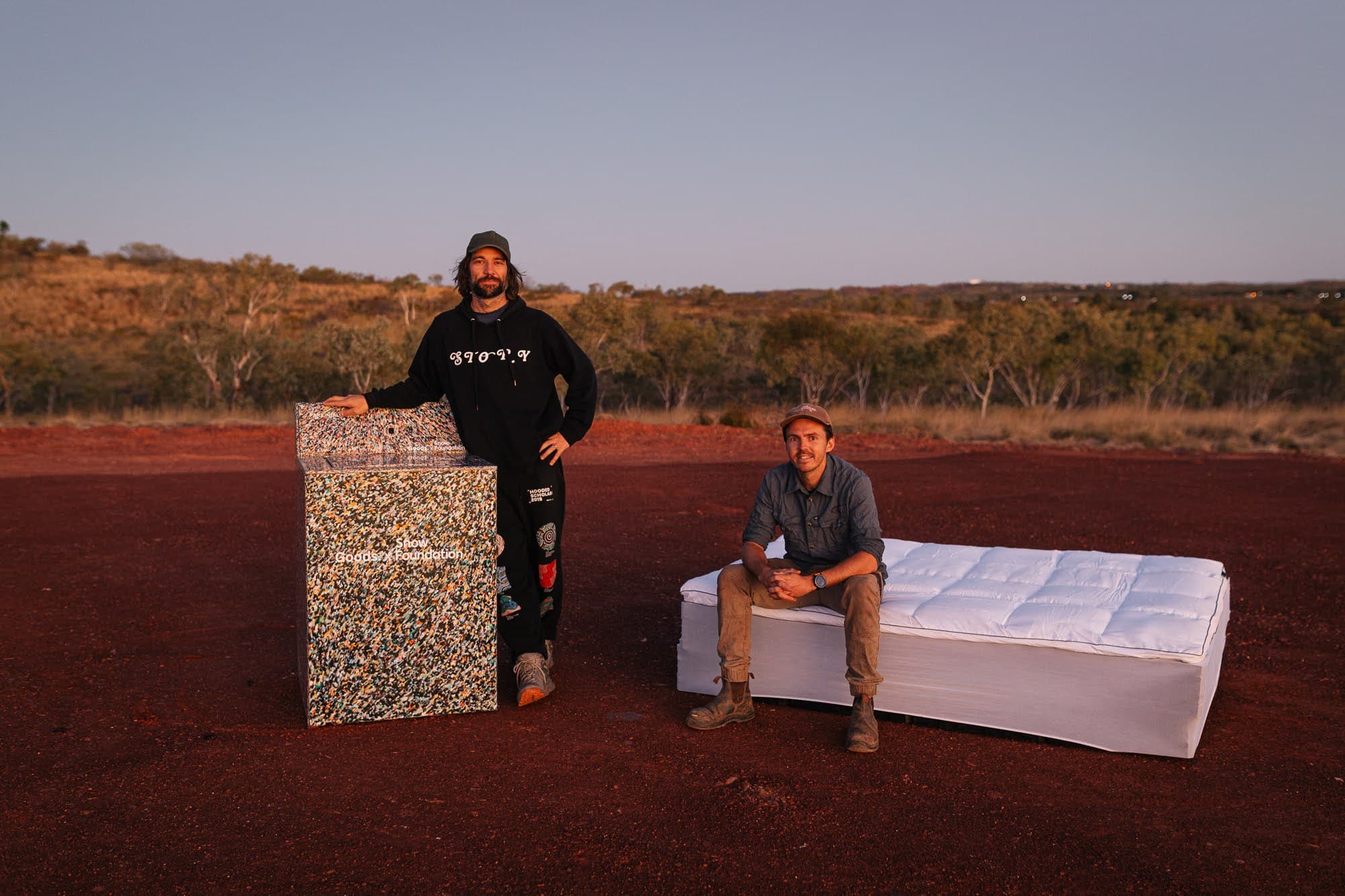
Nicholas Marchesi
Co-founder and project lead
Product development, manufacturing and community relationships.
Benjamin Knight
Co-founder, story and technology
Evidence, storytelling, systems and partnerships.
Community organisations lead their enterprises and decide how to use their sales income. Goods is developing shared support in production, buying, design, training, finance and communications.
6
Six places taught us the model.
Each stop changed the product, the price, or who does the work.
01
Before the first bed, there was a health question.
Ninga Mia, Kalgoorlie, WA
In 2018, Nic heard paediatric cardiologist Dr Boe Reményi explain how environmental health shapes preventable disease. Not that a bed is a medical device. The question was more practical: what are people sleeping on, and can it be cleaned, repaired and kept off the ground? At Ninga Mia, Gloria Turner made that question real.
“Sleep on a good mattress. For the back, the legs, the muscles.”
Gloria Turner · Community member · Kalgoorlie, WA 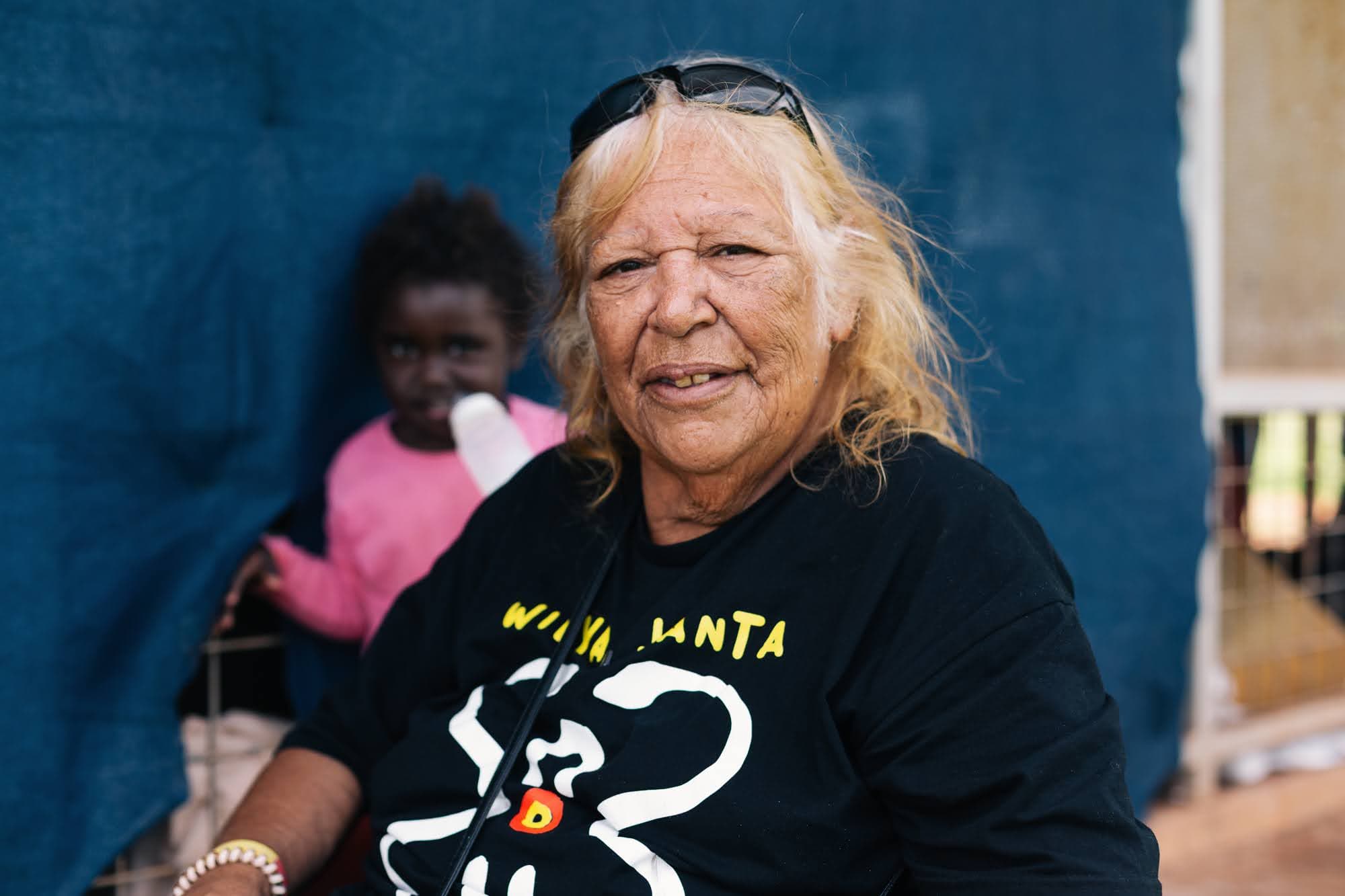
02
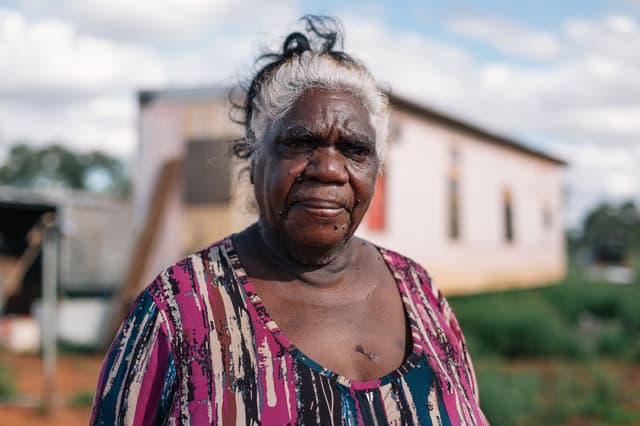
Linda Turner told us what had been missing: nobody had asked.
Tennant Creek, NT
We kept coming back to Tennant Creek. Over years, Goods listened, changed the beds and delivered more than 100 Basket Beds. Linda Turner's question changed how the work happened from then on: ask first, then build.
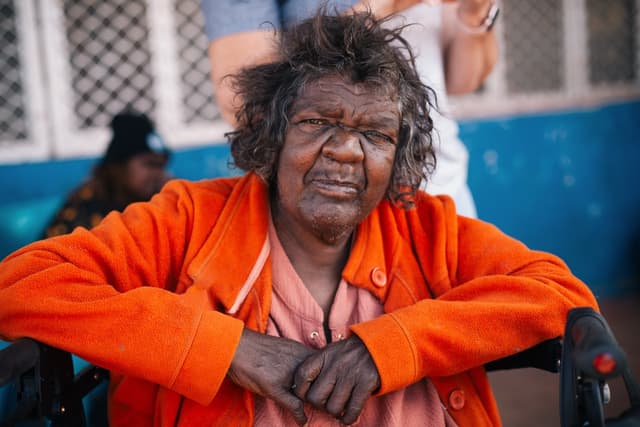
“We've never been asked what sort of house we'd like to live in.”
Linda Turner · Community member · Tennant Creek 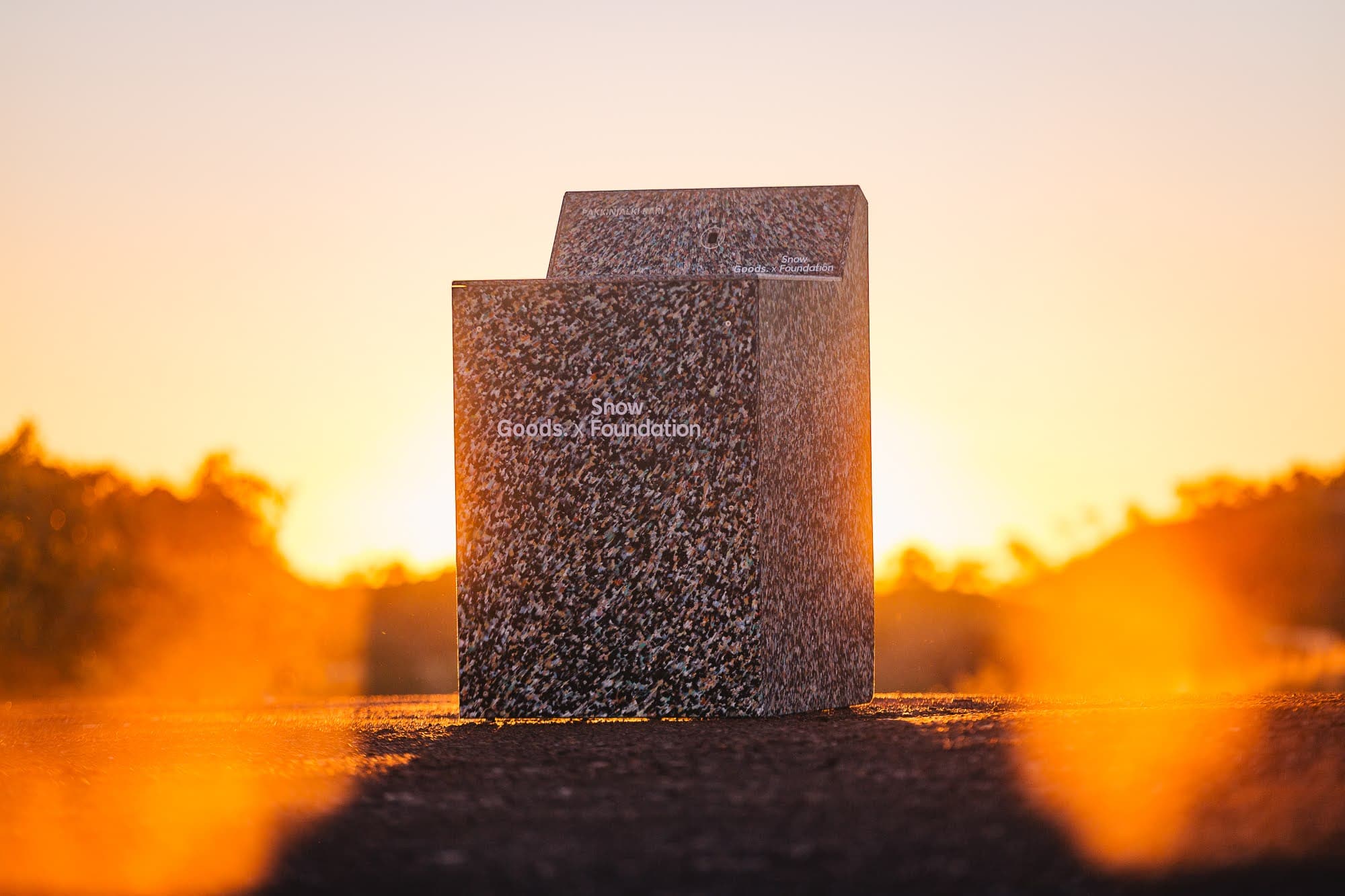
03
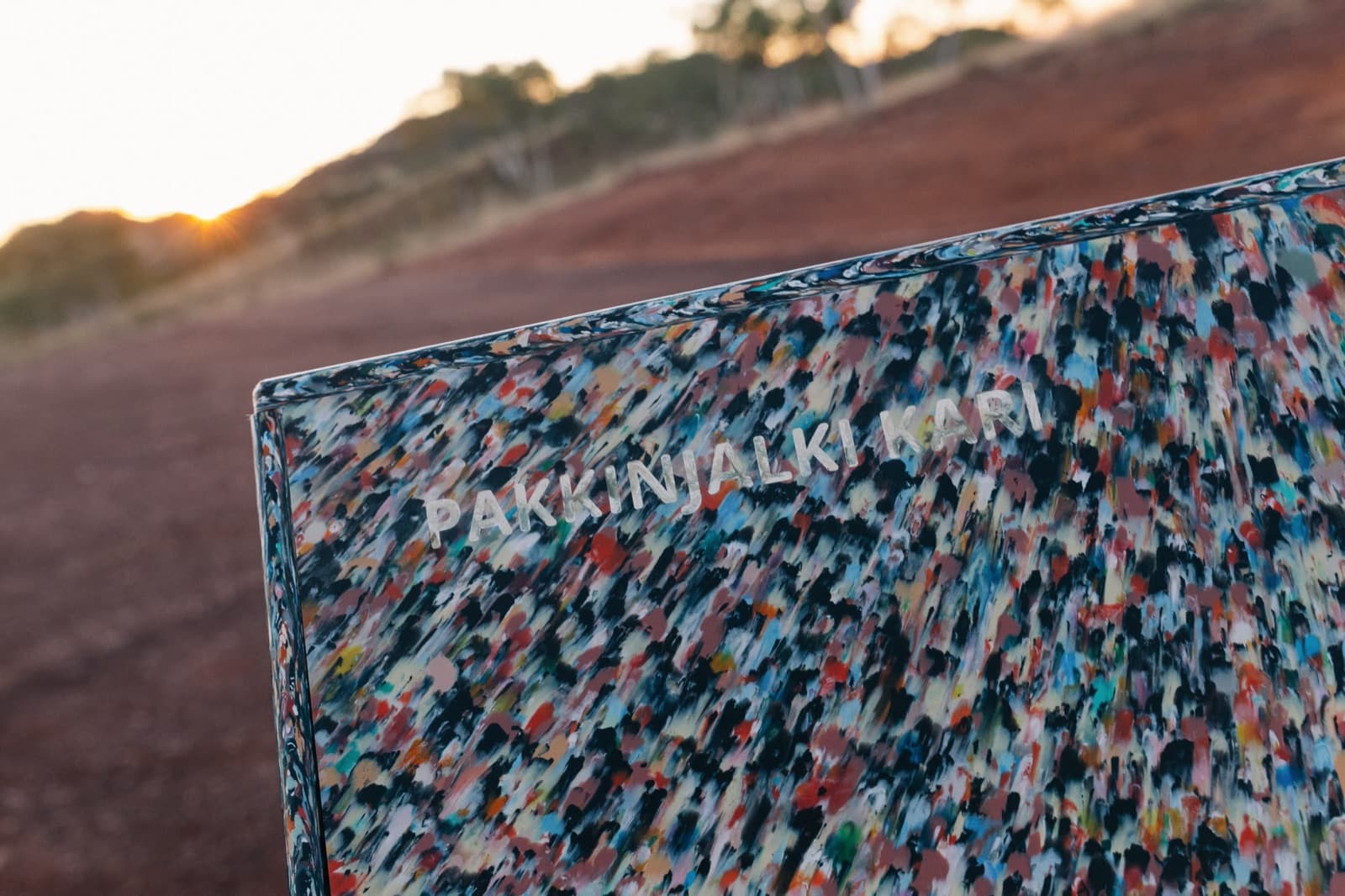
Dianne named it Pakkimjalki Kari.
Tennant Creek, NT
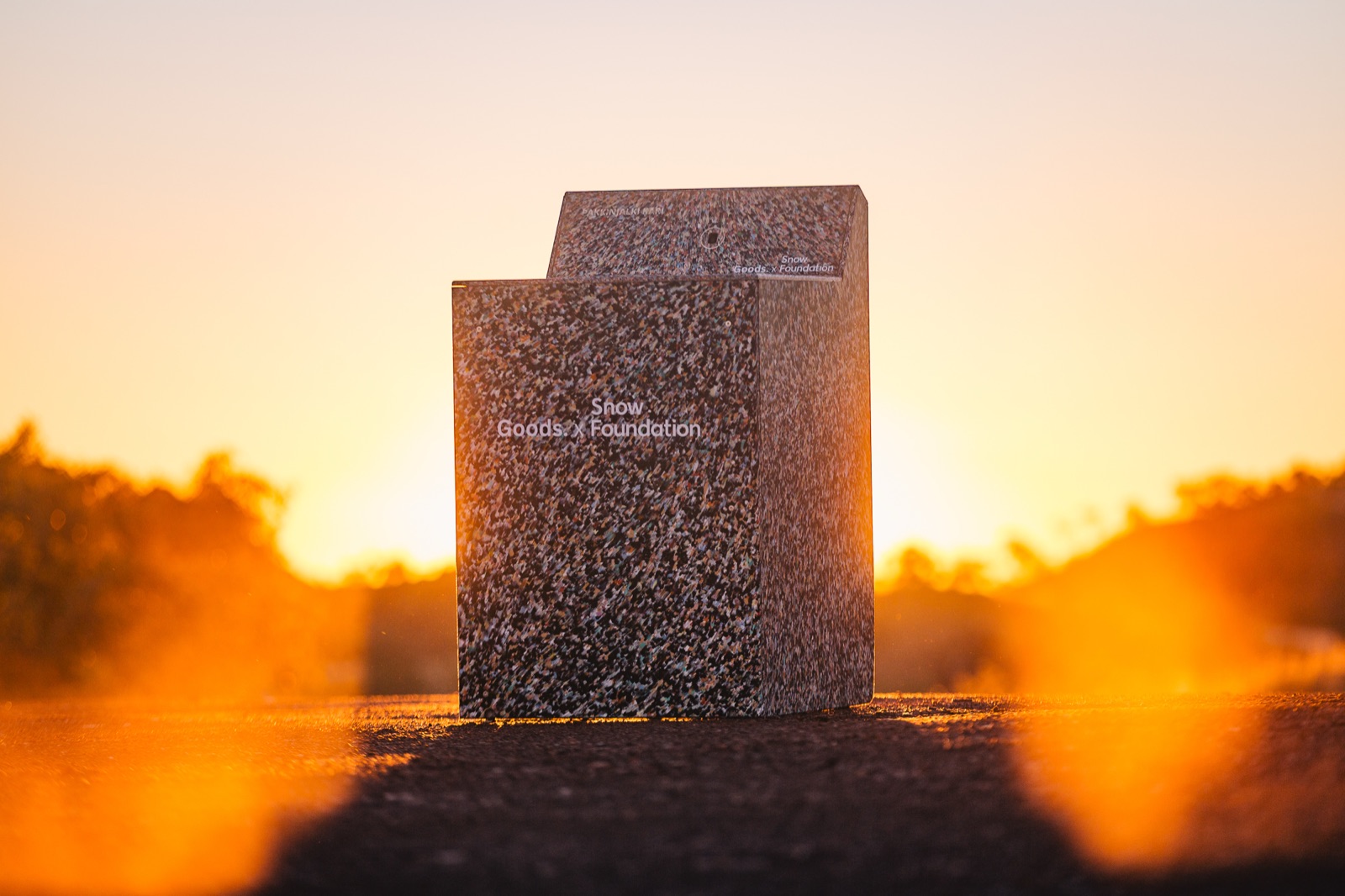
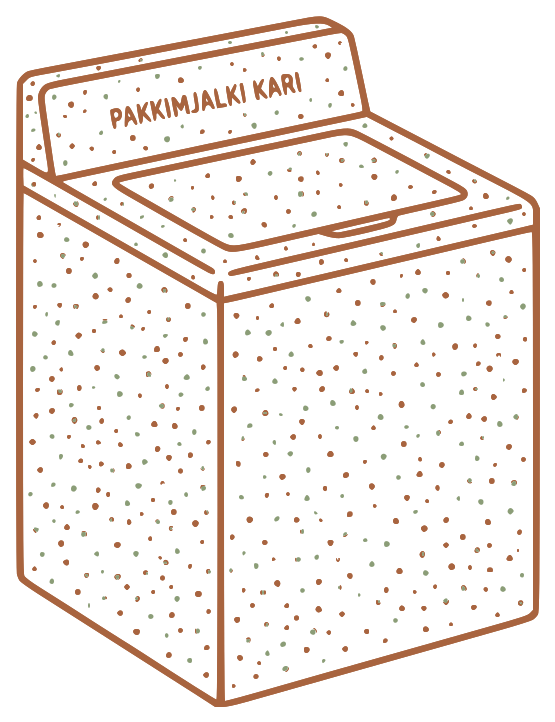
People in Tennant Creek asked Goods to look beyond beds. Dianne helped shape a one-button washing-machine prototype, then gave it a Warumungu name.
“I will know where to come. If I need to wash my blanket, I don't have to go do it in town. Laundry, do it here.”
Dianne Stokes · Warumungu and Warlmanpa Elder. Designed and named both products. · Tennant Creek 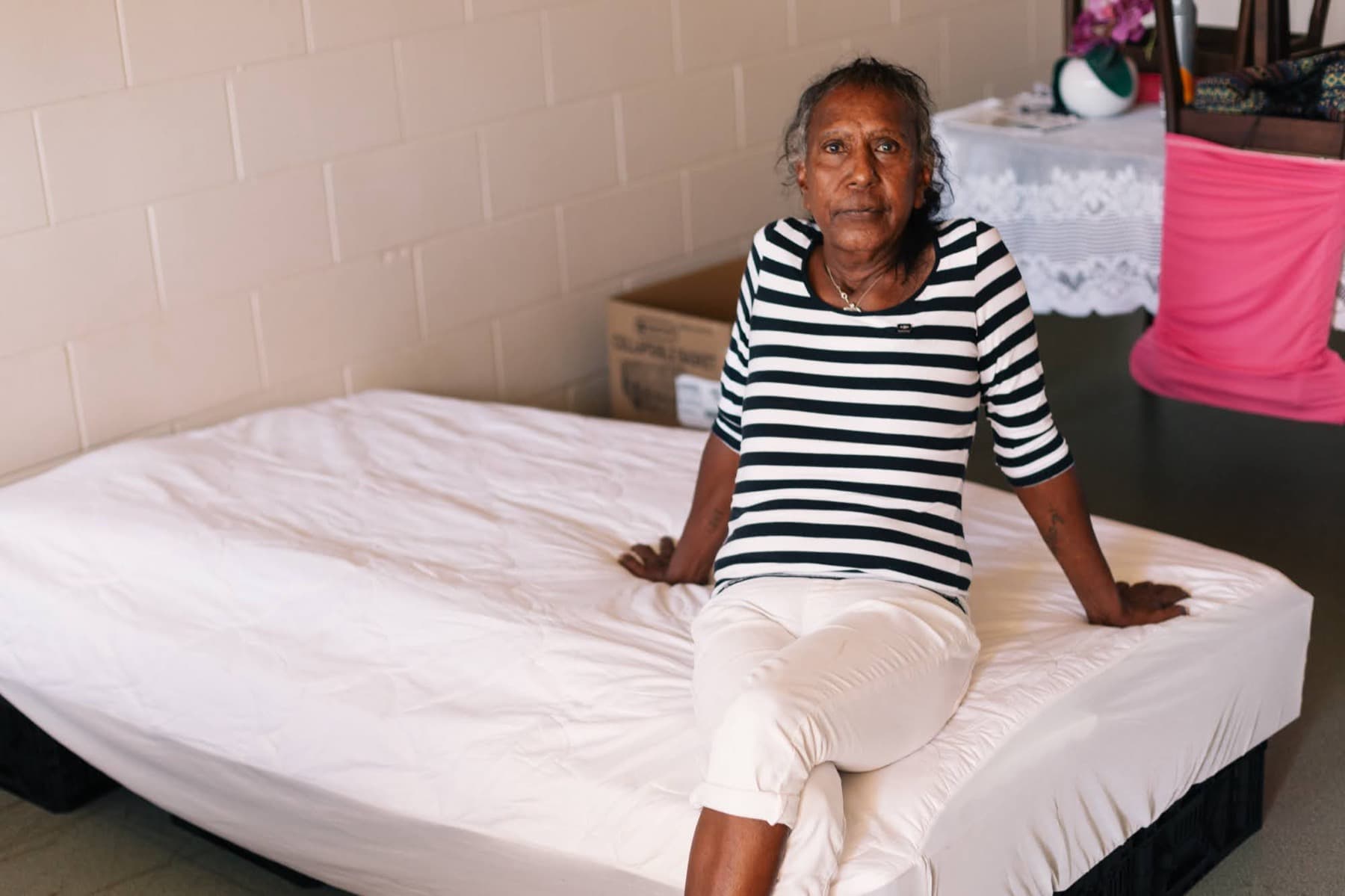
04
The price is only the beginning.
Palm Island, QLD
A bed reaches Palm Island by barge. Freight can push a durable bed close to $1,000, while cheaper beds cost less upfront but need replacing sooner.

“You have to bring them on the barge. You can't just take them on the boat. You have to pay for freight. It all adds up.”
Alfred Johnson · Community member · Palm Island 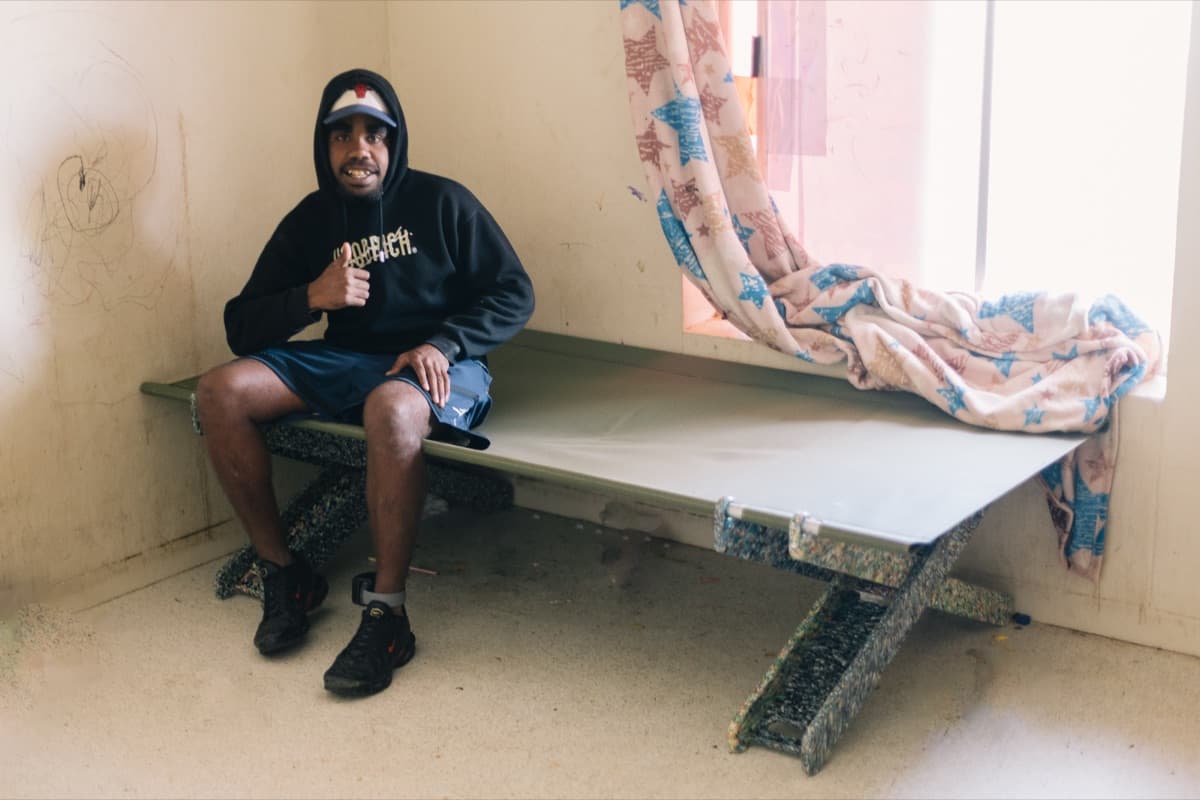
05
Mykel built the bed he slept on that night.
Utopia homelands, NT · May 2026
He turned the finished bed over in his hands. Bottle lids had become something strong enough to sleep on. By the end of the second day, he had built seven. We asked if he would come back every day if there were a place here to make them. "Yeah, I'll be rocking up every day to make them."
“I sleep in the tent but look, there's my house or the rubbish house ... No mattress. Look, the bed was mine. Just for chucking us blanket, that's all, that's all I was sleeping.”
Margaret Lloyd · Utopia homelands community member, ~30 years on her homeland · Utopia homelands 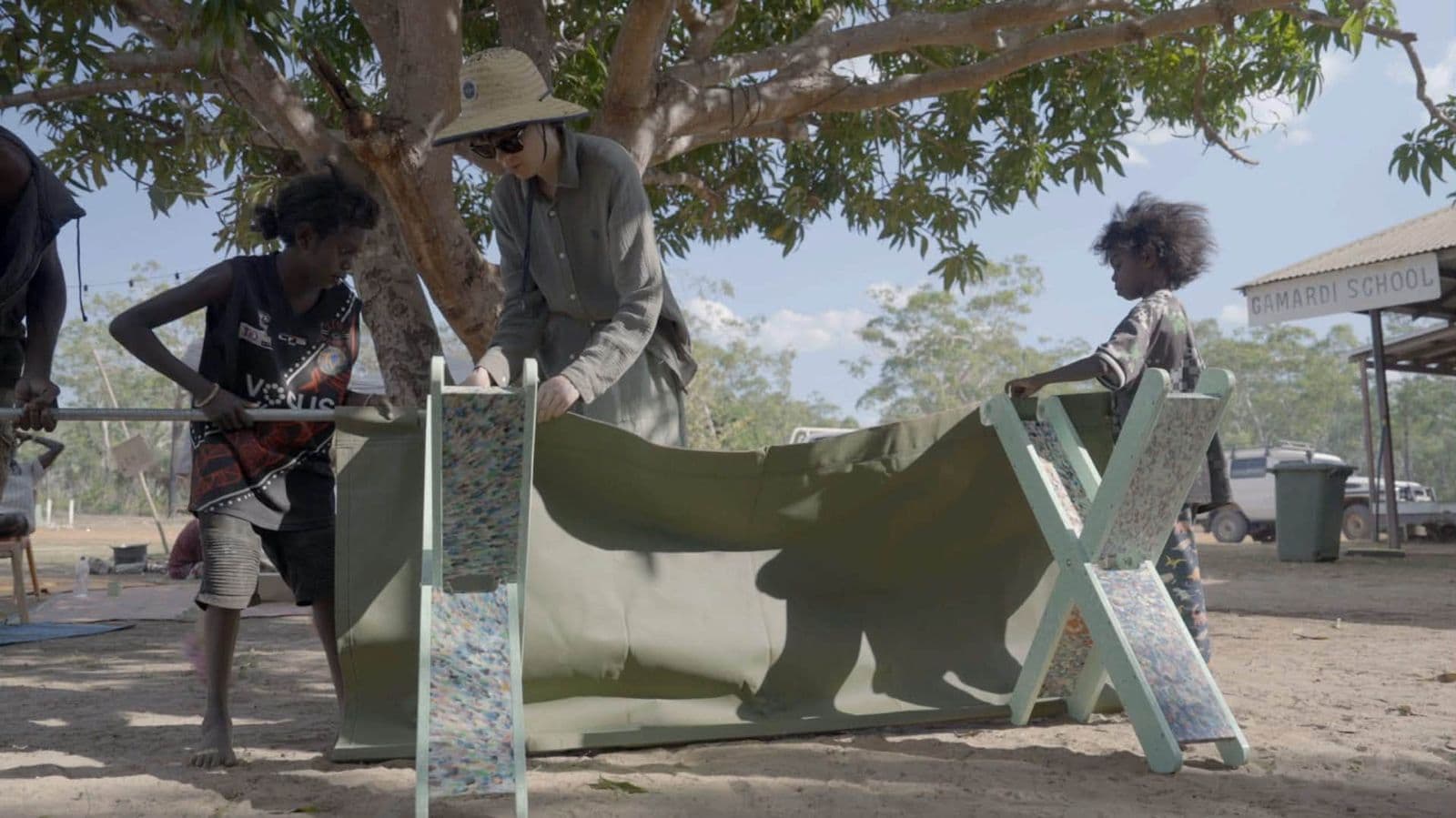
06
We pressed, routed and packed the parts at the farm. In Maningrida, young people turned them into forty beds.
The farm, and Maningrida, Arnhem Land NT
Defy Design supplied the shredded recycled plastic. We pressed, routed and packed the parts at the farm, then sent them to Maningrida. Young people assembled the forty beds with community.
“A good night's sleep means the kids are fresh and ready for school the next day.”
Tehmineh Mason · Principal, Homeland School Company · Maningrida 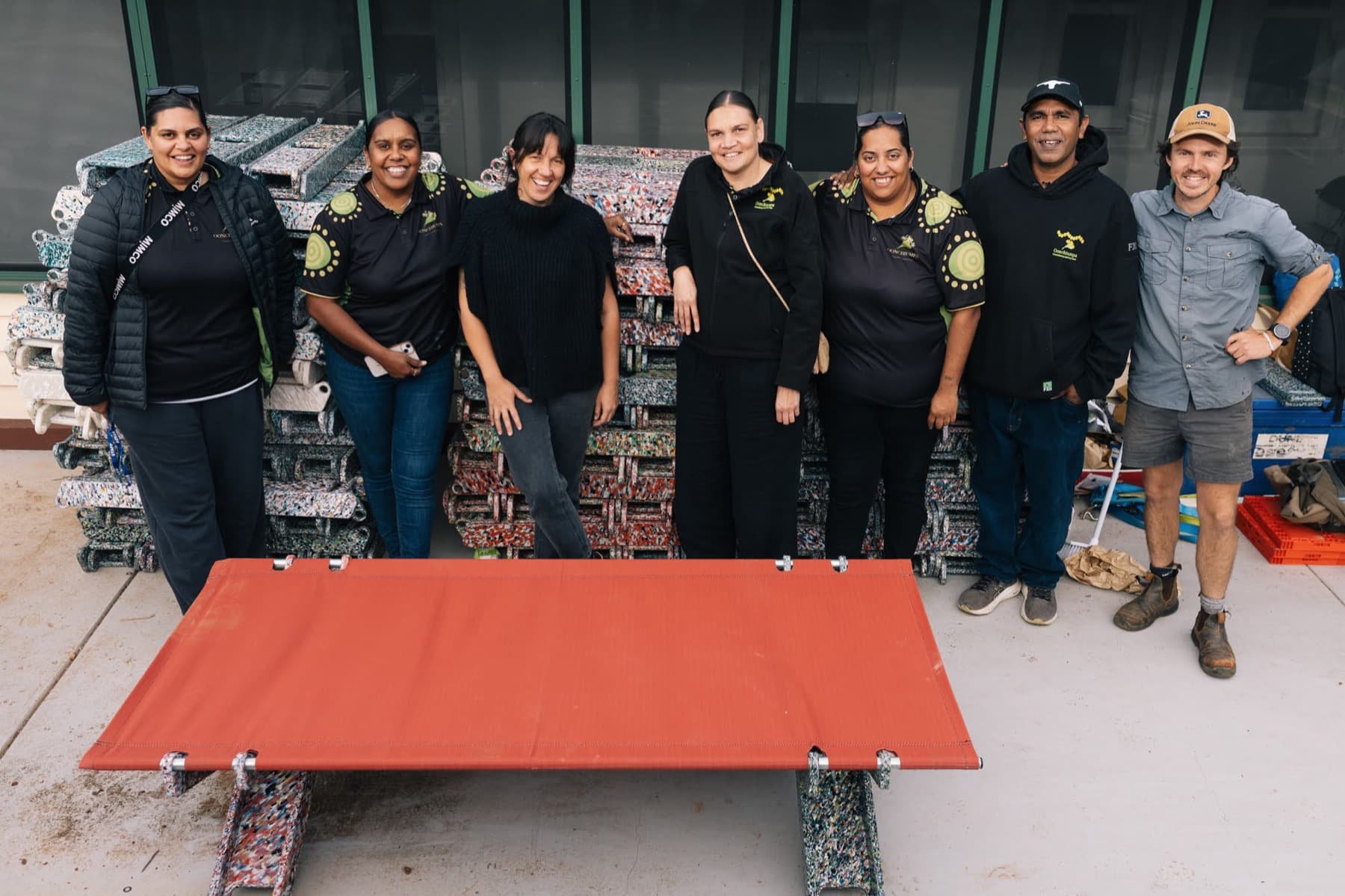
07
Oonchiumpa asked what it would take to make the beds themselves.
Alice Springs and Utopia, NT
Oonchiumpa already runs its own business and works with young people. Its team has built beds with Goods and expressed interest in production. The next conversation is practical: could the community entity sell the beds while Goods supplies equipment, training and support?
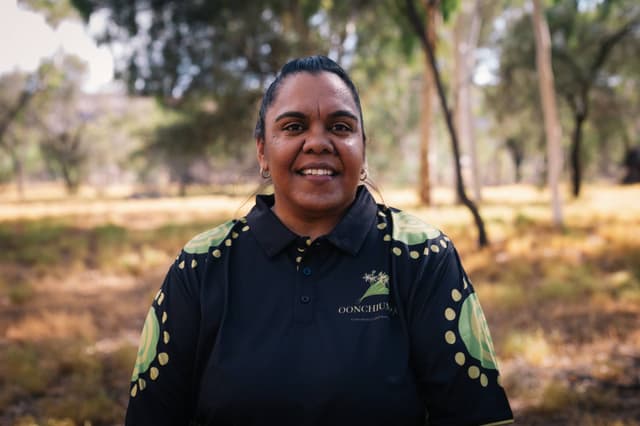
“We want to create a safe space for our young people. There's a lack of housing, which leads to a lack of sleep, which leads to low school attendance.”
Kristy Bloomfield · Oonchiumpa co-founder, Traditional Owner · Alice Springs / Utopia
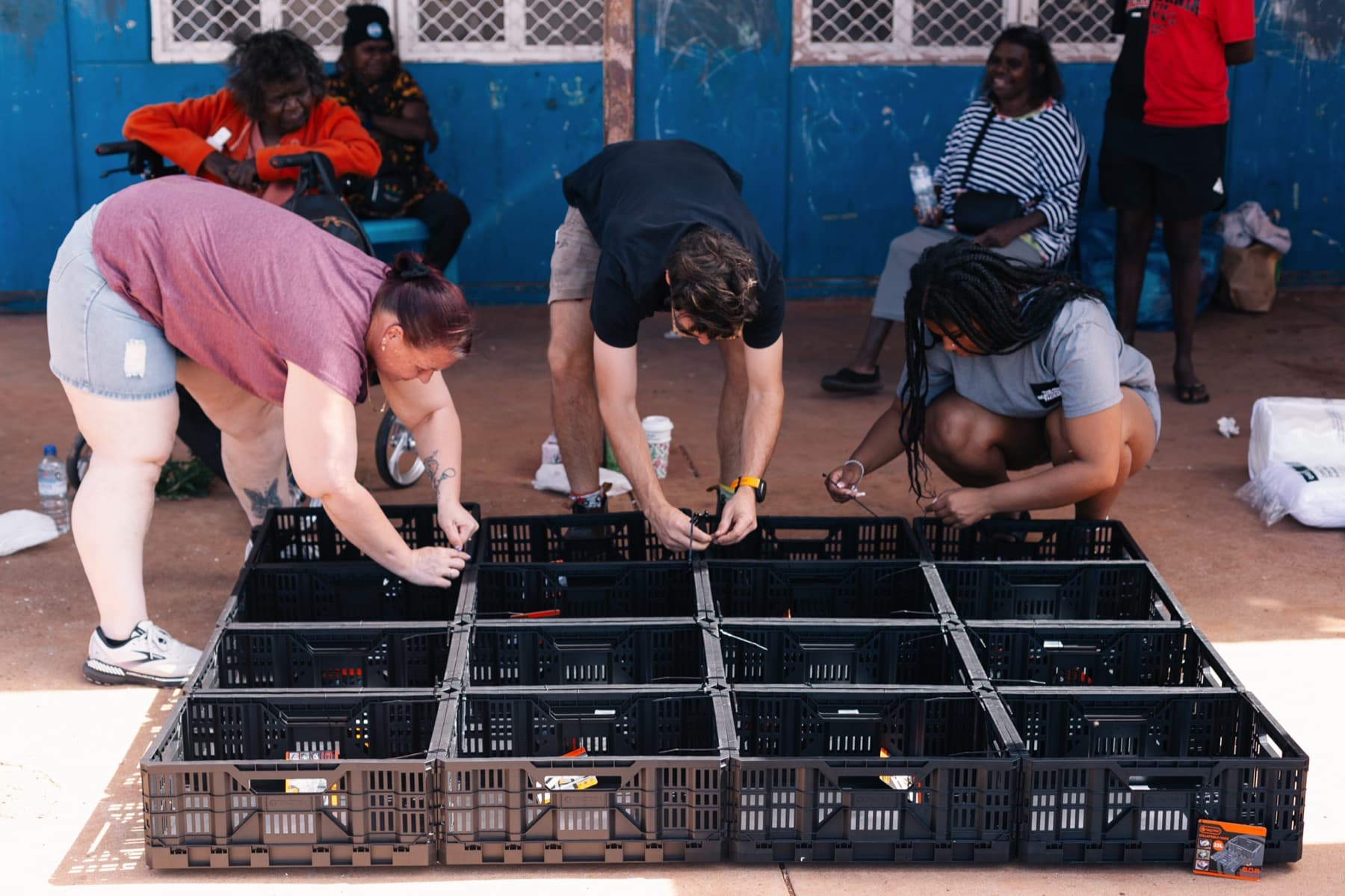
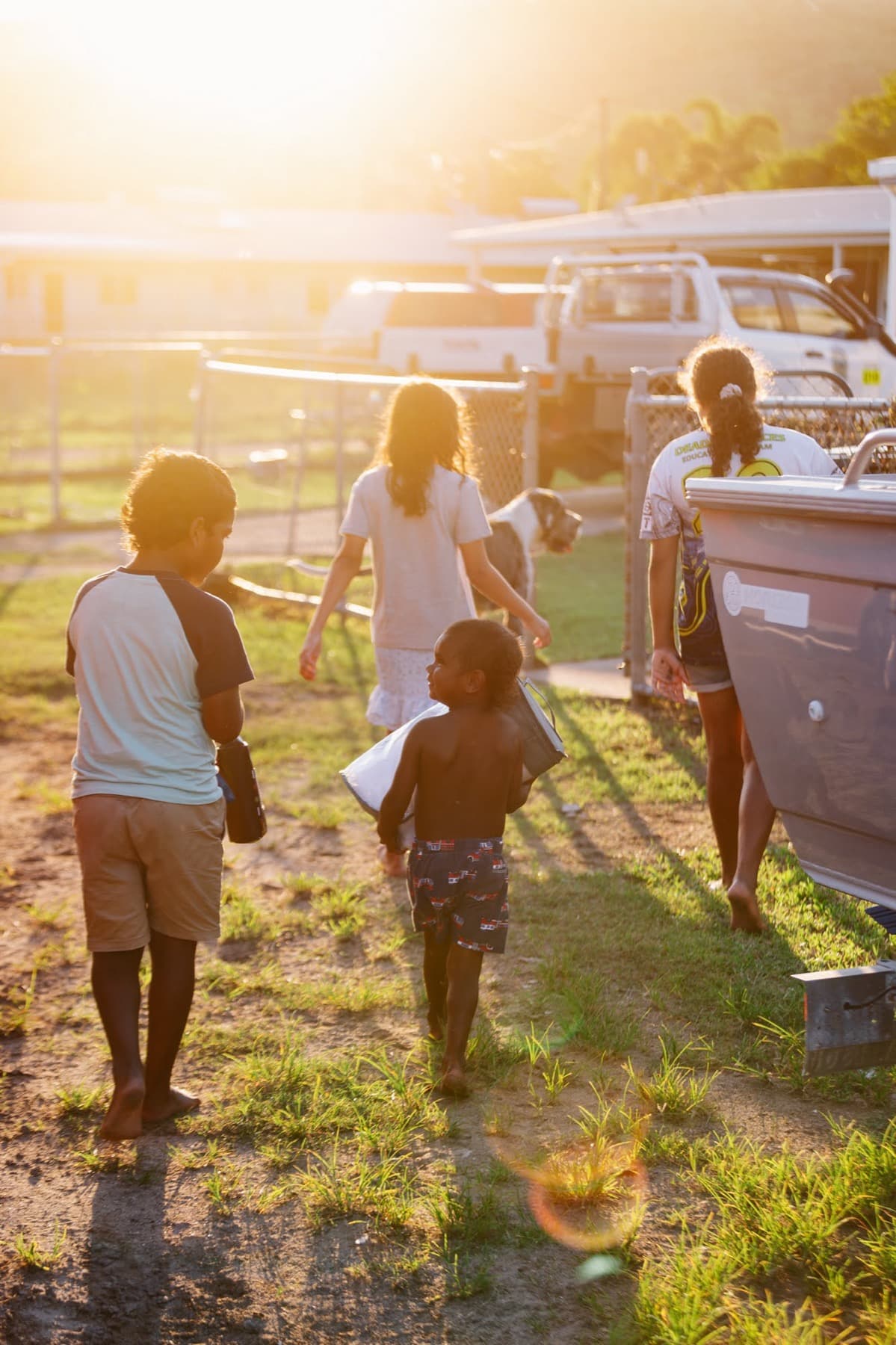
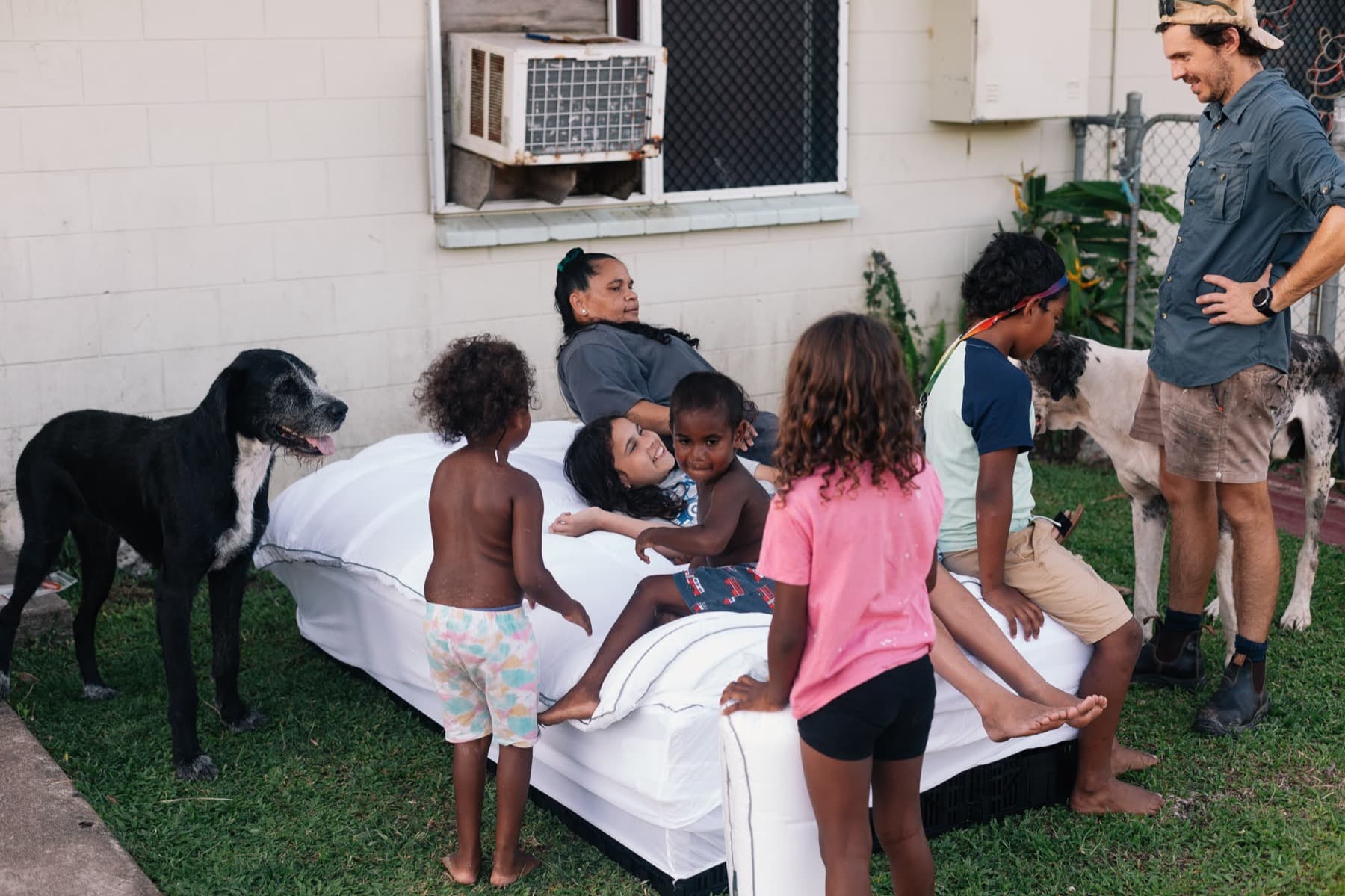
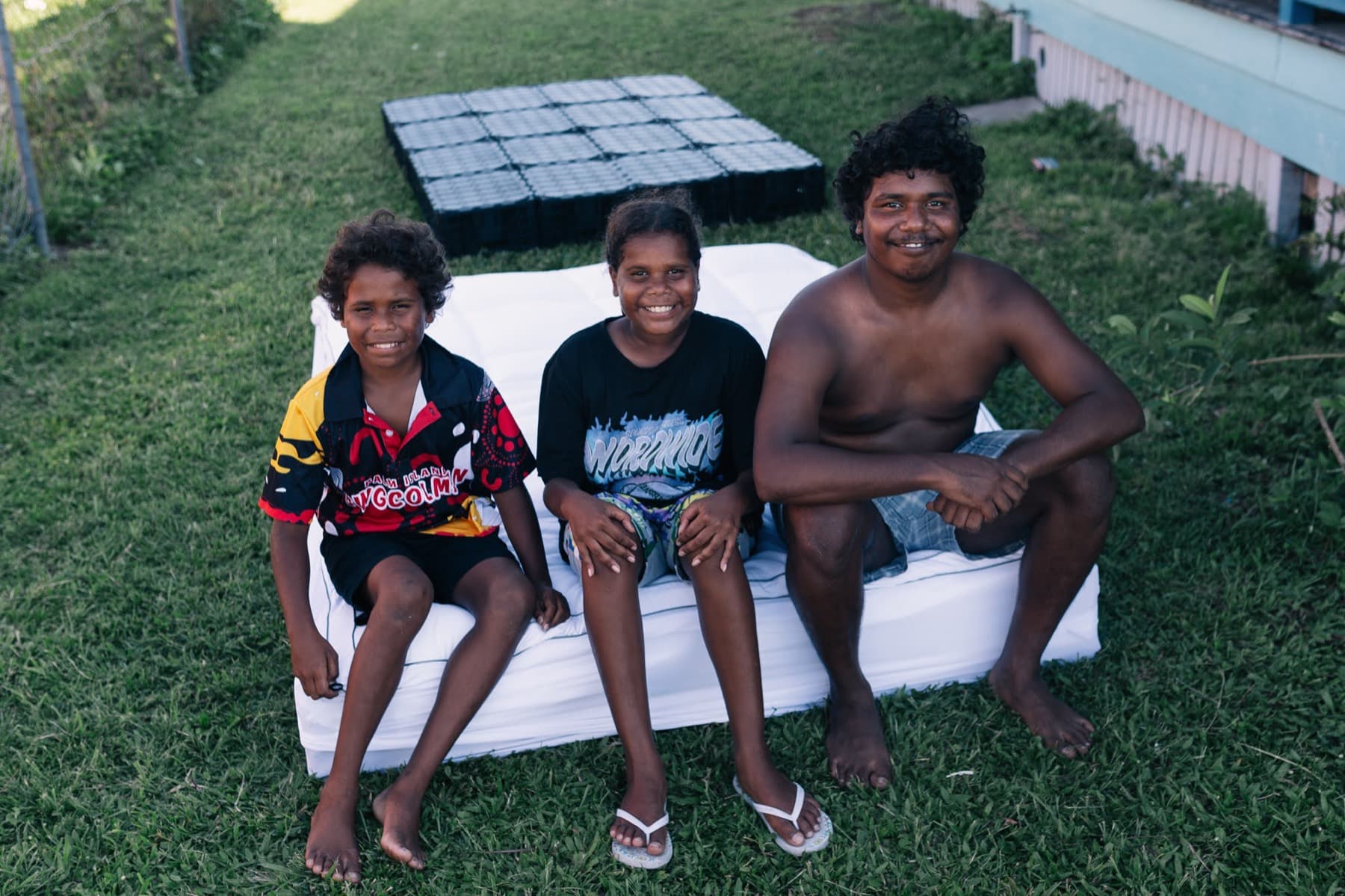
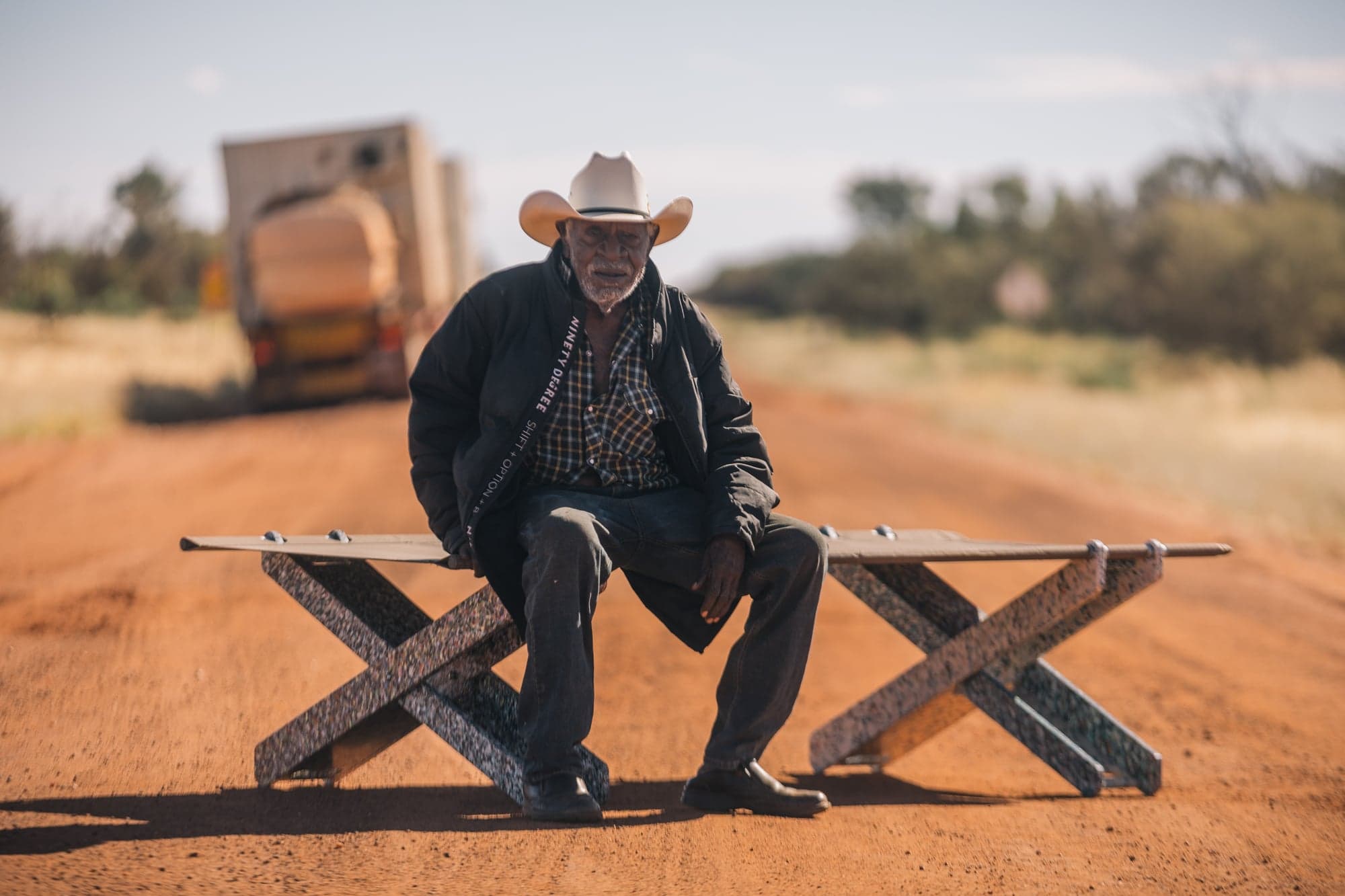
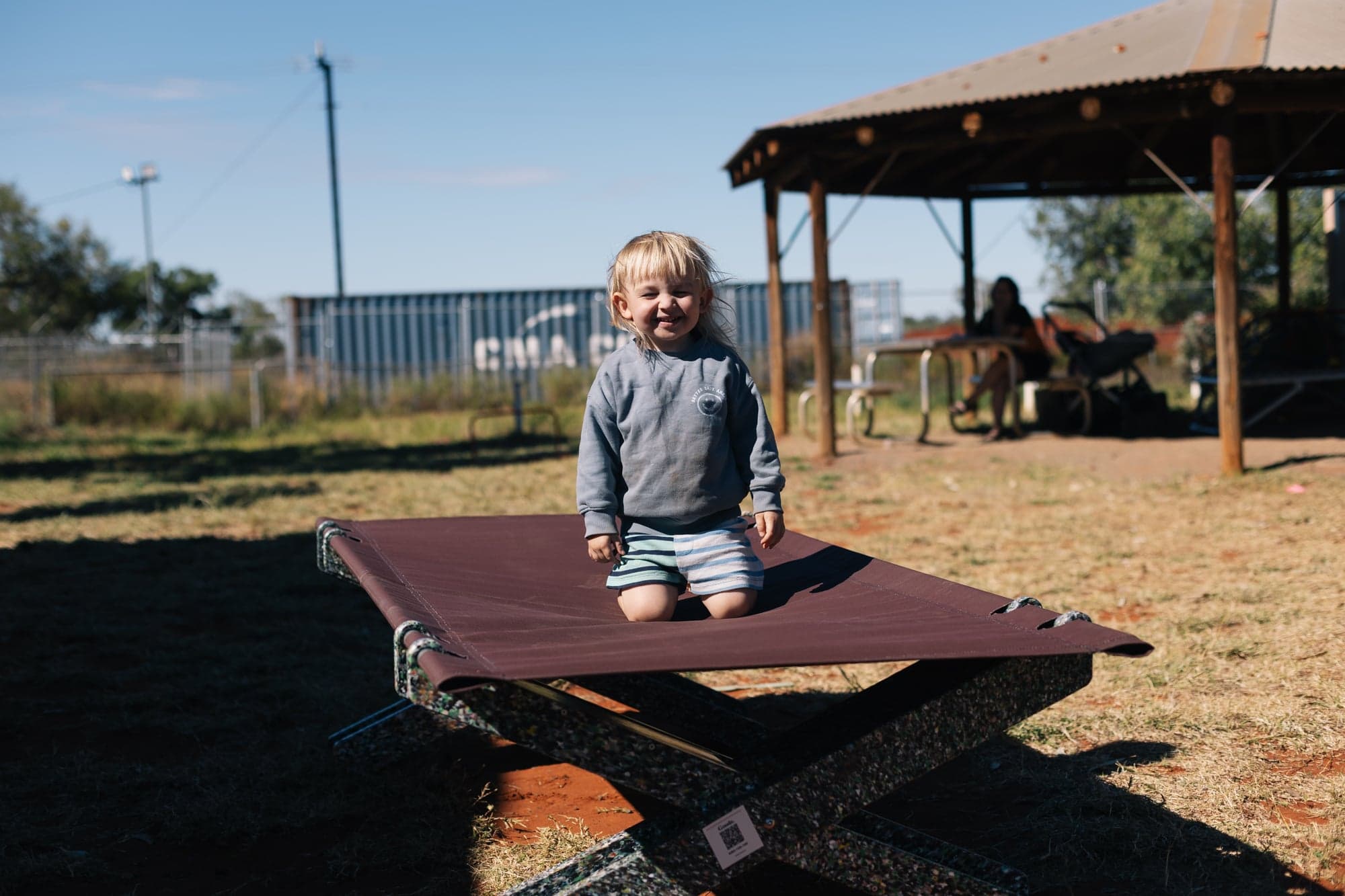
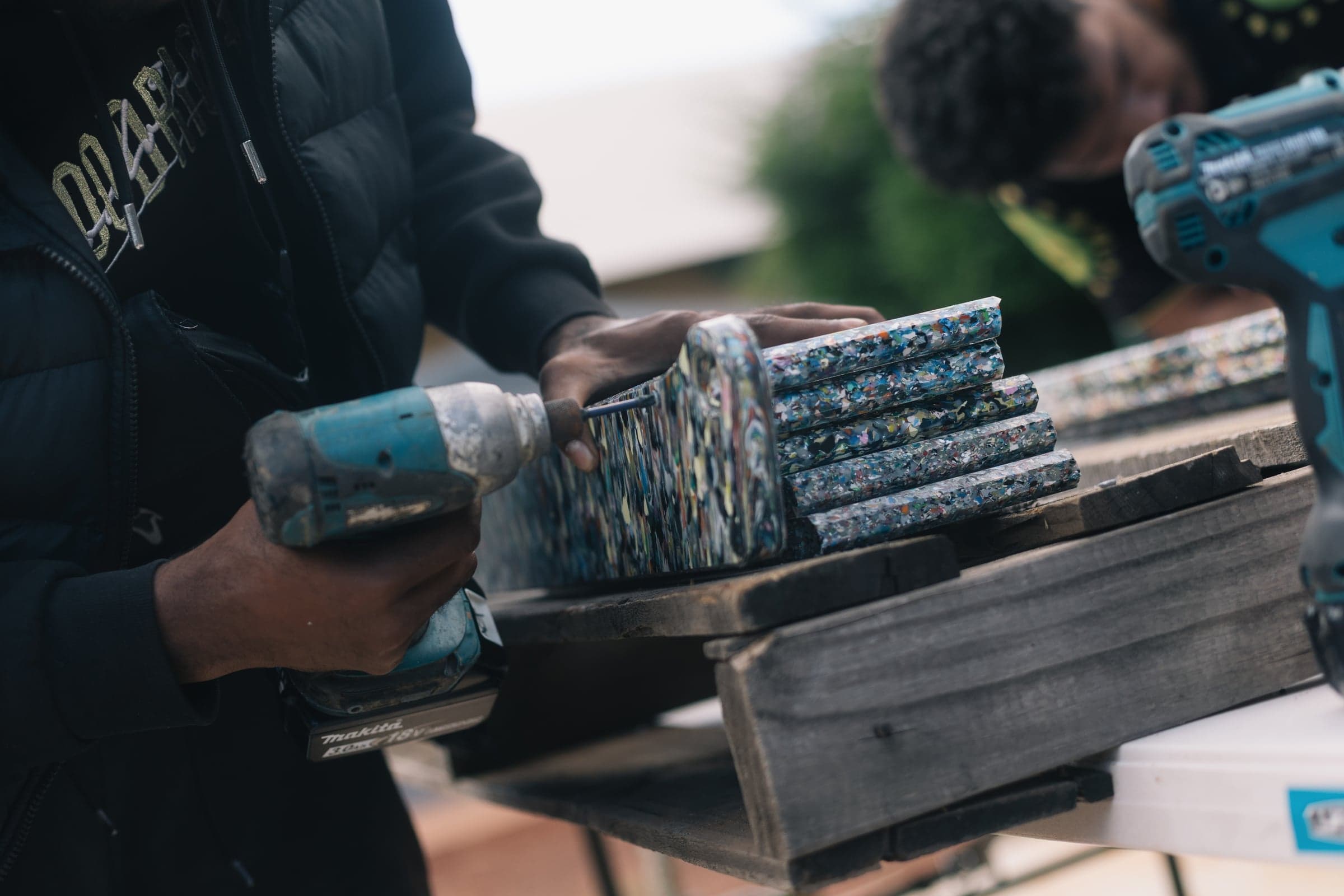
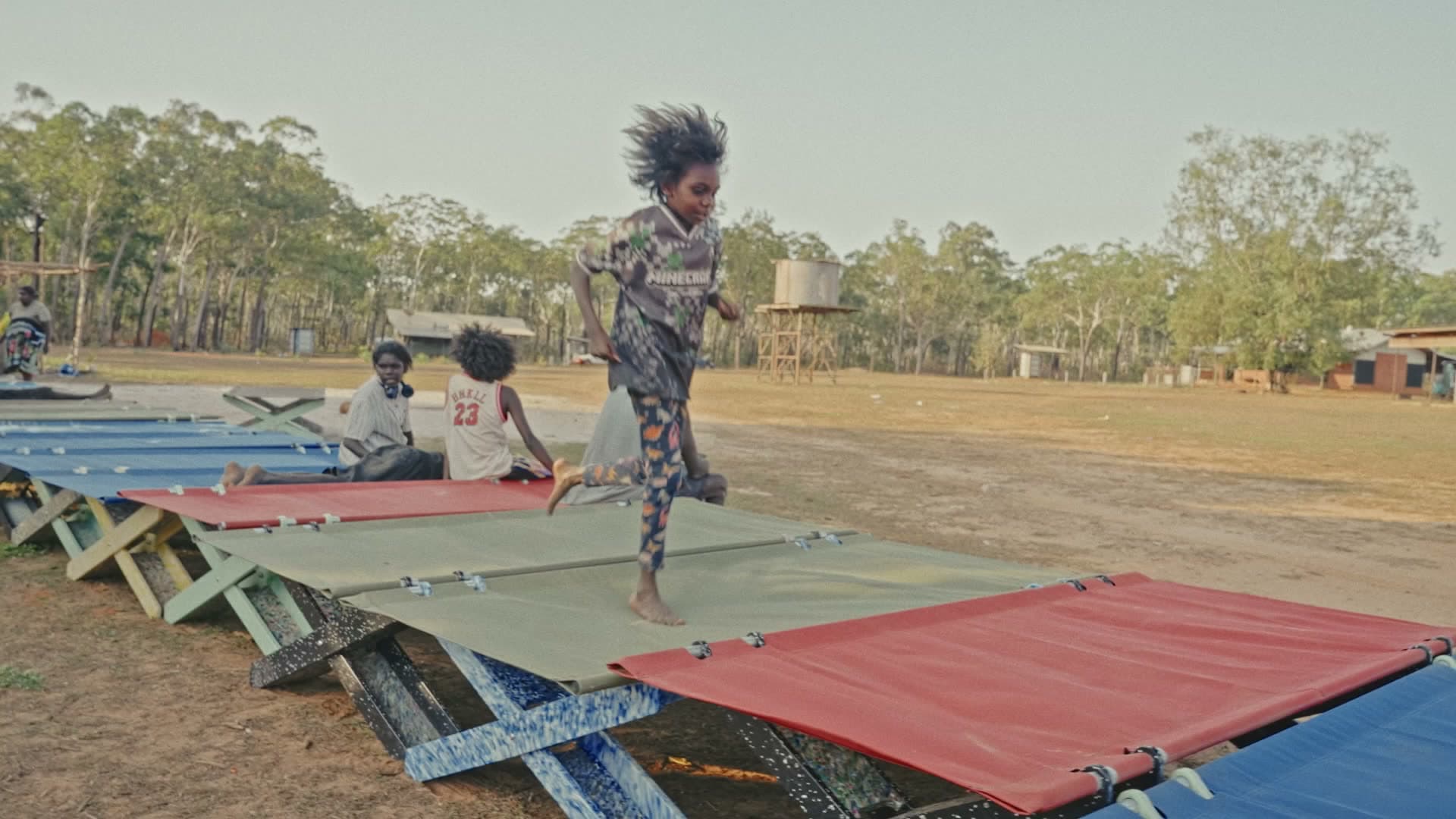
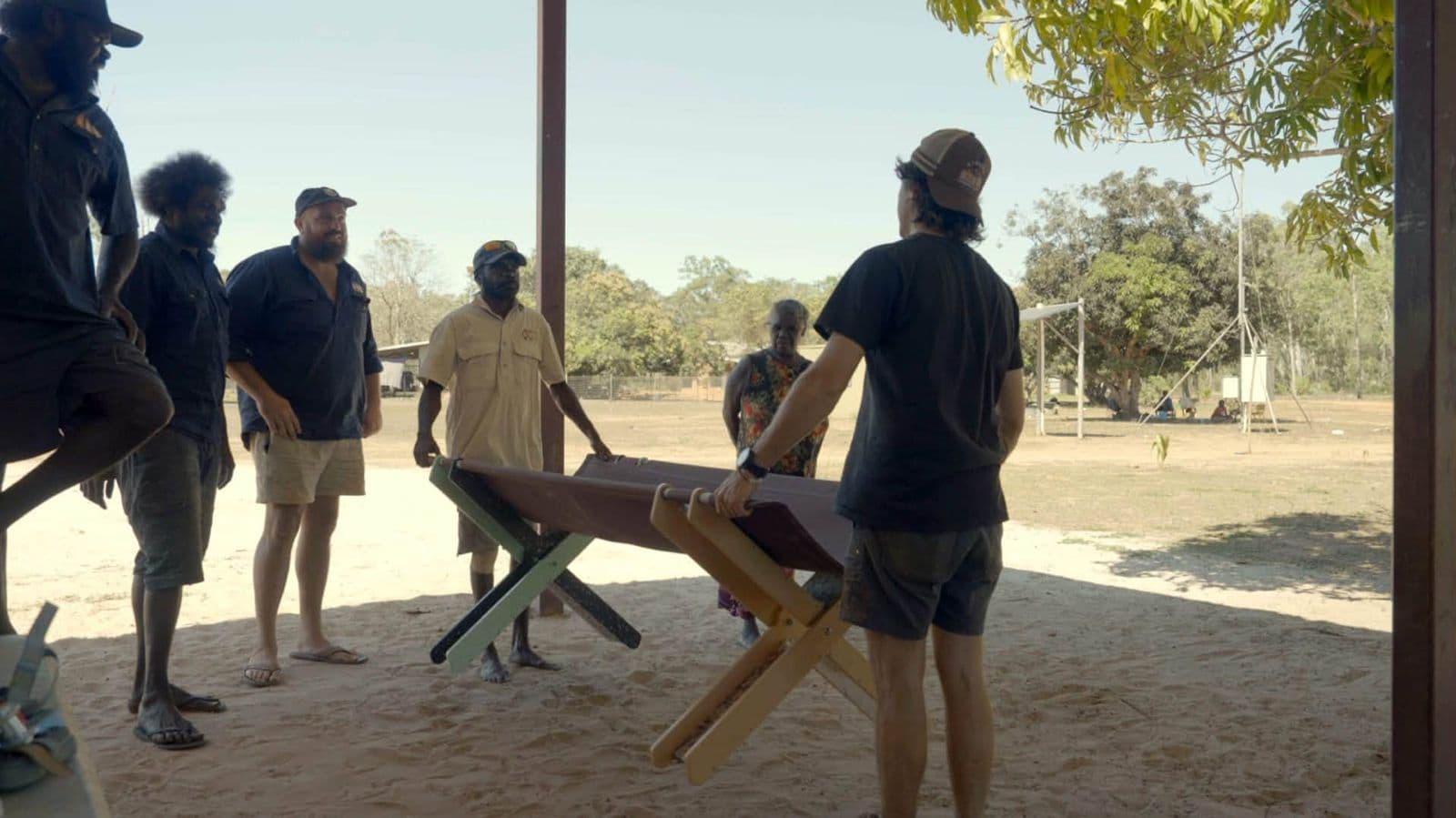
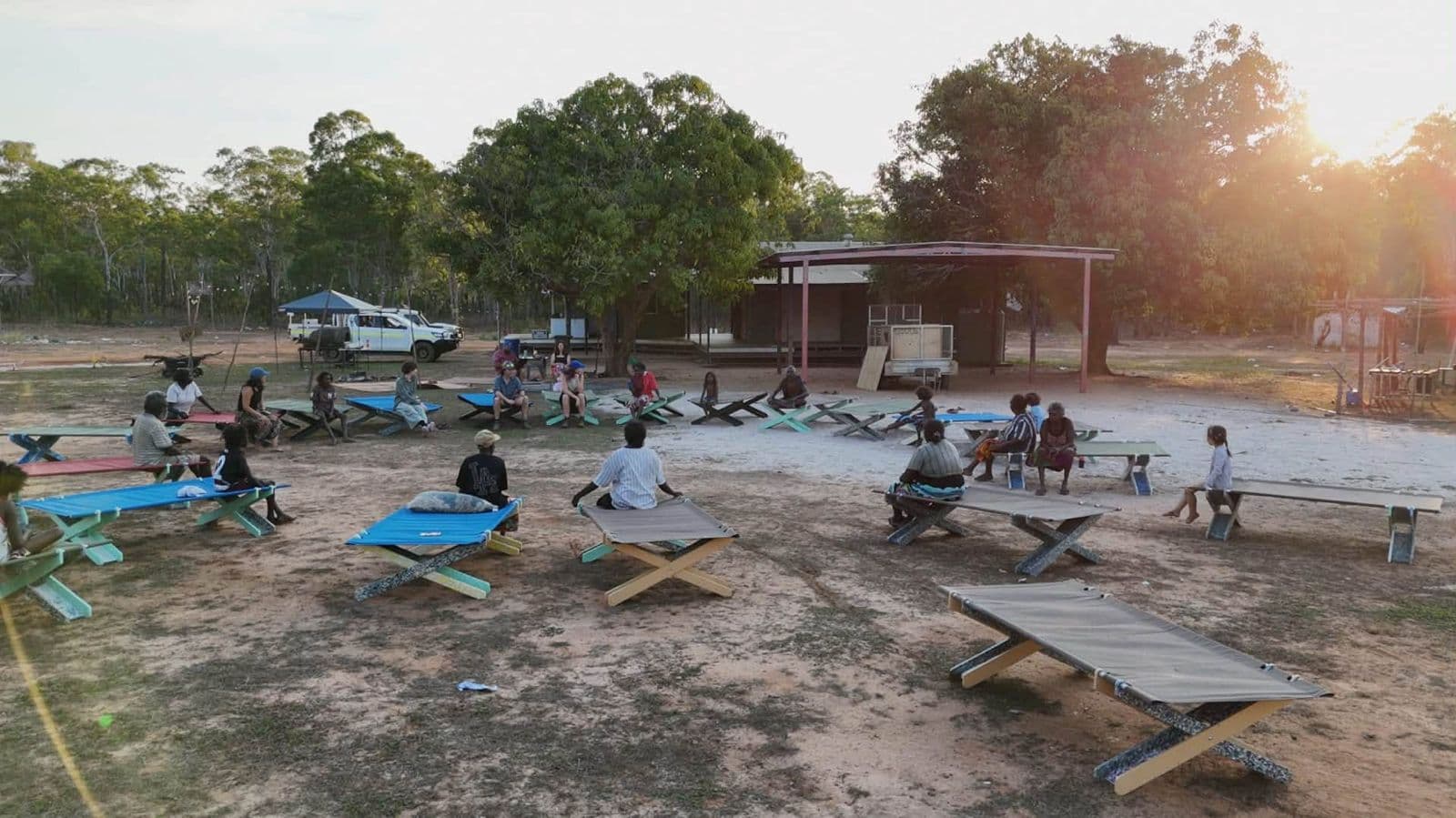
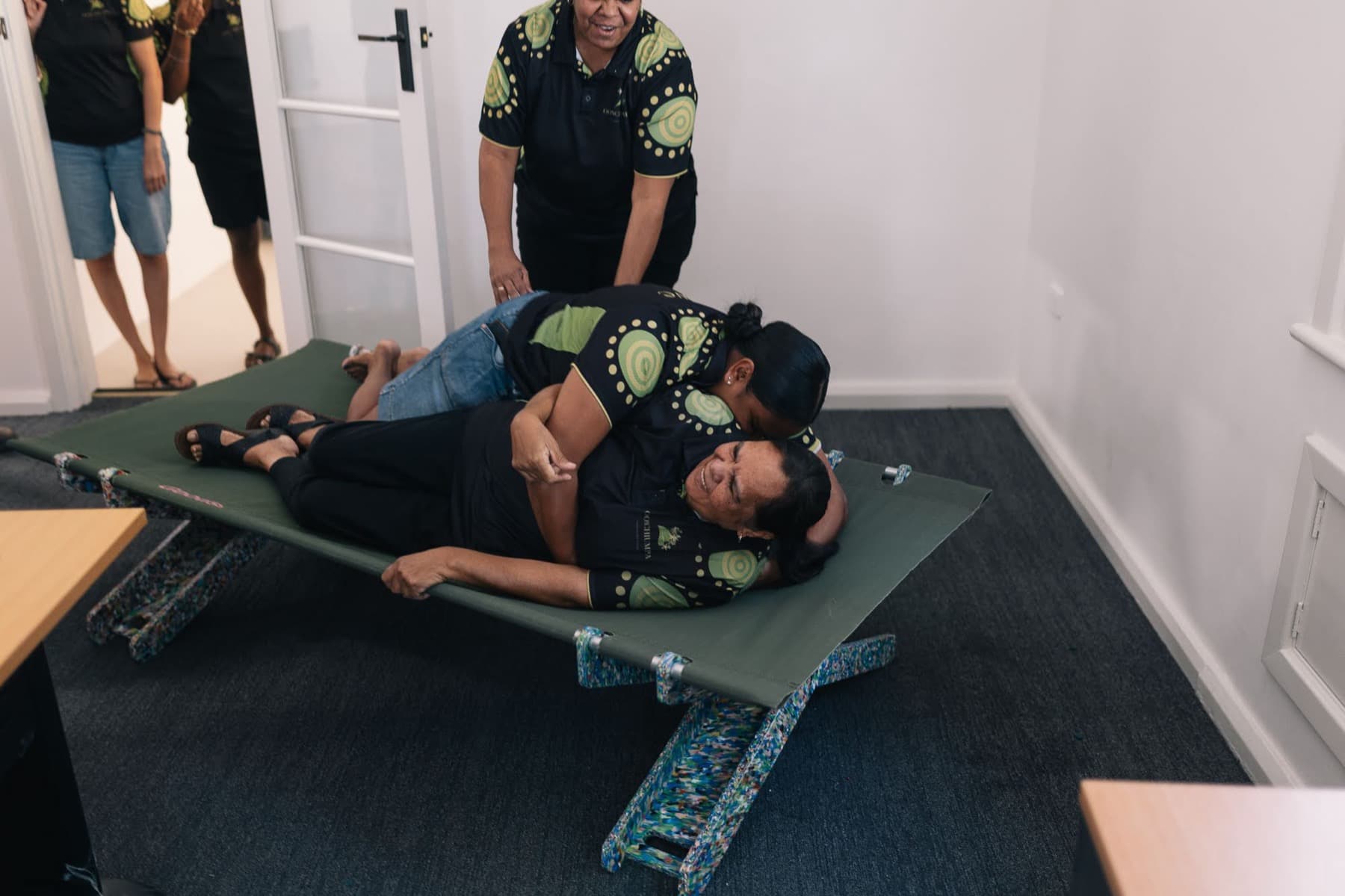
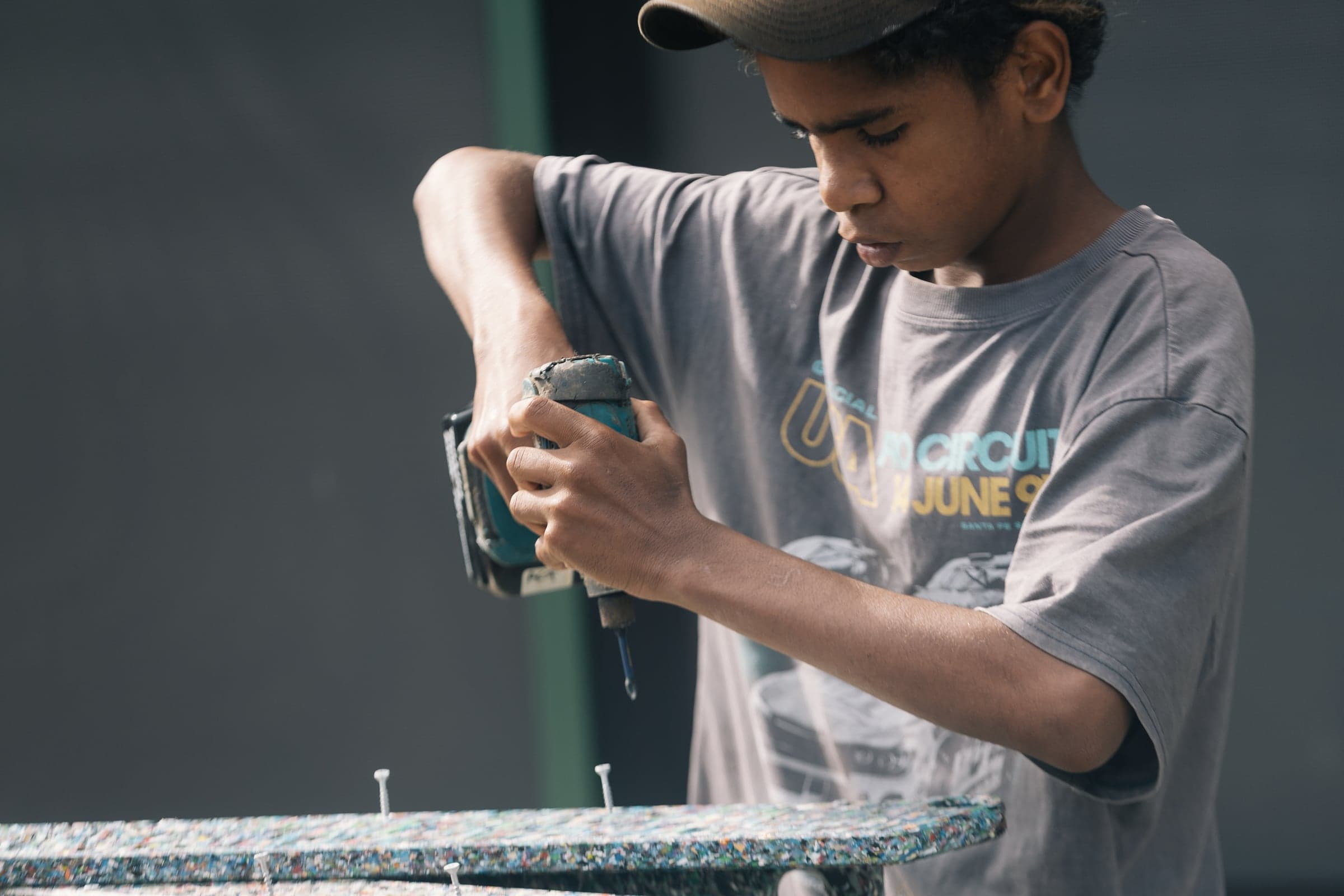
Flat-packed parts can travel and become useful beds through local hands.
A purchase moved through local hands, reached homes and created the next conversation.
7
What we make now and what comes next.
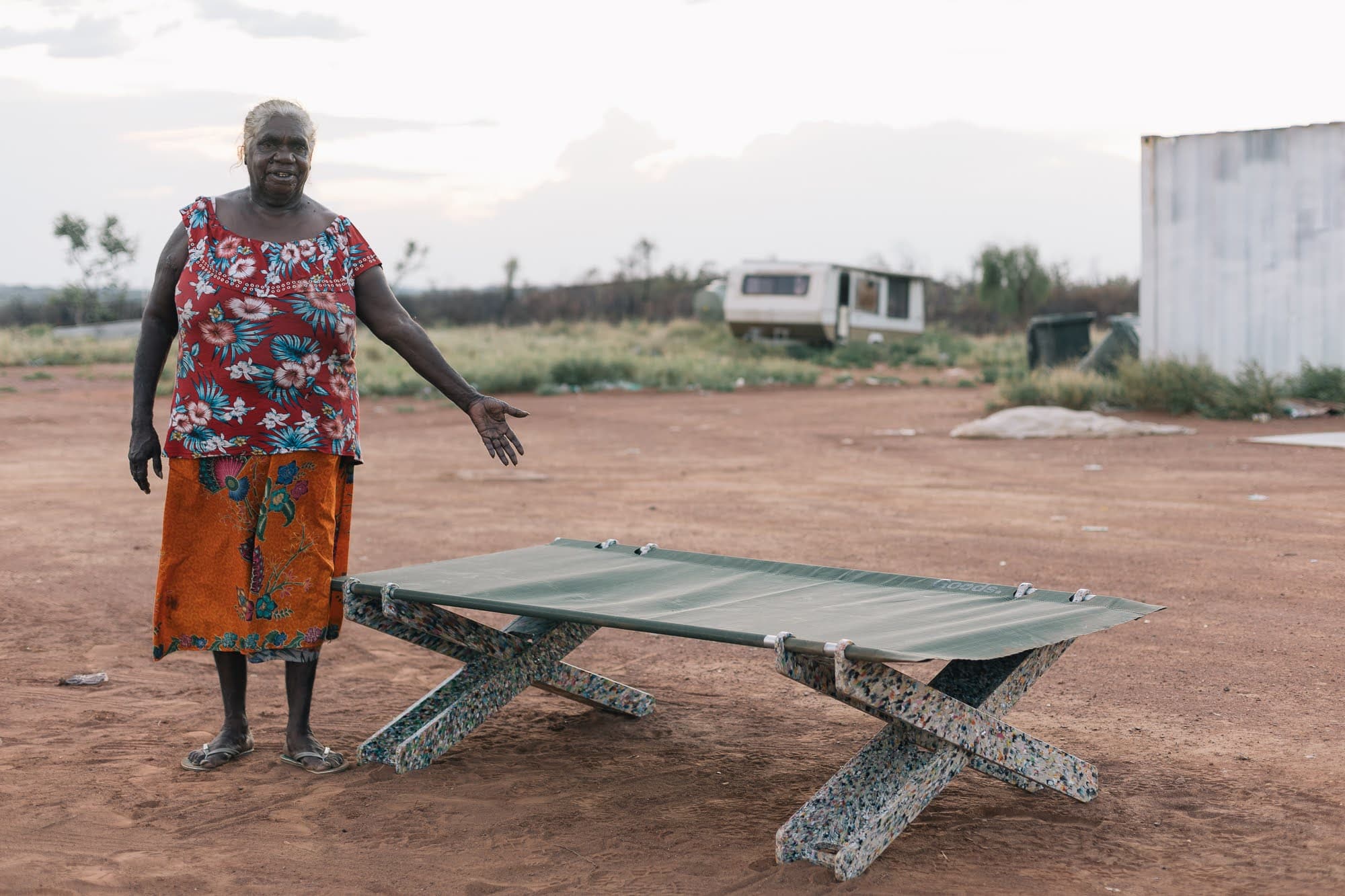
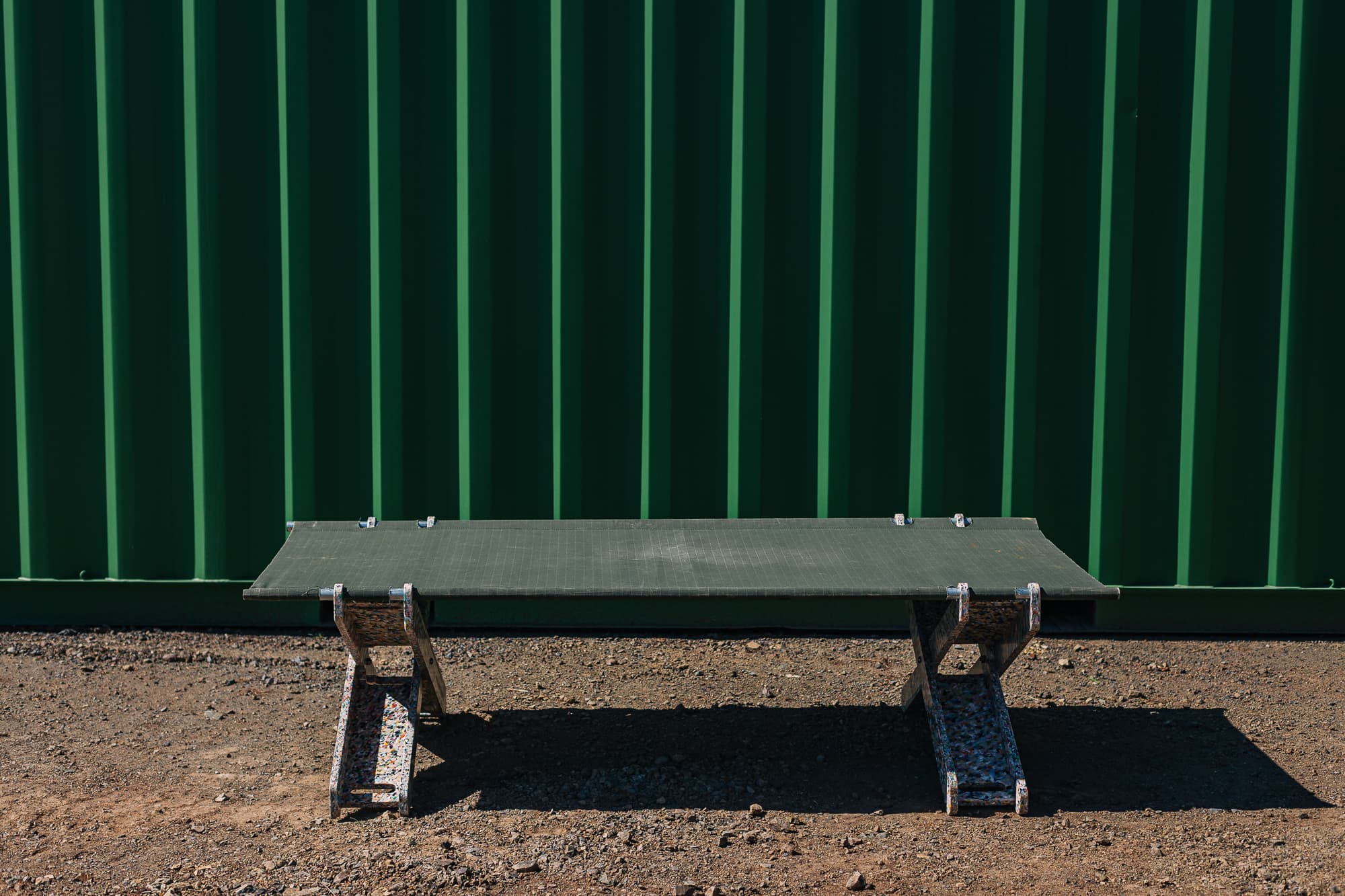
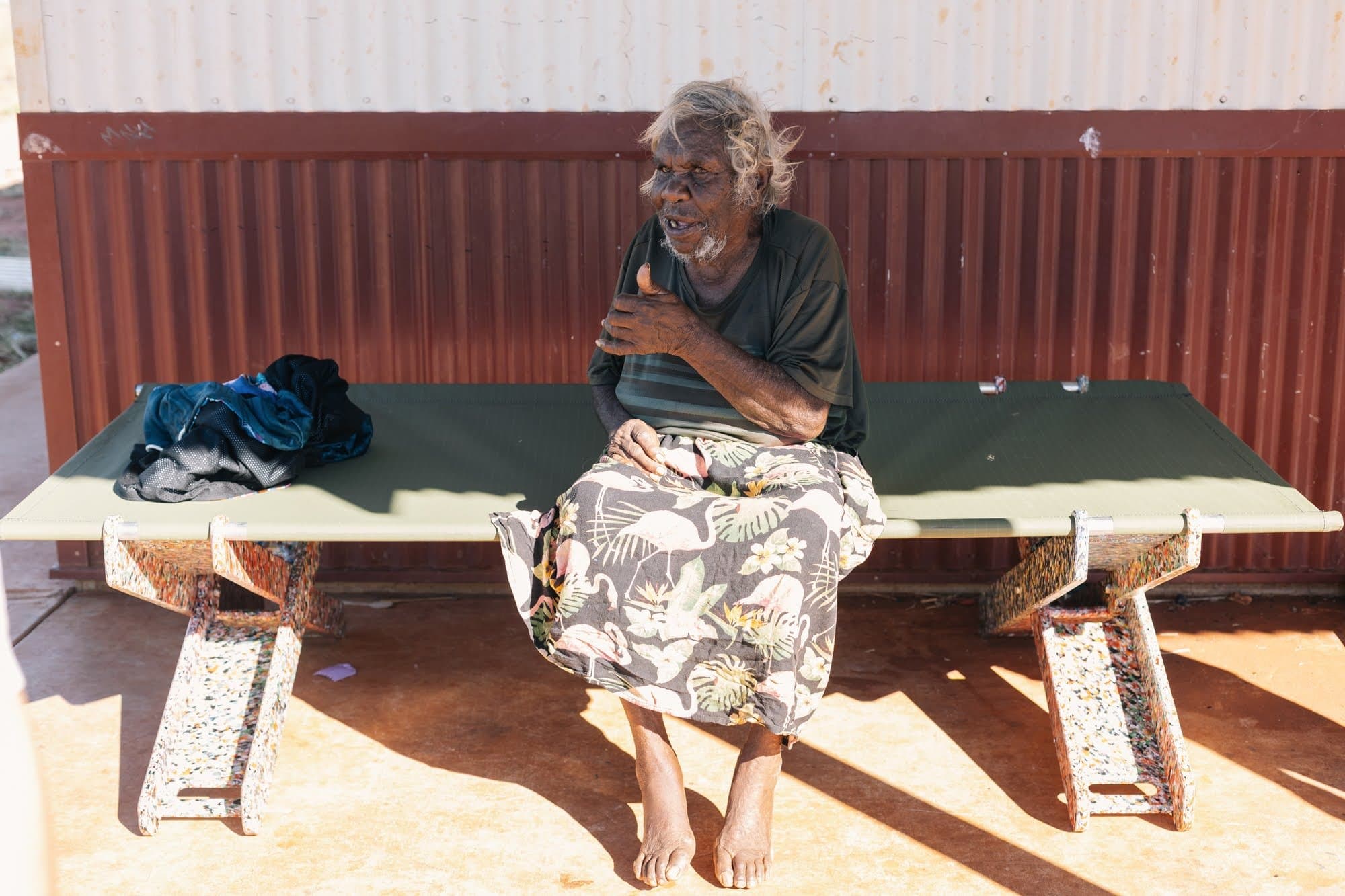
A flat-packable, washable bed made from recycled plastic, heavy-duty canvas, and galvanised steel. Press a part.
1Heavy-duty Australian canvas
Fully washable, quick-drying. The canvas is structural: its tension holds the bed up.
2Galvanised steel pipe
26.9mm OD × 2.6mm wall, 1950mm length. Two poles thread through the canvas sleeves and the top holes of the X-legs.
3Recycled HDPE plastic X-trestle legs
Two crossed-plank "X" trestles, pressed from community-collected plastic waste. About 20 kg of recycled HDPE in every bed.
- ~5 minutes
- to assemble, no tools
- 200kg
- load
- 26kg
- flat-packed
- 20 kg
- recycled plastic in every bed, modelled
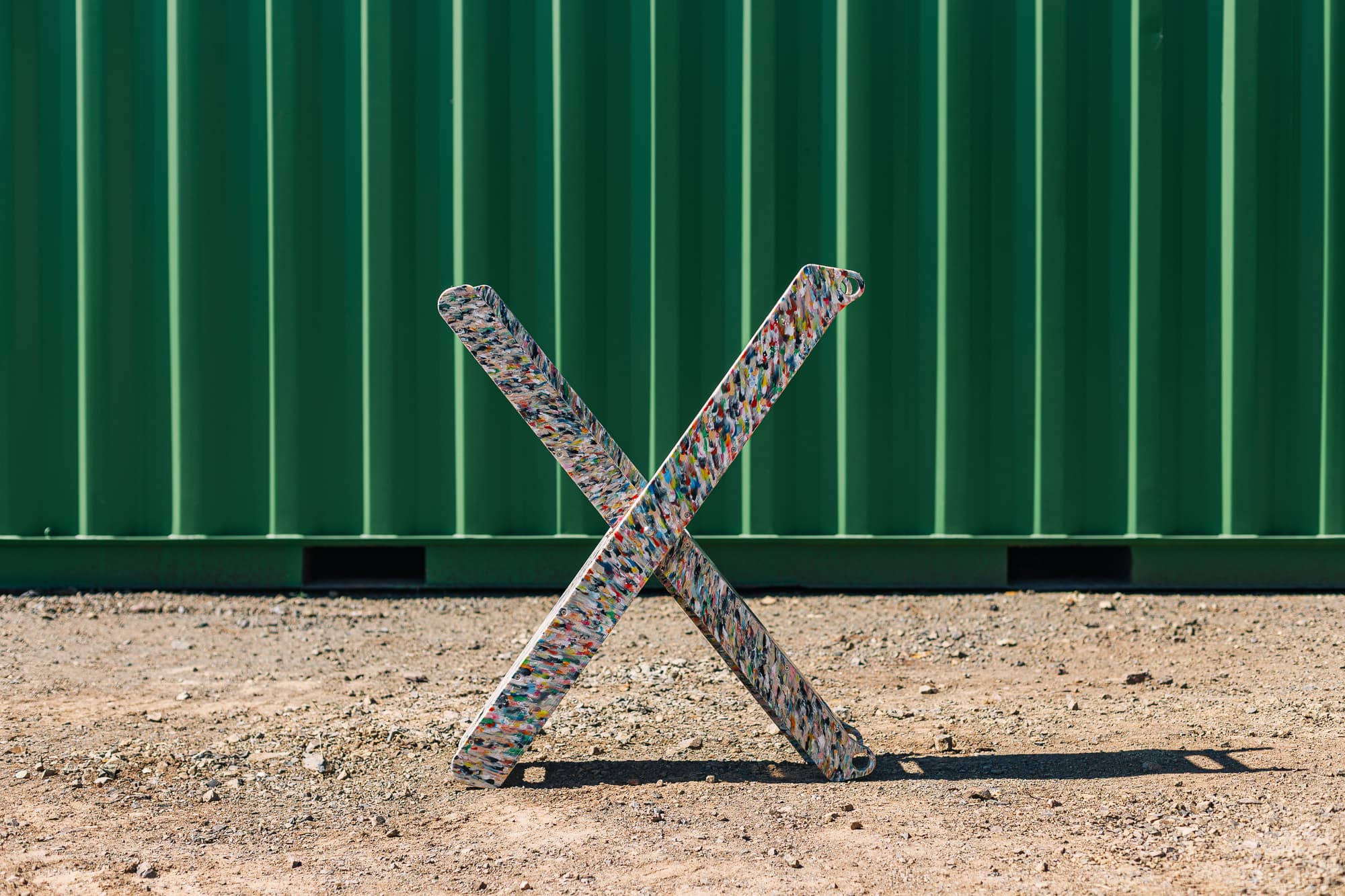
Recycled plastic legs
Crossed X-legs pressed from HDPE. About 20 kg of plastic in every bed.
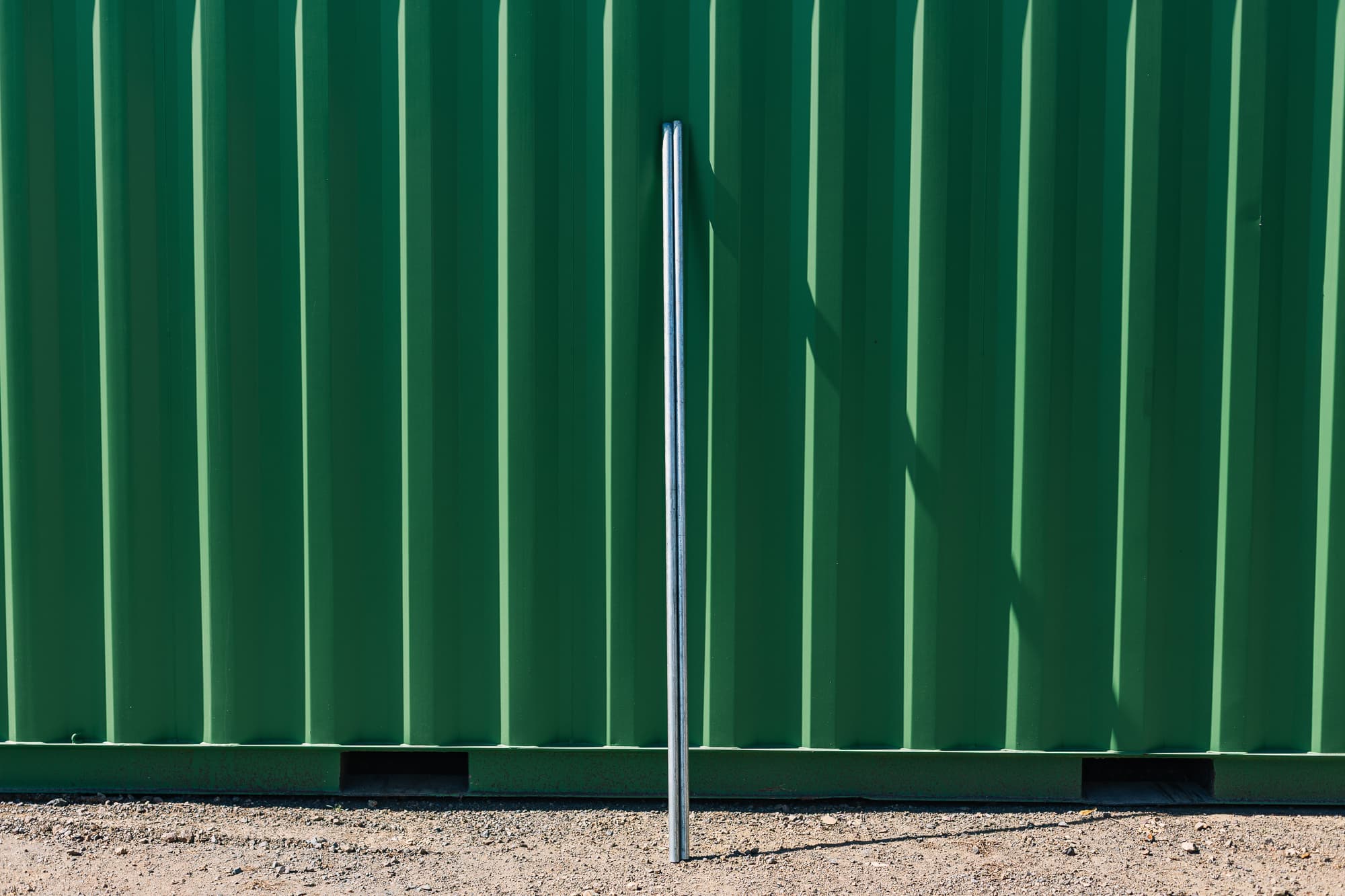
Galvanised steel poles
Two poles thread through the canvas sleeves and the top holes of the legs.
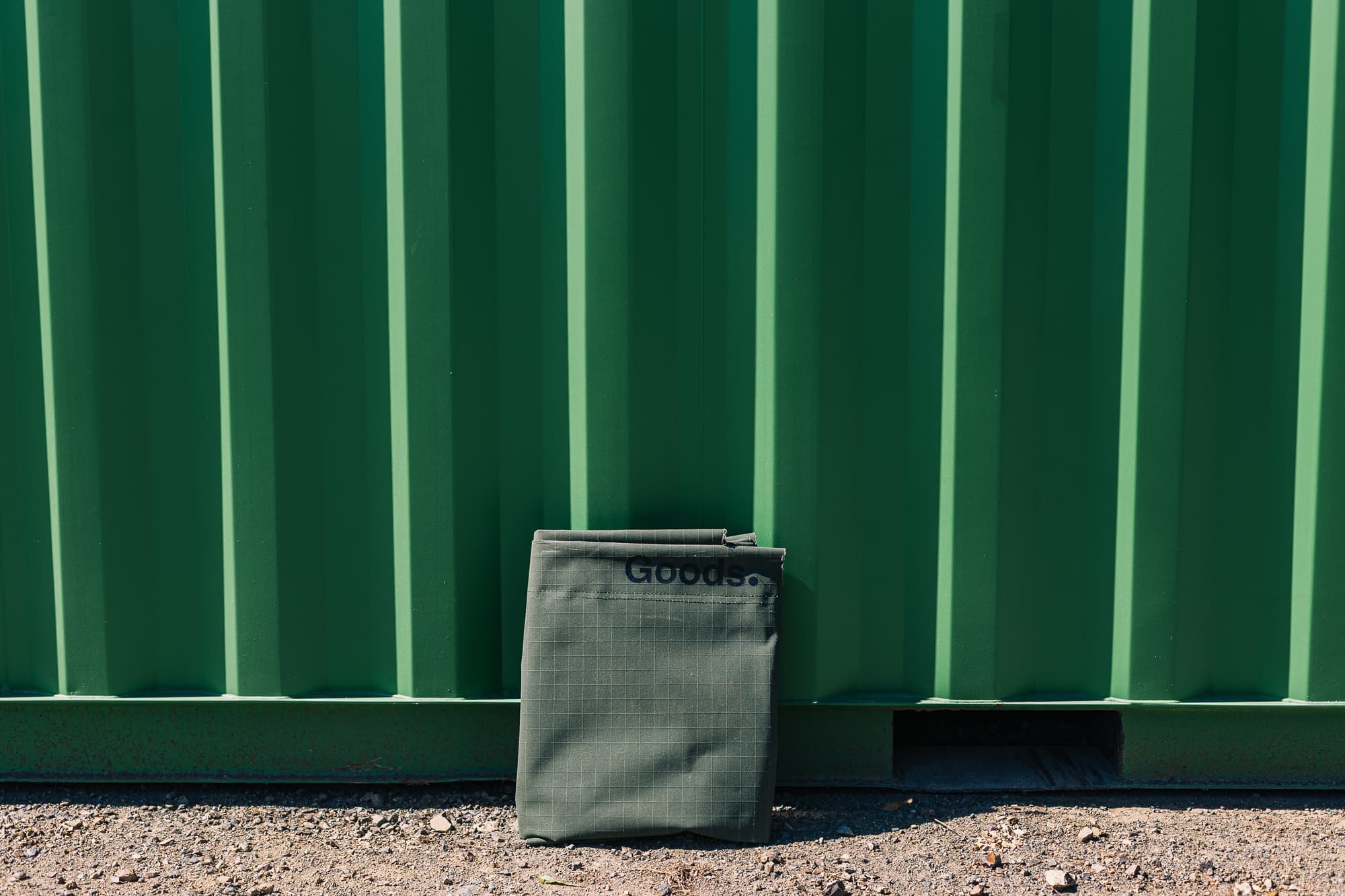
Heavy-duty canvas
Washable, repairable, and structural: its tension holds the bed up.
The support around it
Every bed is on the register. Facilitation and support for the workshopping in community come with it.
Assembled in community
Two poles through the canvas sleeves and the top holes of the crossed legs. Tensioning pulls the poles deep into the legs and the canvas becomes the structure.
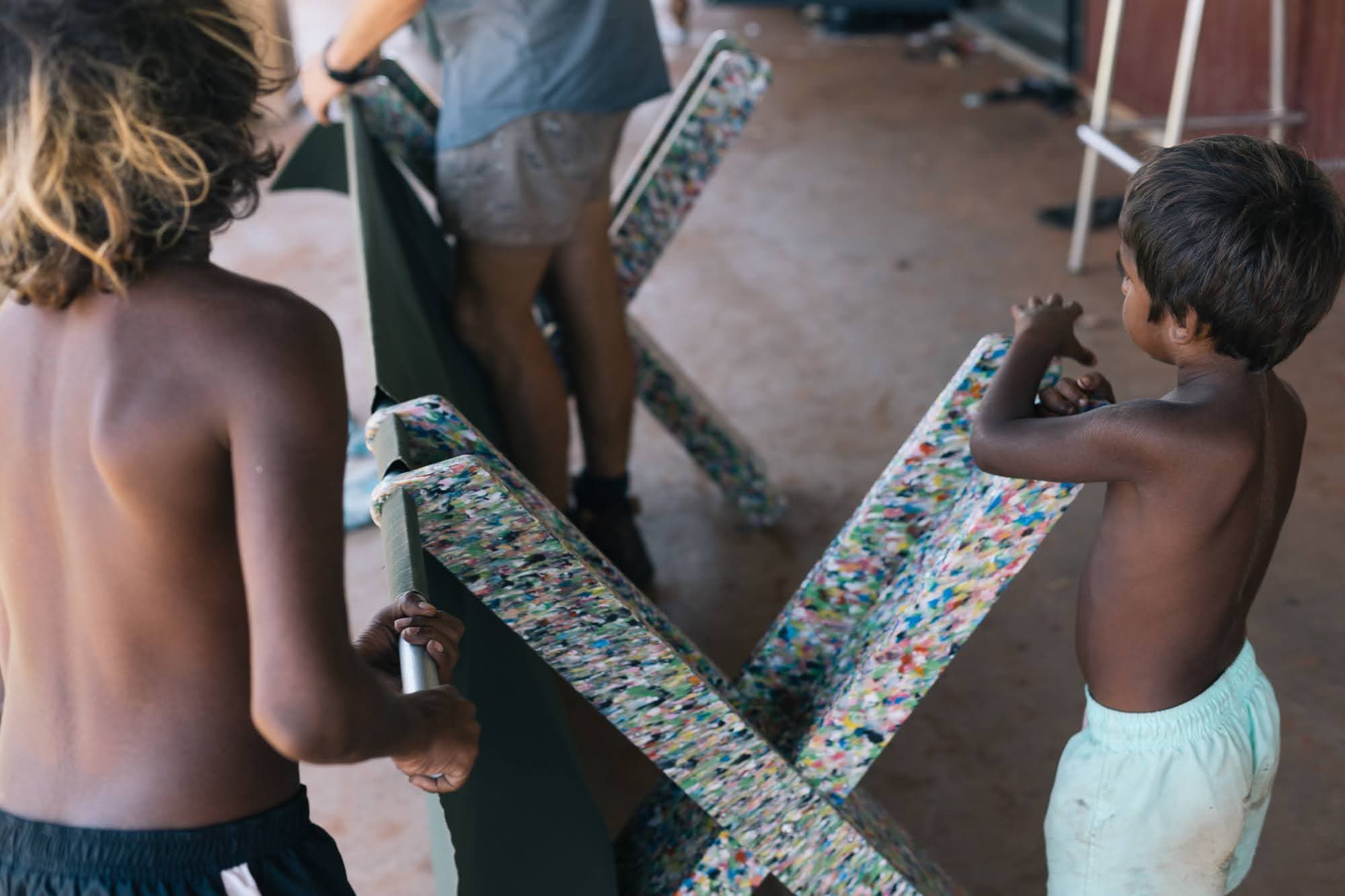
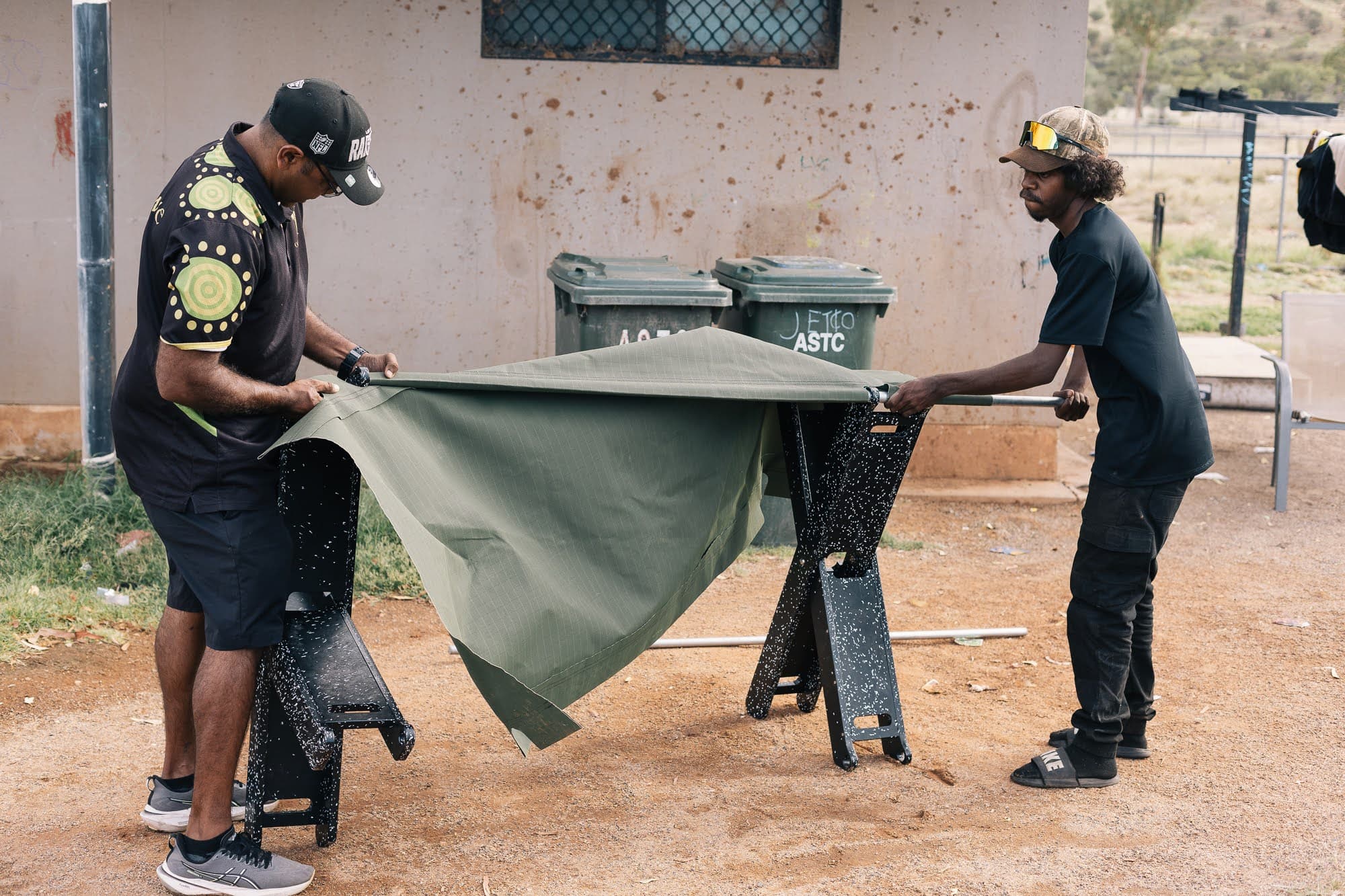
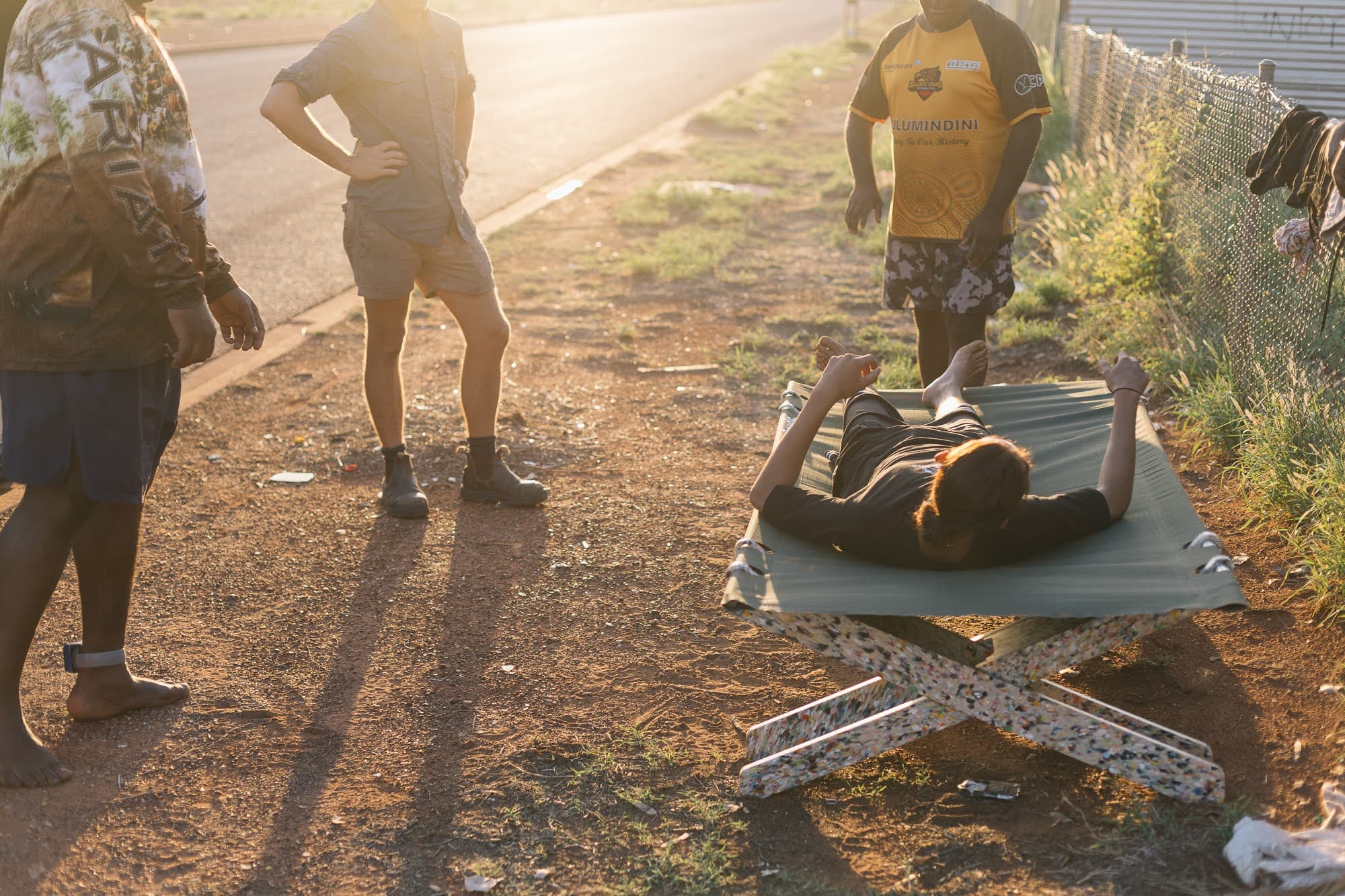
Thread poles through the X-legs
02 · Prototype
Pakkimjalki Kari
A commercial-grade Speed Queen base with one-button operation, named in Warumungu by Elder Dianne Stokes. We are opening the design and build knowledge now so local makers can help bring the price down.
The first prototype
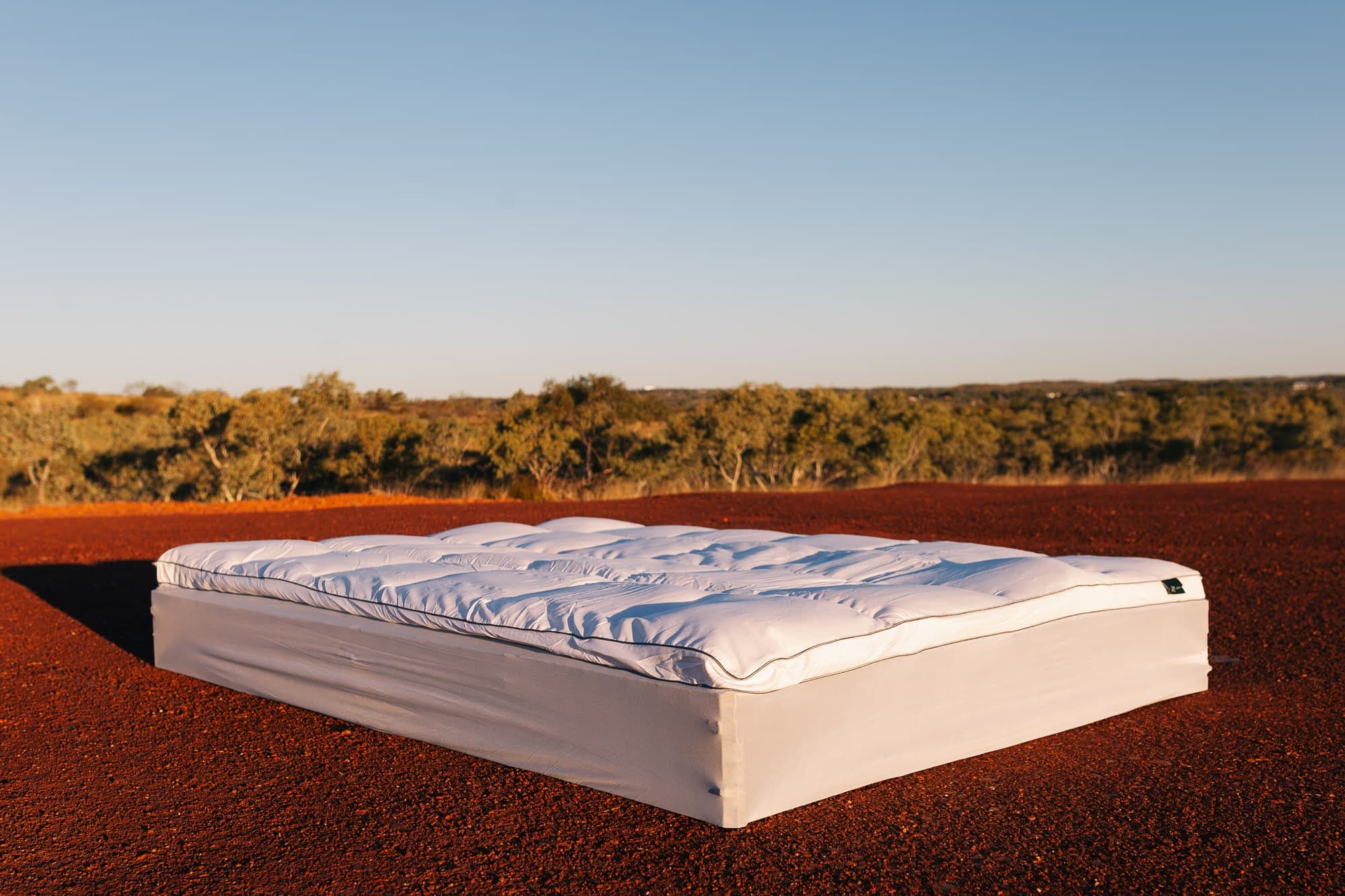
Basket Bed
Our first prototype: collapsible baskets with zip ties and toppers. Now open source. Sales discontinued; the plans are free to download.
03 · Possible
Refrigeration
Refrigeration for houses where the power is unreliable. An idea for the future; nothing is built.
Whatever a community asks for next, the community chooses. A Curious Tractor does the research and development.
“It means something that really makes me happy.”
8
The work has travelled a long way.
The next step is to move more of the making closer to Country.
- 0
- beds deployed, 177 Stretch and 363 Basket
- 0
- washing machines in community
- 0
- communities served
- 0
- kg recycled HDPE, 177 Stretch Beds at 20 kg design mass
9
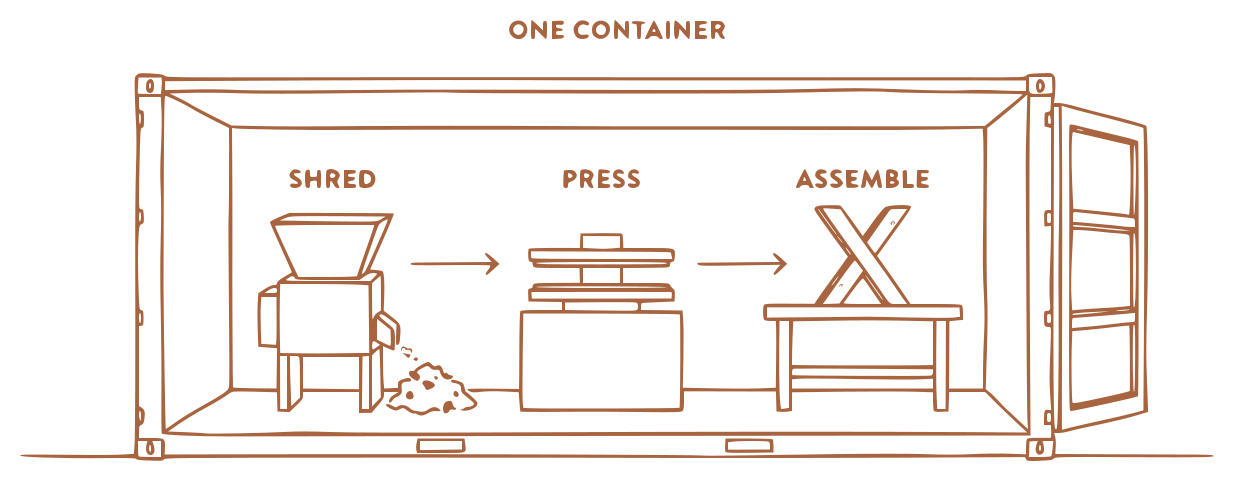
Plastic becomes useful parts here.
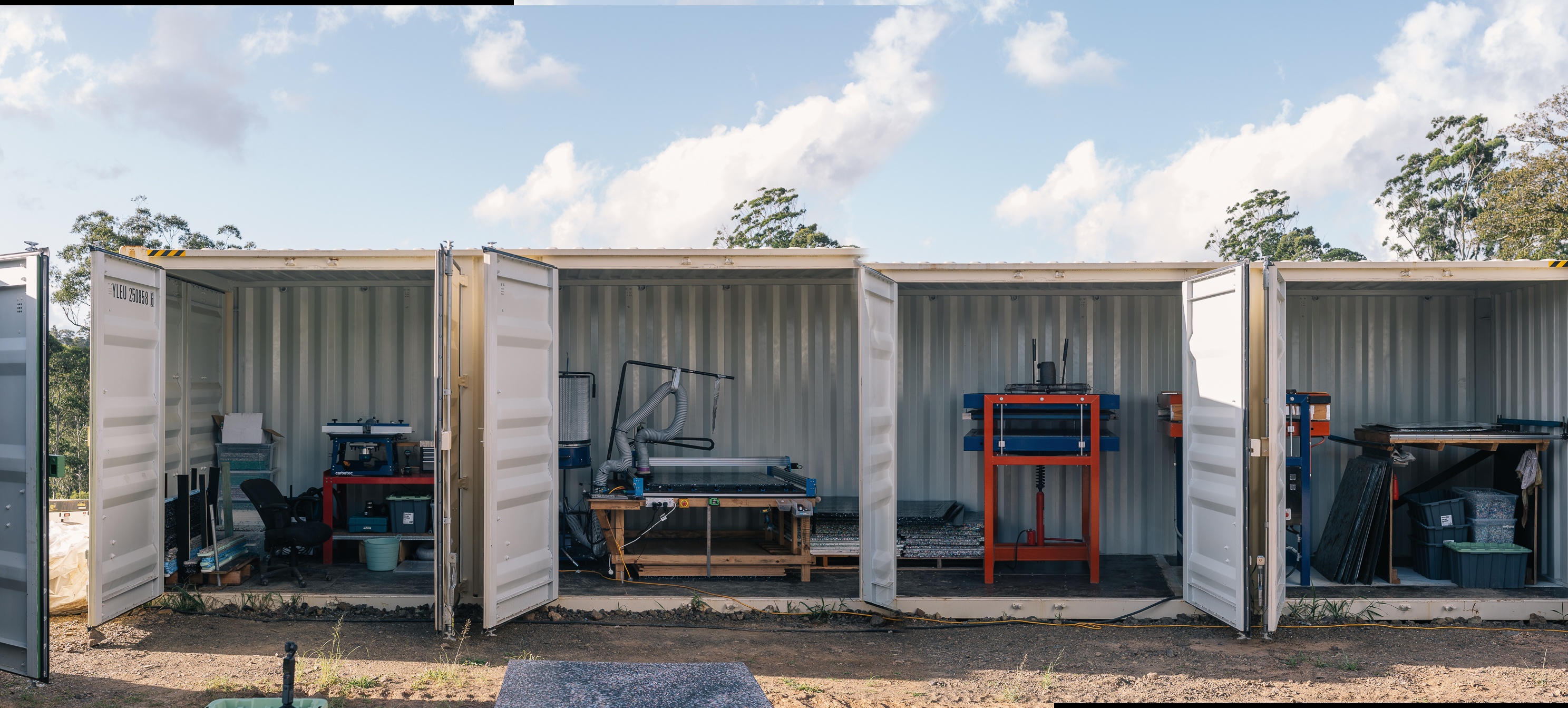
Waste plastic becomes a durable bed through one compact, teachable production line. Goods on Country production facility at The Harvest. Walk the line.
1Sort and shred
Clean HDPE and PP plastic is sorted, then granulated into consistent flakes. The shredder and the chip bins sit in the first container.
2CNC cut and finish
The cooled sheet is cut into flat-pack bed parts on the router and every edge is smoothed. Offcuts go back to the shredder.
3Heat, press and cool
Flakes are spread evenly, melted into a sheet, pressed to thickness, then cooled under pressure. The red press is the heart of the line.
4Assemble, test and pack
Parts meet steel poles and canvas, the bed is checked, then packed flat for the journey to community. Finished sheets and kits are stored in the last container.
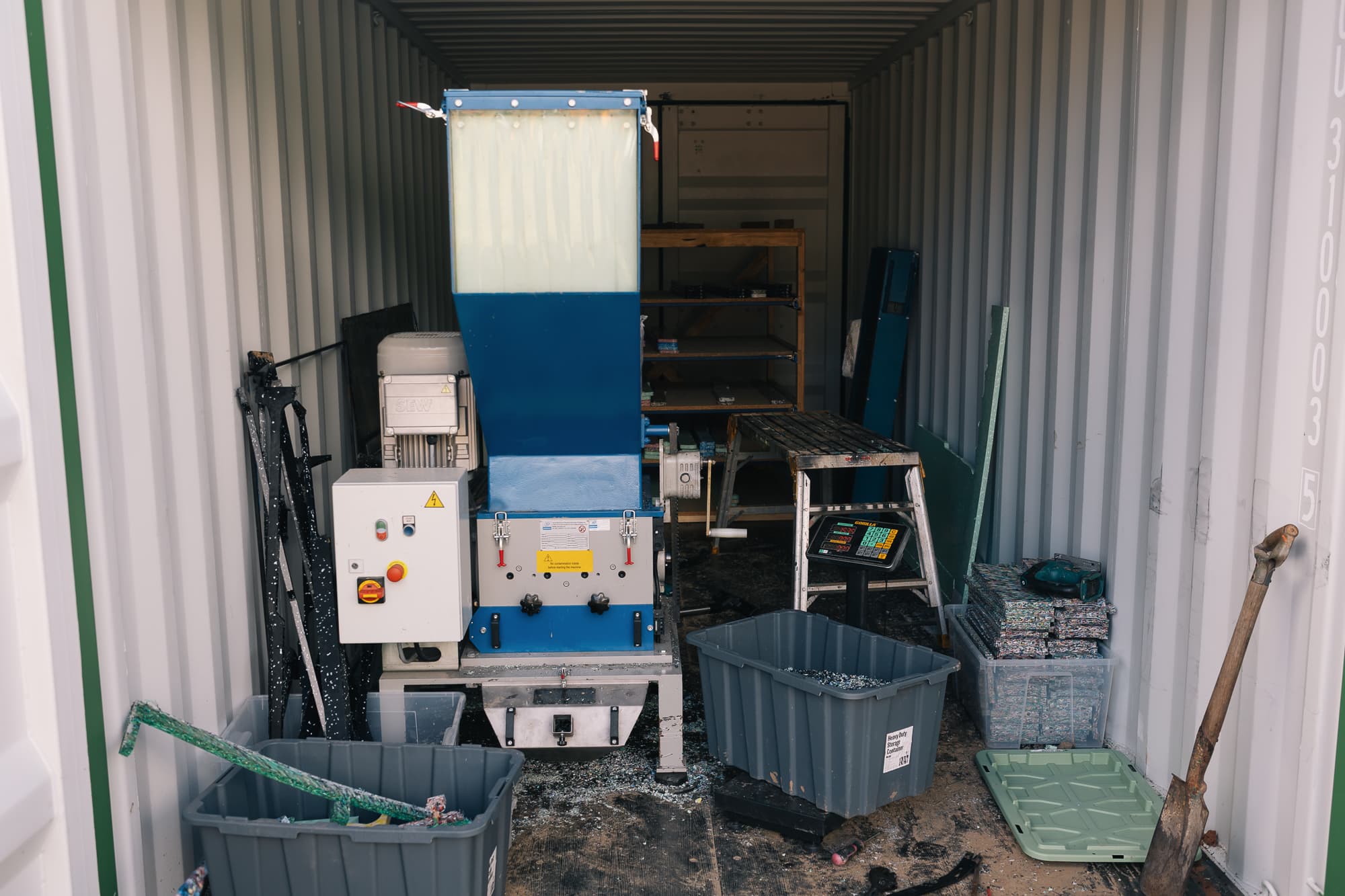
01Sort and shred
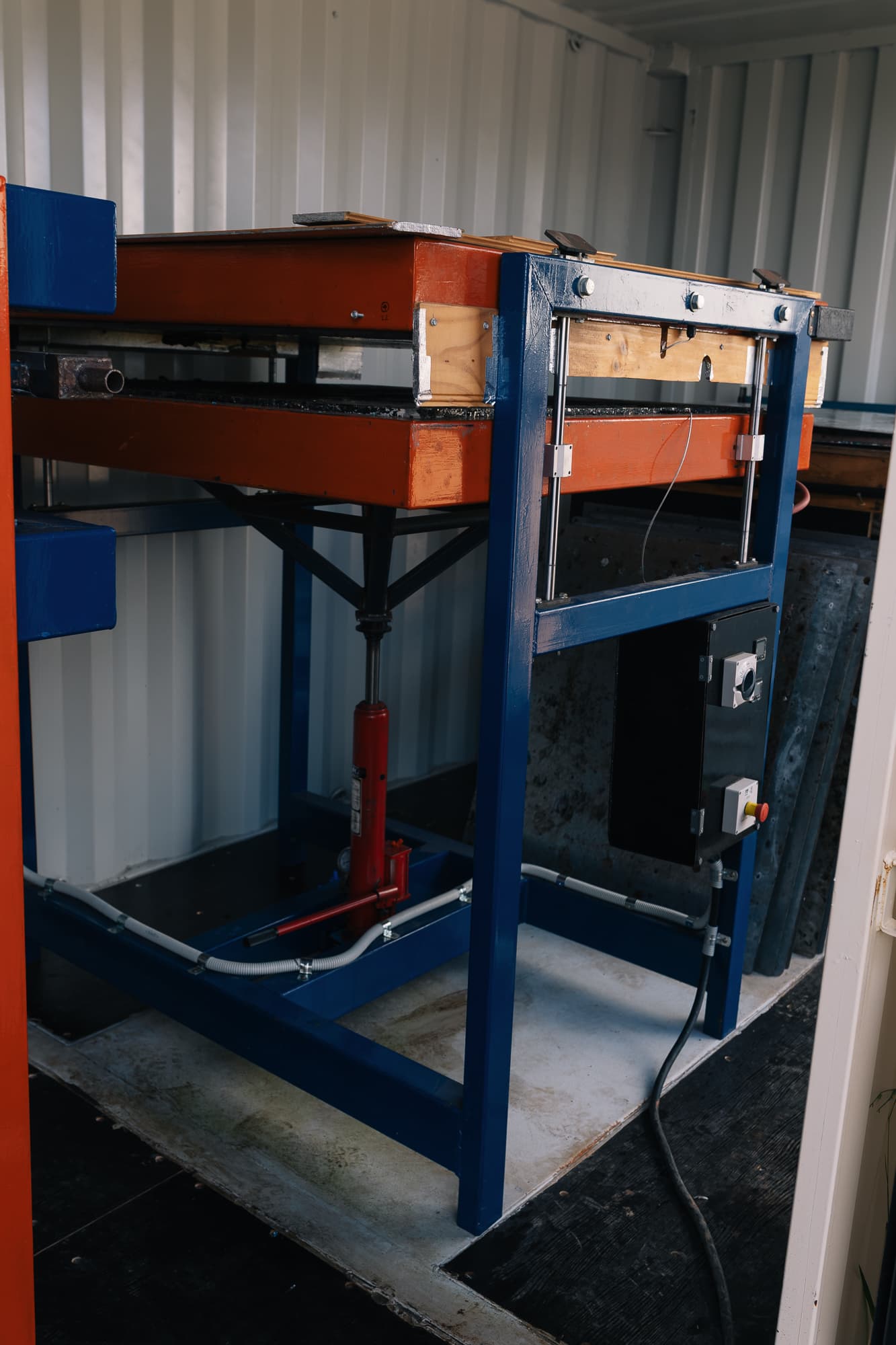
02Heat, press and cool
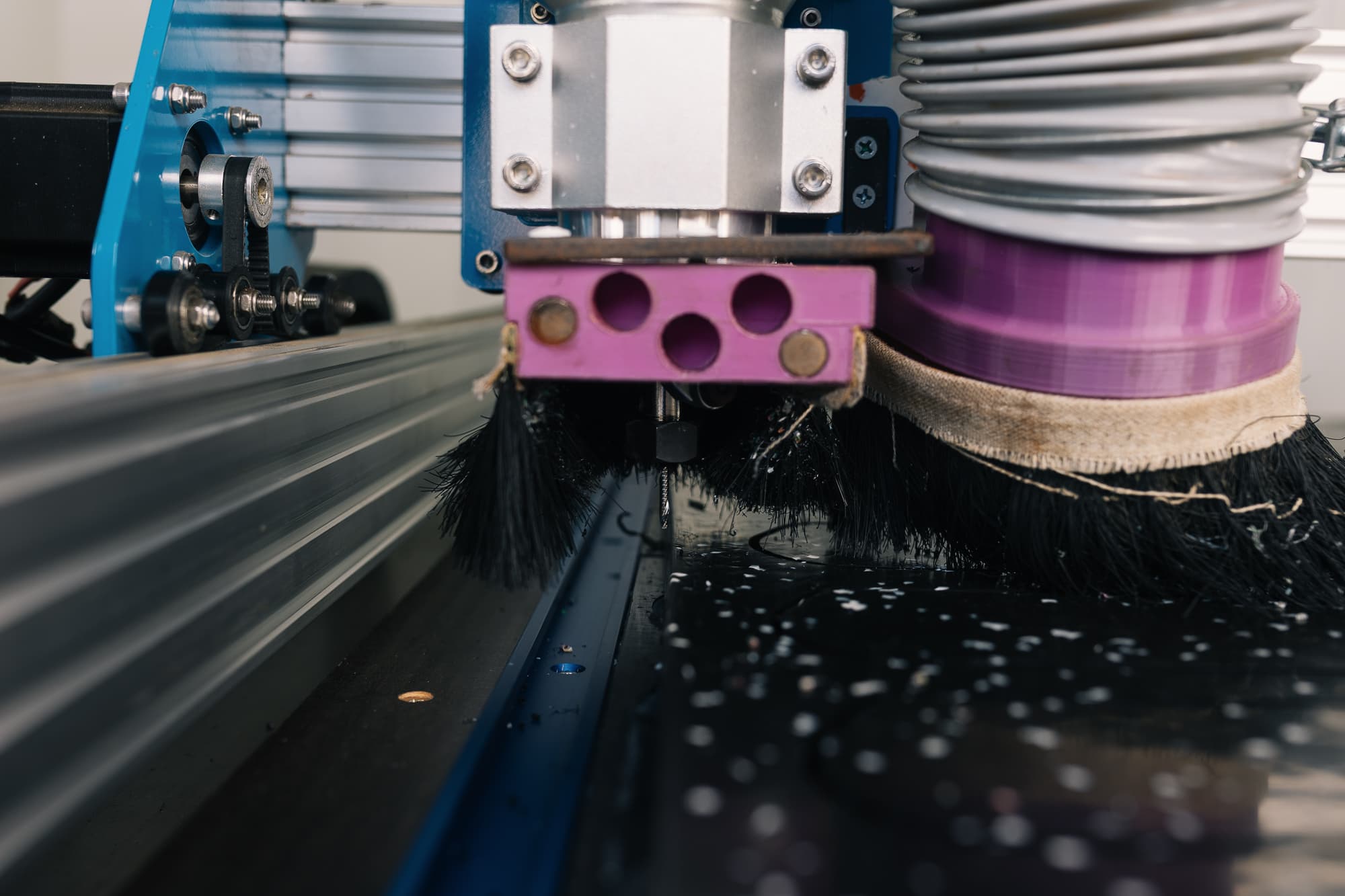
03CNC cut and finish
04Assemble, test and pack
Walk through the facility with Nic
walkthrough
Filmed earlier in the year; the figures said aloud are older than the ones on this page.
Waste plastic becomes a durable bed through one compact, teachable production line.
10
40 Stretch Beds. Made at The Factory. Assembled at Gamardi.
A community-controlled organisation asked for beds and washing machines for homeland families. We pressed and packed the parts at our own facility, sent them north, and young people assembled every bed in community. It is the run that proves the making.
Forty beds and the school washing machine, built with the Gamardi community and Homeland School Company. Four minutes, worth the sound on.
The Homeland School Company bought and paid for 40 Stretch Beds in May 2026. We pressed the tab sheets and cut the legs at our facility in Queensland, then sent the parts north flat packed. At Gamardi, young people assembled every bed with the school and handed them out across the homelands. Two washing machines went with them. Mala'la Health Service had bought 13 beds the year before, so two organisations in one place now hold Goods stock.
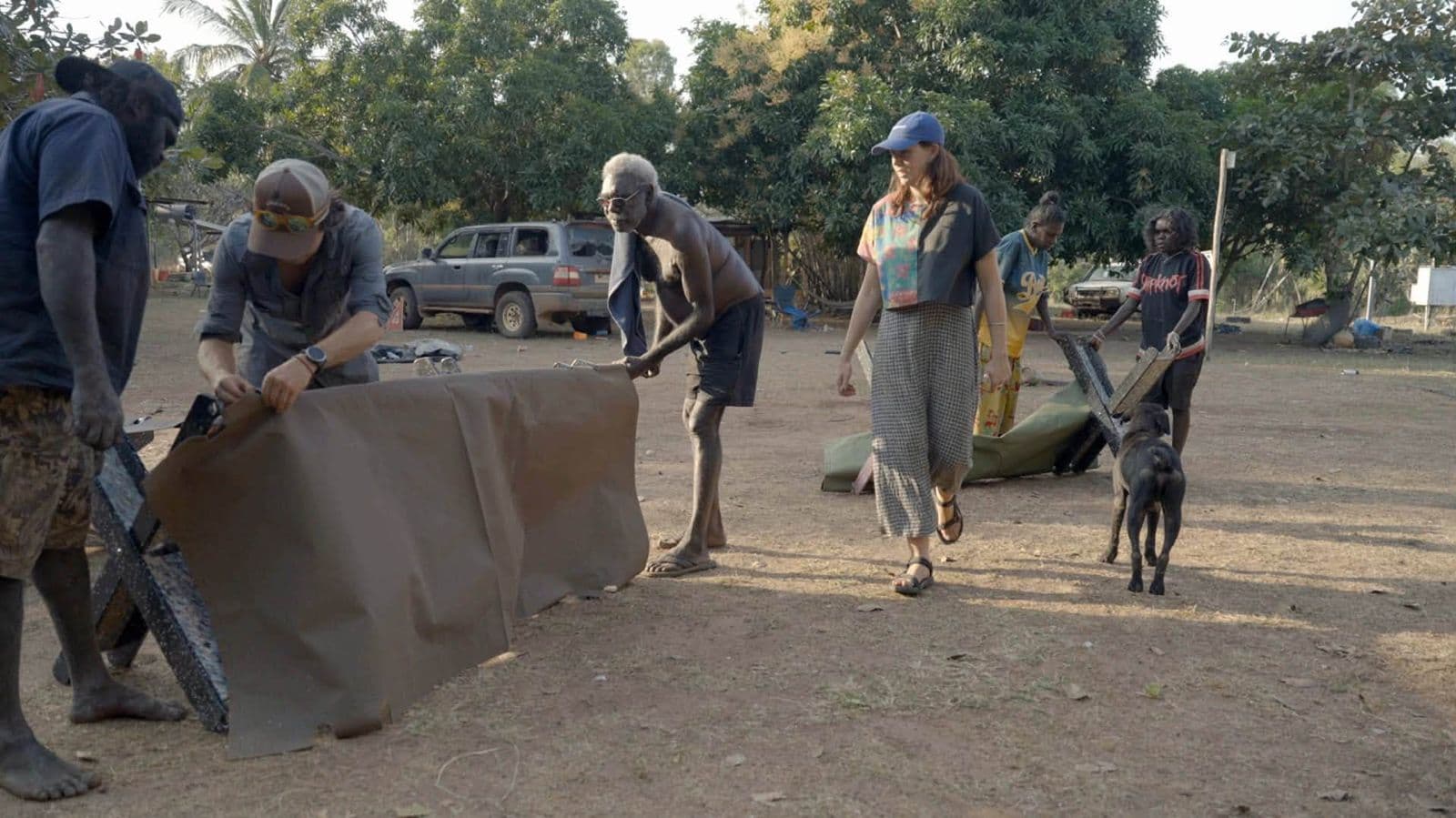
01It started with their ask
The organisation came to Goods with a specific request for homeland families: durable beds and washing machines that survive distance, dust and crowded houses. The order, the timing and the destination were theirs. Nothing was pitched at them.
02The parts were made, not bought
At our production facility at the farm we pressed the recycled-plastic stock, routed the X-frame legs and packed complete kits for forty Stretch Beds. Canvases were sewn by a family business in Alice Springs. Shredded HDPE came from Defy Design.
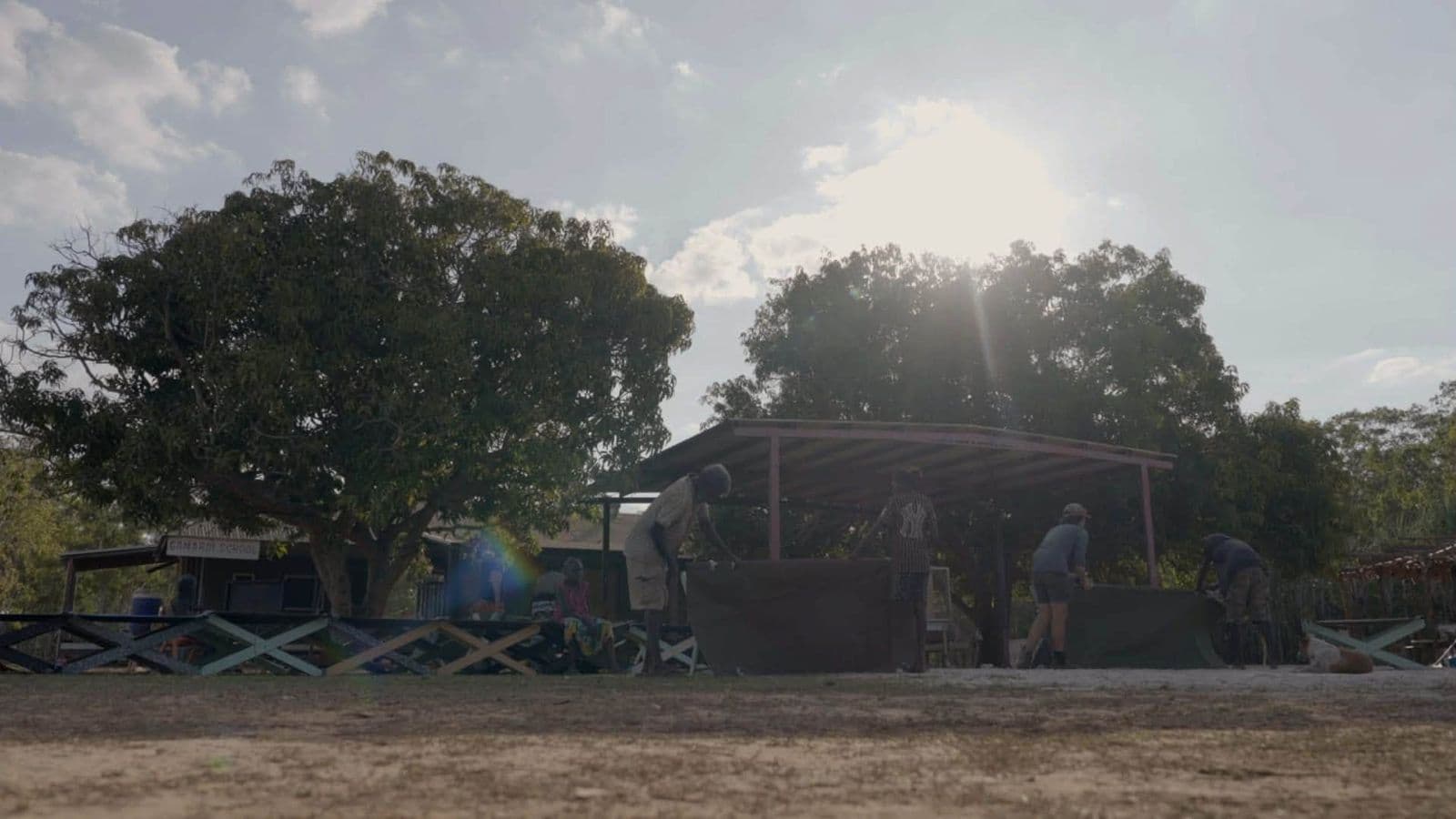
03Community assembled every bed
The kits travelled to Maningrida and young people assembled the forty beds with community, learning the build as they went. A bed that assembles in about five minutes with no tools is a bed a community can own the making of.
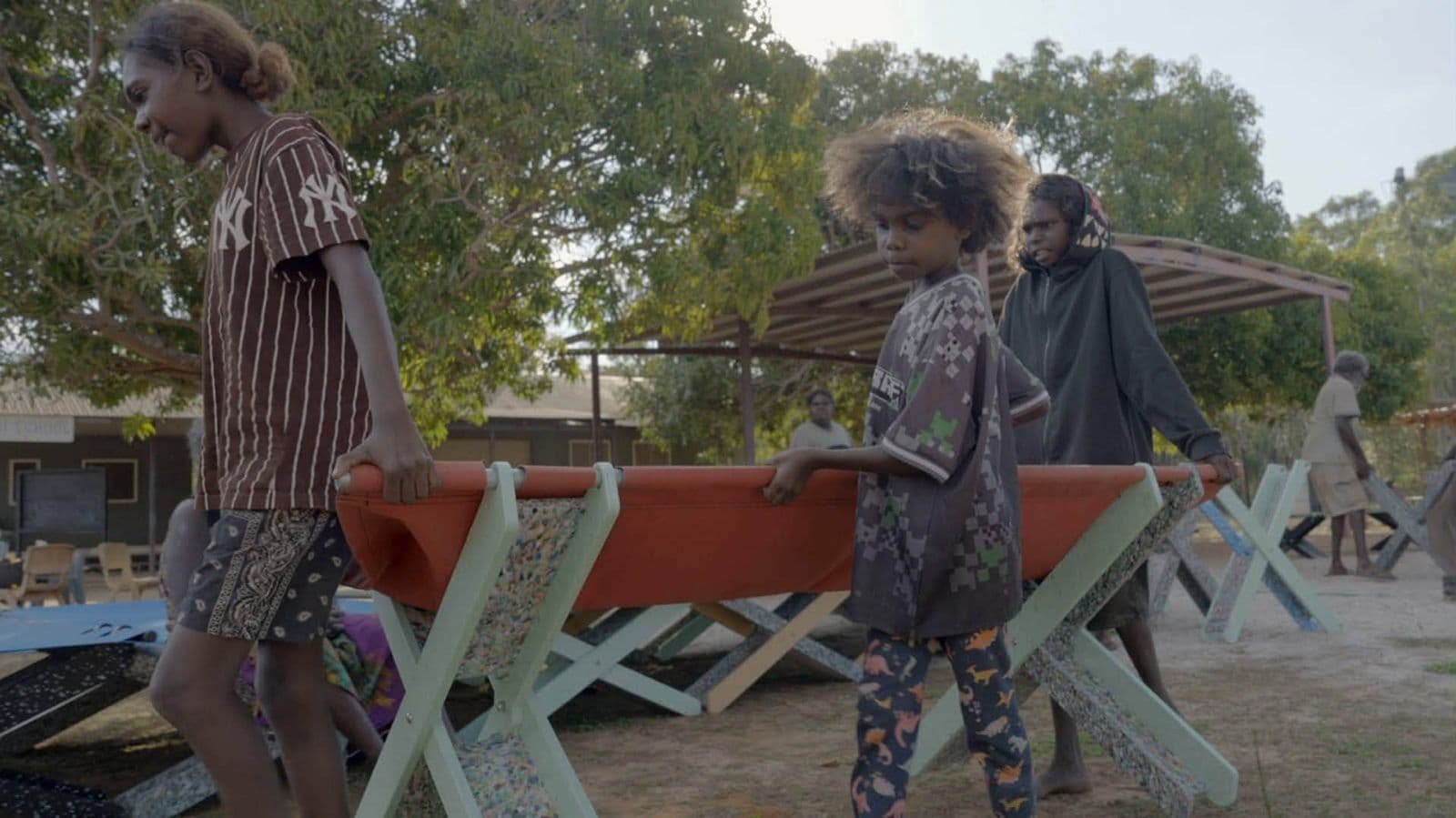
04The beds stayed, and so did the machines
Every bed is in a home and on the register. Washing machines went into community on the same run, joining the machines already working there.
“A good night's sleep means the kids are fresh and ready for school the next day.”
With Homeland School Company. The full case study.
11
The work moved through local hands.
Oonchiumpa held the build and the relationships. Urapuntja staff led the final local delivery and the feedback that now shapes what comes next.
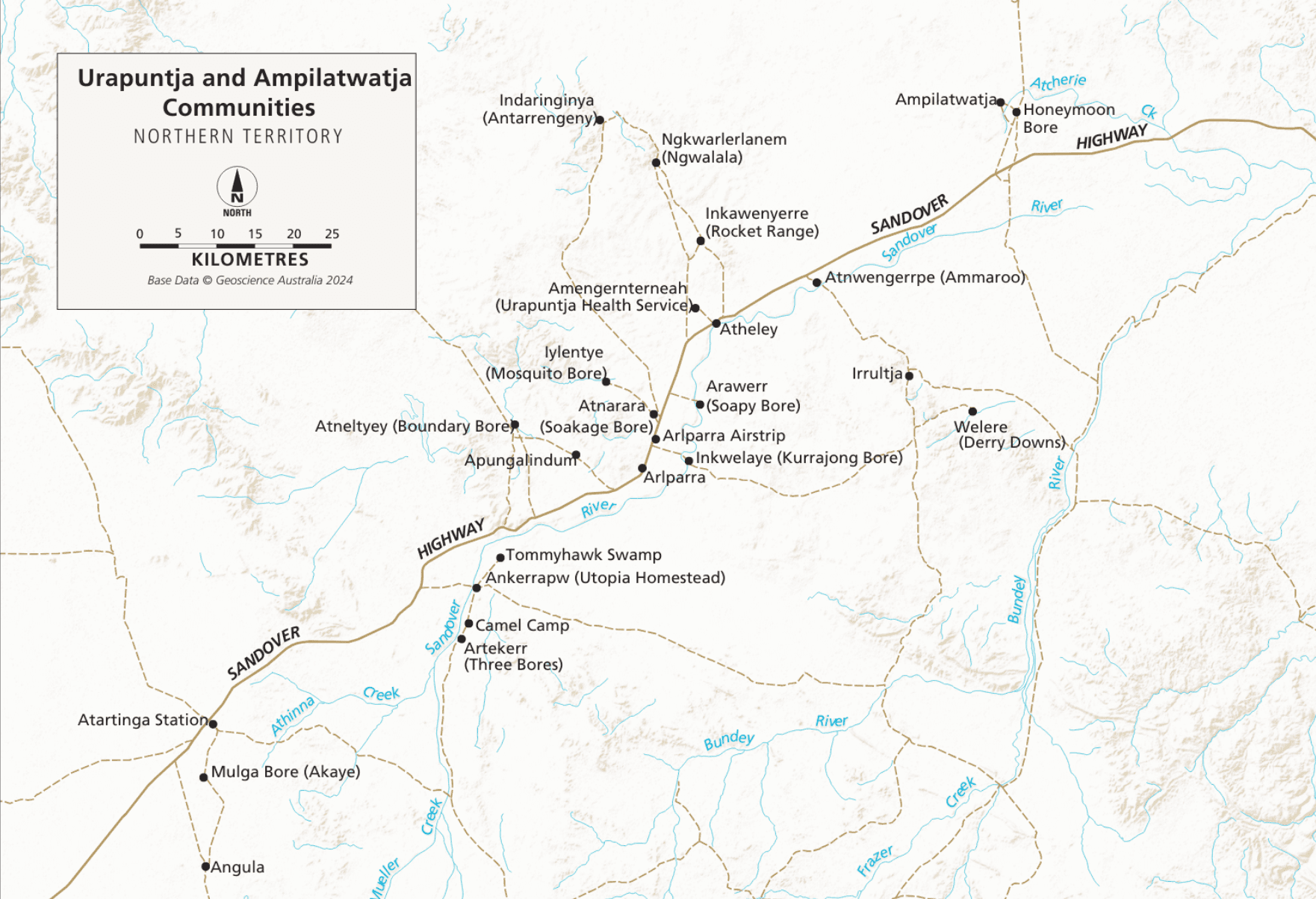
Where we were
Urapuntja (Utopia) and Ampilatwatja sit on Anmatyerr and Alyawarr Country, north-east of Mparntwe (Alice Springs). Both are made up of many small homelands rather than one township. The names you will see in this story (Arawerr / Soapy Bore, Ampilatwatja) are outstations within that wider Country.
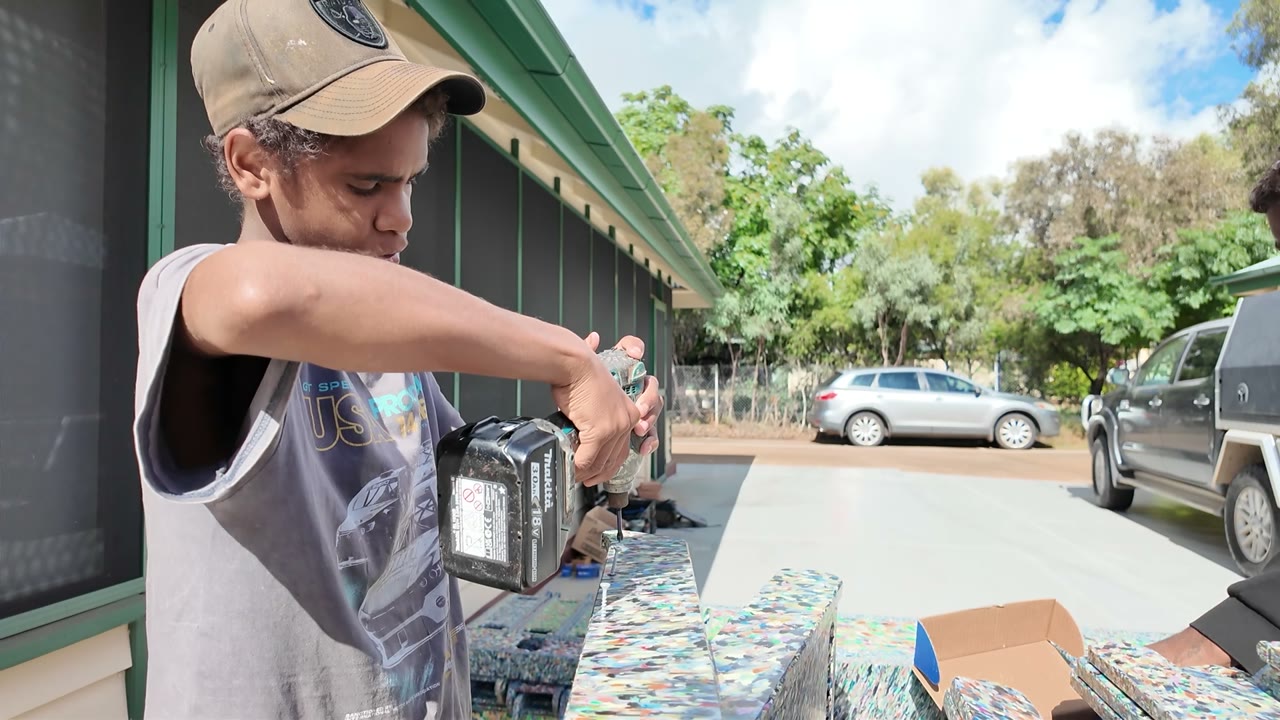
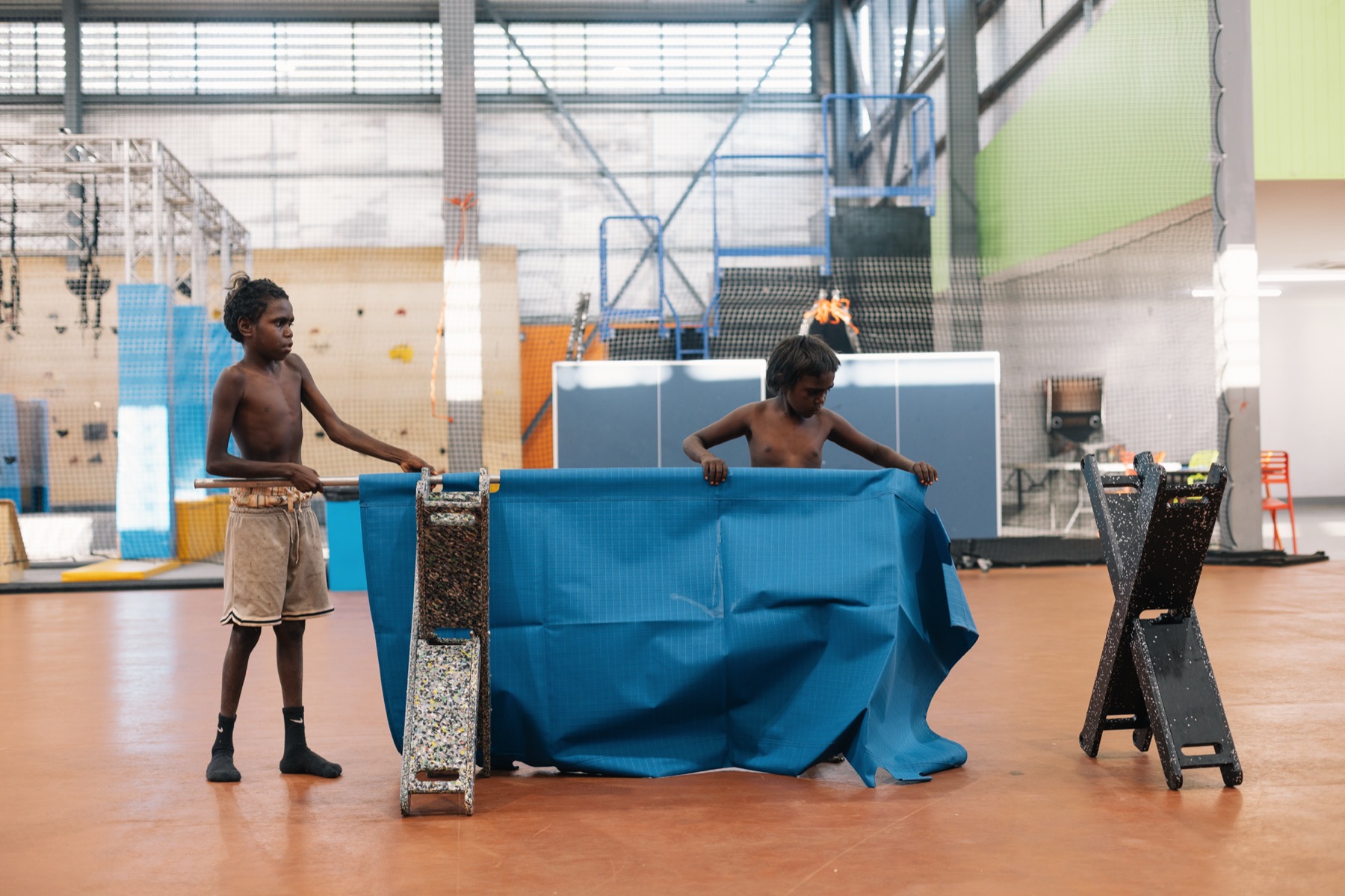
The boys, building
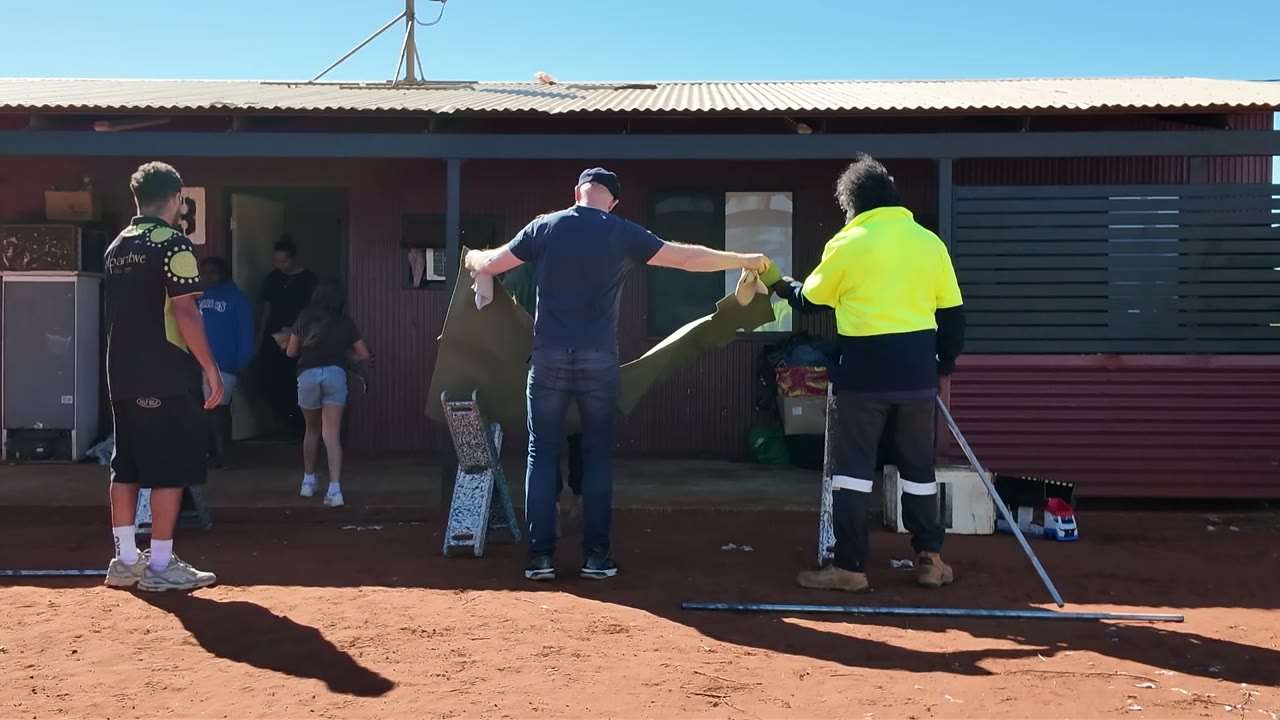
Alice Springs · 20 May 2026. Young men supported by Oonchiumpa, making the beds they will sleep on.
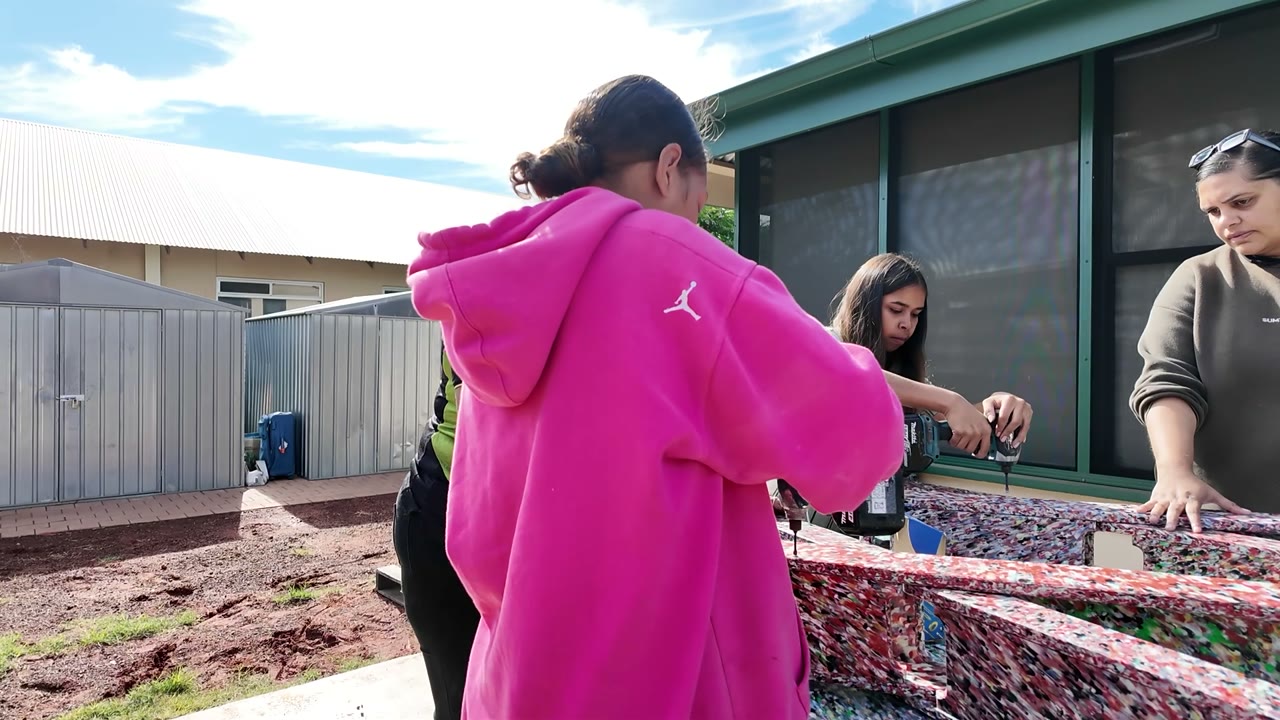
The girls, building
Alice Springs · 19–20 May 2026. Young women supported by Oonchiumpa, building their own beds.
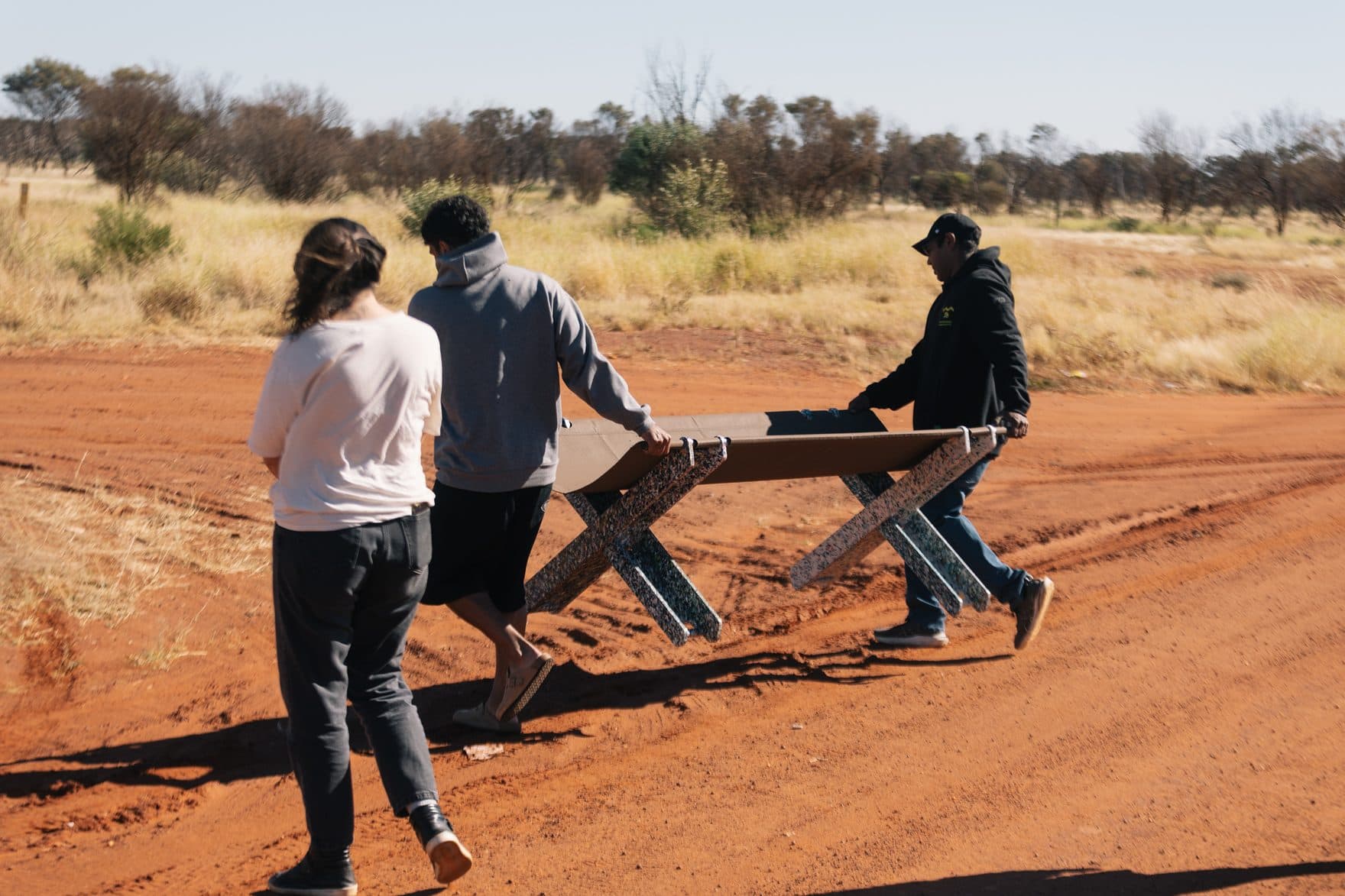
From town to the homelands
Oonchiumpa led the way. We followed onto Anmatyerr and Alyawarr Country.
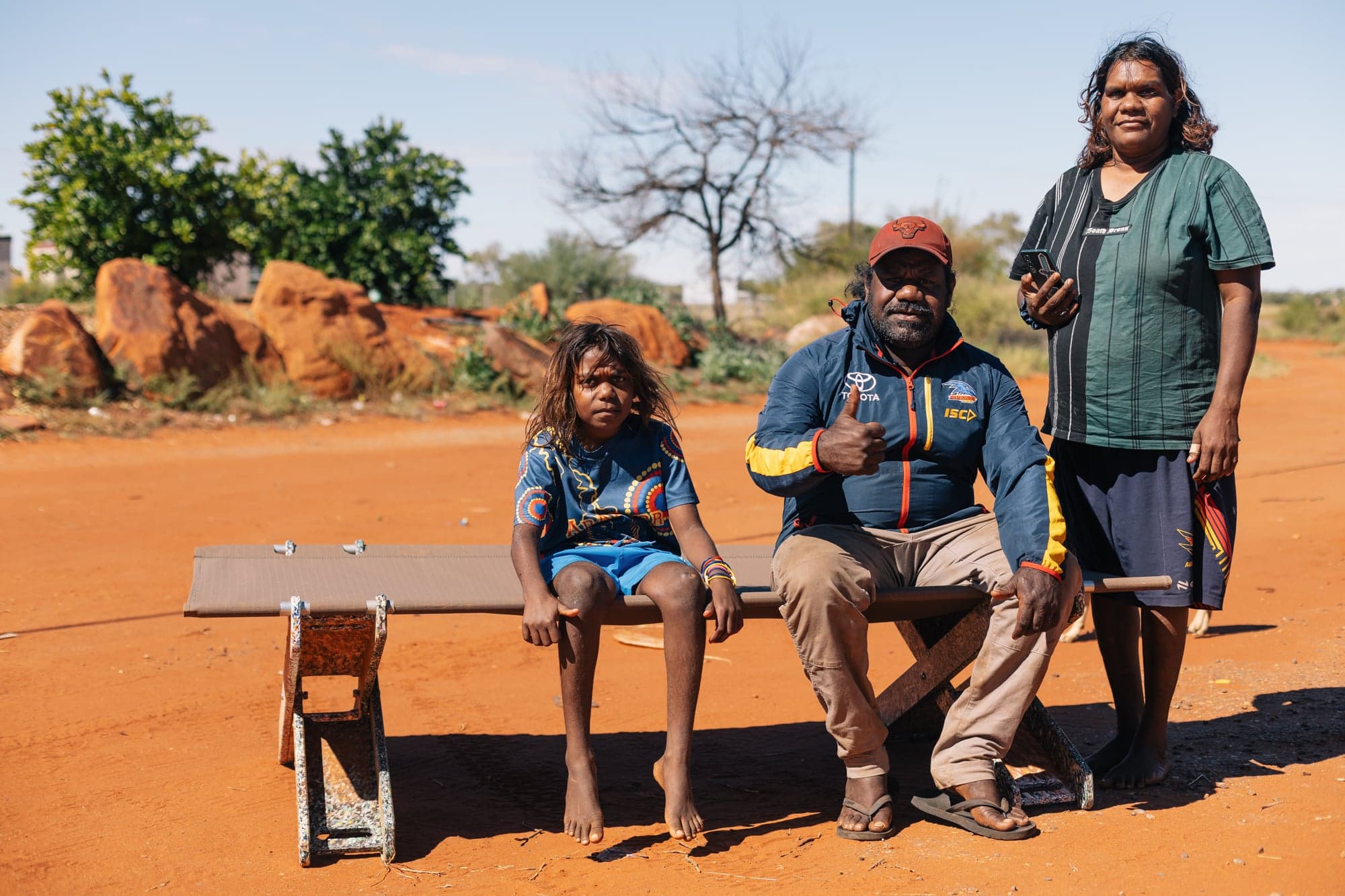
The beds go to the homes
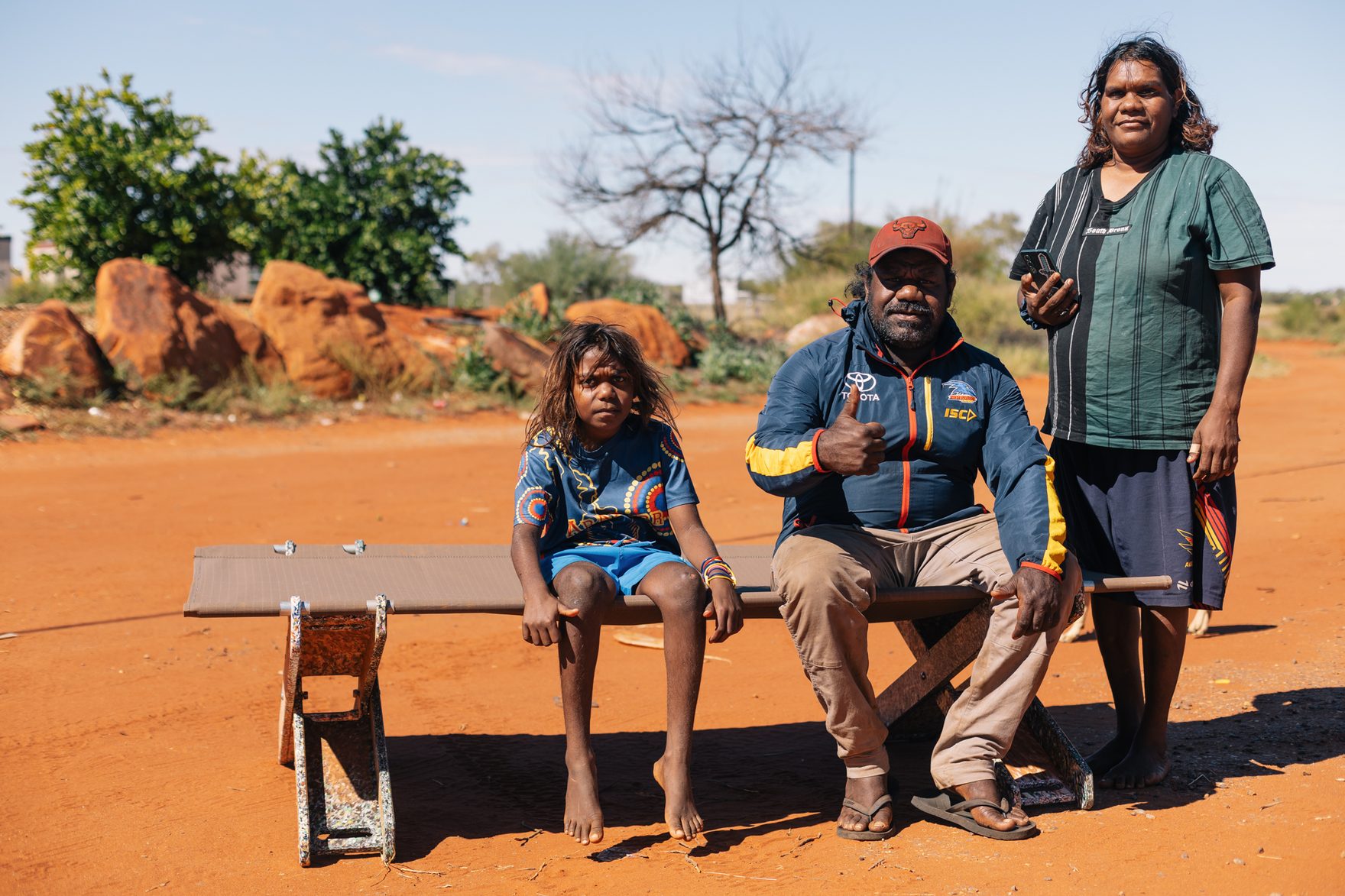
Arlparra was where most of the beds landed, and where we slept. The local friends we met there led the deliveries. We followed people who knew which house was which.
A bed, in the time it takes to drink a cup of tea
Arlparra · 22 May 2026. The build of a Stretch Bed, in community.
Two or three for every house
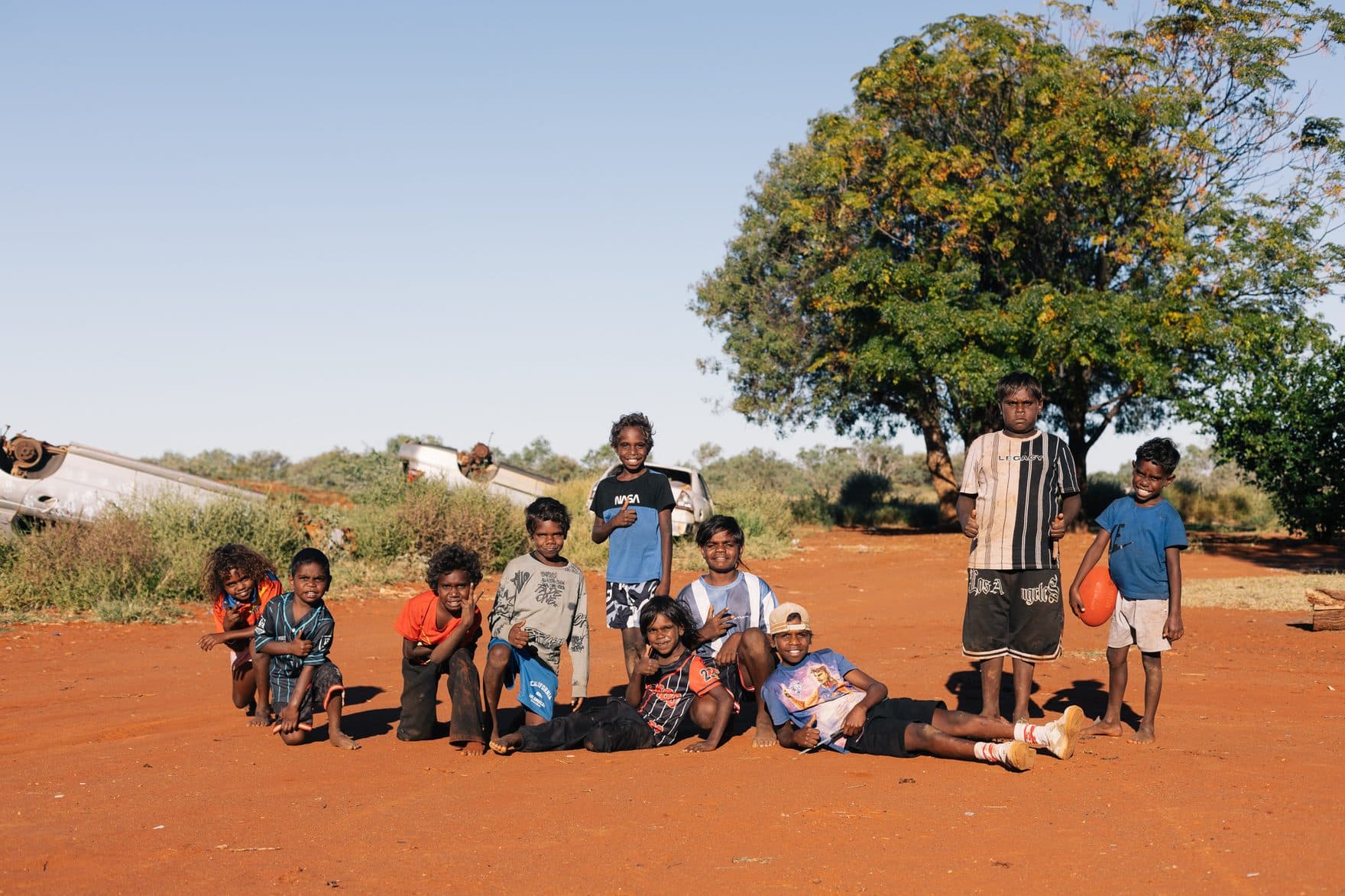
At Arawerr each household asked for two or three. The second-community visit was the Urapuntja team's call, not ours. We followed.
Plastic collected on Country becomes the legs on these beds.
“Never would have thought it would have come out like that.”
Mykel · Young maker · Utopia
“To see kids' faces with joy after making a bed, it just really hits you.”
Karen Liddle · Oonchiumpa co-founder · Utopia (Oonchiumpa)
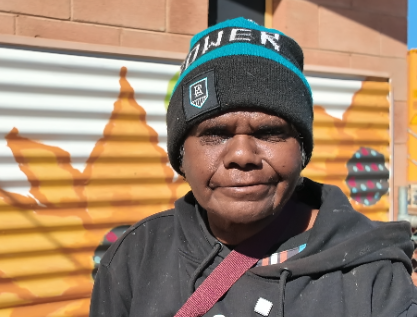
“Good for me and comfy, easy to put together.”
Dorrie Jones · Community member · Arlparra (Utopia Homelands)
The trip, in pictures
32 photographs, Alice Springs to Ampilatwatja, 20 to 22 May 2026.
12
320 beds and 11 washing machines, bought and paid for.
Who buys from a community organisation
Health services, schools, housing programs, research programs and families. The organisation holds the stock, invoices the customer and keeps the whole $750.
Goods on Country brings the customer connections, the contracts and the freight.
Centrecorp Foundation
Two orders for the Utopia homelands. Oonchiumpa held the build. 147 are in households and 20 are made and waiting.
167
ALIVE National Centre, University of Melbourne
Paid in full before one bed was made, for Gathering the Parts.
100
Homeland School Company, Maningrida
The first full run off our own press, assembled at Gamardi.
40
Mala'la Health Service, Maningrida
Bought the year before, so two organisations in one place hold Goods stock.
13
13
The Goods on Country model.
Community sleeping on durable, fit-for-purpose beds, building the products, and earning inside community-run enterprises.
The raise · nothing signed
Asked $750,000.
Watch where each part of it goes as the loop builds.
- QBE
- $300,000
- Beds
- $300,000
- Loan
- $150,000

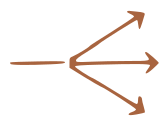
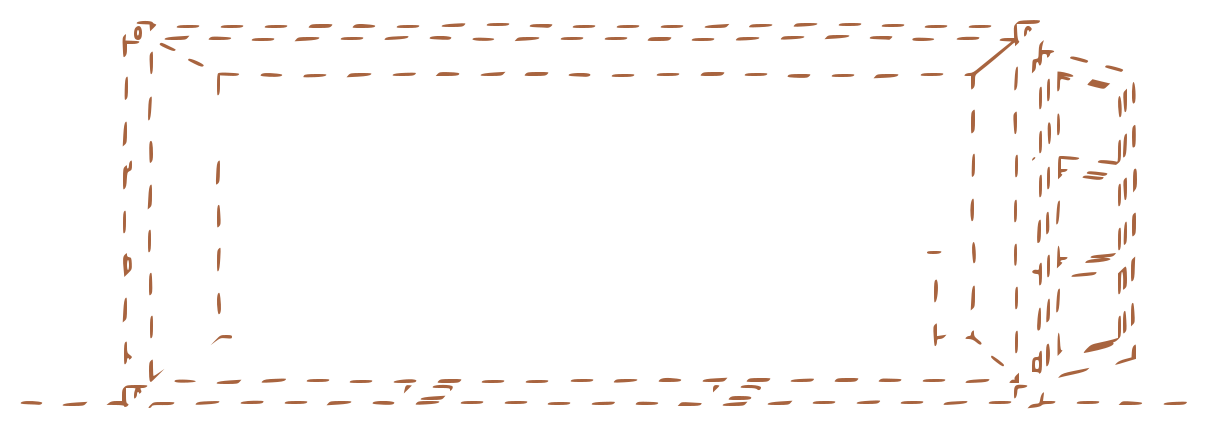
Read the model as a list
- Asked $750,000. Watch where each part of it goes as the loop builds. QBE $300,000: Two community production facilities. Beds $300,000: Three grants, each 133 beds at $750. Loan $150,000: First-year running cost, repaid from beds sold.
- Goods on Country facility. Makes the first 400 beds. 20 kilograms of recycled plastic in every bed. One bed sells for $750, and nothing is added to it.
- Four community organisations. 100 beds each. The beds are theirs to sell.
- The customers. People, businesses and service providers: health services, schools, housing providers, families.
- The money stays in community. Customers pay the community organisation directly.
- The community decides. After costs: more beds, paid local work, or making their own.
- Two community production facilities. QBE's $300,000 builds the first two, $150,000 each, where a community is ready and asks. Then beds made locally, same customers.
- The next thing they choose to make. Washing machines are already being tested. A Curious Tractor does the R&D.
- Four things we count. Employment: Paid local work, at the plant and in community. Recycling: 20 kilograms of recycled plastic in every bed. Enterprise: Sales, repeat customers, money kept in community. Health: Beds in use, checked at six and twelve months.
- Made and sold in community. Support inside the price of a bed: customer connections, contracts, logistics, training, product development.
- Goods on Country facility to Four community organisations: 400 beds, 100 each
- Four community organisations to The customers: beds sold
- The customers to The money stays in community.: payment
- The money stays in community. to The community decides.: after costs
- The community decides. to Two community production facilities.: if the community chooses
- Two community production facilities. to The customers: beds made locally, same customers
- Two community production facilities. to The next thing they choose to make.: then
- A Curious Tractor to The next thing they choose to make.: R&D
14
Four things we count, and how far each is counted today.
Enterprise
Beds paid for, and enterprises trading
0bedsverified
320 beds and 11 washing machines paid for, A$273,966 including GST.
Year one plan: 400 beds as community stock, four organisations selling. target
Settled invoices in Xero. The organisation's own sales record. Community enterprises trading today: 0.
Paid work
Paid hours of making
0hoursestimate
2,080 hours by Goods staff over six months.
Year one plan: 800 paid hours a year for 400 beds at two hours a bed. modelled
Ben's estimate today: eight hours a day, five days a week, six months, two people. The daily production log and wages paid from here.
Recycling
Plastic kept out of landfill
0kgmodelled
3,540 kg design mass in 177 Stretch Beds. Weighed: 0 kg.
Year one plan: 8 tonnes for 400 beds at 20 kg a bed. modelled
Shred weighed in and parts weighed out, every batch.
Health and daily life
Beds in homes, and follow-ups done
0bedsverified
540 beds in homes across 11 communities. Follow-ups done: 0.
Year one plan: 50 beds followed up at delivery, six weeks and three months. target
The register. Consented follow-up visits. Clinical outcomes need their own study.
One of four measures is verified today. The first year is what makes the other three measurable. Every figure carries its label: verified, estimate, modelled or target.
14b
If two communities a year take a facility.
Beds made each year, at the Goods on Country facility and at community facilities. Targets inside modelled capacity. Not forecasts. Push the number and watch the model recompute.
- 14,234
- beds in FY36
- 154,132
- paid hours over ten years
- 1,541 t
- plastic kept out of landfill
The table, year by year
| Year | Facilities open | Beds | Paid hours | Tonnes | Enterprises |
|---|---|---|---|---|---|
| FY27 | 2 | 800 | 1,600 | 16.0 | 6 |
| FY28 | 4 | 2,714 | 5,428 | 54.3 | 8 |
| FY29 | 6 | 4,154 | 8,308 | 83.1 | 10 |
| FY30 | 8 | 5,594 | 11,188 | 111.9 | 12 |
| FY31 | 10 | 7,034 | 14,068 | 140.7 | 14 |
| FY32 | 12 | 8,474 | 16,948 | 169.5 | 16 |
| FY33 | 14 | 9,914 | 19,828 | 198.3 | 18 |
| FY34 | 16 | 11,354 | 22,708 | 227.1 | 20 |
| FY35 | 18 | 12,794 | 25,588 | 255.9 | 22 |
| FY36 | 20 | 14,234 | 28,468 | 284.7 | 24 |
These are targets inside modelled capacity. They are not forecasts. No buyer has ordered beyond year one, no facility beyond the first two has a site or a funder, and the two-a-year pace is a working assumption from Ben on 15 September 2026. Hours a bed and kilograms a bed are modelled and have not yet been measured on a production run. The running cost of the organisation is not modelled here. Every community-made bed is assumed sold at $750 for the local capital line; the community organisation decides what it sells and what it gives out.
15
Keep each dollar in its own lane.
Philanthropy buys the first beds. QBE builds the two facilities. A loan carries the first-year running cost and is repaid from the beds Goods sells. Customers pay the community organisation, and that money stays there.
Philanthropy · three grants
$0
Buys
The first 400 beds
133 beds a grant, at $750 a bed.
Ends up
Four community organisations
100 beds each. Theirs to sell or give out. They invoice the customer and keep every dollar.
QBE Foundation
$0
Buys
Two community production facilities
$150,000 each, where a community is ready and asks.
Ends up
Beds made in community
Community-run. Make beds locally for the same customers, and employ local people.
A loan
$0
Carries
The first year of running Goods on Country
First-year running cost.
Comes back
Paid back
From the beds Goods on Country sells. Never from a community organisation’s sales.
no money back to Goods
Customers pay the community organisation $750 a bed, and it stays in community.
Asked · nothing signed
$750,000
- Beds $300,000
- QBE $300,000
- Loan $150,000
Where the $750 goes
The whole $750 is theirs.
- Making $262provisional
- Freight $100
- Facilitation $100
- Carries the organisation $288
17
Four gates. Nothing moves until the one before it is settled.
Gate 01
Agree with each community
Each of the four community organisations signs an agreement: who owns the beds, who is paid, who decides.
No money moves yet.
Gate 02
Cost each facility
Site, power, shed, freight. One quote per facility. QBE and the community say yes before anything is bought.
QBE's $150,000 a facility is released here.
Gate 03
Confirm beds and buyers
The first 400 beds are paid for. Who buys and who gets a bed is agreed with each organisation before a bed ships.
Philanthropy's $300,000 buys the beds.
Gate 04
Build, run, review
Facilities open. Six months of making. We publish the numbers and decide with each community whether to add the next.
Every sale stays with the community organisation.
Proposed sequence. A gate is settled when the agreement, the quote, the buyers or the numbers are in hand, in that order.
What a bed changes, in one afternoon.
The first 400 beds get people off the floor. The next 400 are made in community.
Help buy the first beds, and build the two facilities that make every bed after.
Gamardi · Maningrida homelands
20
What we get asked, and what we say.
The questions every room asks, with our answers as they stand on 14 September. Open means we do not yet have an answer we would say out loud.
25 questions, 5 still open or partly answered.
- Where are they selling? Who actually buys the beds?
- The places that buy beds for people: health services, schools and housing providers. Four organisations have already paid for 320 beds on invoice: a national research centre, a foundation buying for the Utopia homelands, a homeland school company and a health service. Each community organisation sells its beds under its own rules, to whoever it chooses, and the buyer pays the community organisation. We do not add requests together into a demand number. We say what people have done.Partly answered.
- Is A$750,000 the income?
- No. It is the raise: QBE A$300,000 for two production facilities, and A$300,000 of bed money for the first 400 beds, three grants each buying 133 beds at $750 with the support and the freight inside the price, and a loan of A$150,000 for the first-year running cost, repaid from the beds Goods on Country sells. Sales money belongs to the community organisation that sells the bed, and none of it is income to Goods on Country.
- What does the money actually buy?
- Three things, kept apart. A loan of A$150,000 carries the first-year running cost and is repaid from the beds Goods on Country sells. QBE’s A$300,000 buys two community production facilities, A$150,000 each as a planning allowance; no site has been quoted. The other A$300,000 buys the first 400 beds at The Harvest Plant, 100 for each of 4 community organisations: three grants, each 133 beds at $750. The work around every bed and the freight sit inside the price of a bed. The beds are the community organisations’ to sell.
- What does QBE’s money actually buy?
- Two proposed production facilities, where communities are ready. Palm Island and Maningrida first; Tennant Creek, Mount Isa and others as options. A$150,000 per site is a planning allowance; no site has been quoted. Sites, costs, approvals and agreements are still to settle, and we say so.
- Why not just give the beds away?
- Because then the beds are a delivery and nothing starts. We are trusting community organisations to take the beds, sell what they decide to sell, and build their own future with the money. The funder acts once. After that the money goes round inside the community. Some beds still go to families who need one tonight; that mix is the community’s call.
- What does it cost to make a bed?
- About A$262 on the flat-pack route: tab sheets pressed at The Harvest Plant, leg panels bought in, kits dispatched flat and assembled in community. A bed sells for A$750 and nothing is added to it: Goods on Country absorbs A$100 of freight and A$100 of facilitation out of its share, and A$288 reaches the organisation. When a community organisation sells a bed, the customer pays it directly and the money stays there. The A$262 is provisional until the bought leg-panel yield is confirmed, and nobody has made fifty in a row at working pace and kept the receipts. That is the measured run.Partly answered.
- What does a community organisation do with the money?
- Whatever it decides, after costs. More beds, paid local work, or making their own. Where a community is ready, a production facility comes to them, and then the next thing they choose to make. The money never comes back to Goods on Country.
- Who ends up owning the making?
- Ownership is a pathway, and we say so on every page. Goods on Country holds the products, the IP, the contracts and the equipment today, under an Indigenous-led board. Each community organisation holds its beds, its sales money and its decisions. Six months into a site we ask four questions: who holds the keys, who runs the payroll, who invoices the buyer, and whether the community decides what gets made and who works on it. Partial counts as no. Until the answers are yes, we do not claim ownership has moved.
- What if a community sells none of its beds?
- Then every bed meets a need and there is no sales money. That is a real outcome and it is the community organisation’s call. The trade does not start there, and we would not push it. What we do first is agree the rules, so that choice is made on purpose and everyone knows what follows from it.
- Is anything signed?
- No. The raise is asked and nothing is secured. What is real is the paid trade, 320 beds on invoice from four buyers, and 540 beds already in community. We say that first, every time.
- Which organisation does the money go to?
- The Butterfly Movement Ltd, the registered charity behind the work since 2012, with deductible gift status. It trades as Goods on Country and is taking that as its name. Everything sits there: the products, the IP, the contracts, the making, the sales, the money and the evidence. Community partners are independent organisations with their own boards, never part of the charity, and buyer receipts stay with them.
- Which entity applies to QBE and receives the grant?
- The Butterfly Movement Ltd, trading as Goods on Country, applies and receives. Ruled 5 September. A Curious Tractor, the company the first beds were made through, is disclosed as a related entity; it does the research and development.
- How fast can 400 beds move?
- As fast as each community organisation agrees its rules. The Harvest Plant makes the first 400 on the flat-pack route, tab sheets pressed at the plant, legs bought in, kits dispatched flat and assembled in community, which is how the forty Maningrida beds were made. We would not move a bed before the rules are agreed.
- How is a grant catalytic if it does not match anything?
- The first money starts a trade that keeps going without it. The first 400 beds go to 4 community organisations, they sell them, the buyer pays them, and the money stays there to pay for the next thing. QBE’s money starts the two facilities that move the making closer. We never say a grant matches, doubles or guarantees anything.
- How do you measure impact?
- Two ways, kept separate. Numbers prove scale: our register counts every bed, washing machine, community and kilo of plastic, and every figure we publish carries a label. Voices prove meaning: Empathy Ledger holds consented interviews with people where the beds went. What we will measure is enterprise, paid work, recycling, and health and daily life: sales and repeat buyers, paid hours and wages, verified plastic used, beds in use and checked at six and twelve months. We do not claim health outcomes.
- What about the washing machines?
- Pakkimjalki Kari, named in Warumungu by Elder Dianne Stokes. A one-button machine on a Speed Queen base, at prototype stage and in several communities. It is the next thing after the beds, where a community chooses it. It is not for sale yet; there is a register-interest form.
- Who runs the line at a site, and who pays them?
- Open, and it is the biggest single dial in our model. A site has a floor cost the day anyone works there, and the wage of whoever runs the line is the part no bed sale covers on its own. An operator and a place, named, with someone paying them, is agreed in the rules before a facility is established.
- Why 100 beds per community organisation?
- Open. We do not yet have an answer we would say out loud.
- Does any of the money come back to the funder?
- No. The funder acts once, and after that the money goes round inside the community. Nobody is buying shares: The Butterfly Movement Ltd is a company limited by guarantee and has none. If a facility is ever financed with a loan, it is repaid from what Goods on Country is paid for making, never out of a community organisation’s sales money.
- What happens if the cost to make comes in over A$262?
- We publish it anyway and redo the maths in the open. The first fifty beds get counted properly: kilos of plastic and what it cost, press time and power, CNC hours, operator hours kept separate from founder time, scrap, freight, what breaks. If it comes in under, the model is right. If it comes in over, the model changes and every page changes with it.
- Is this a health program?
- No. Scabies and rheumatic heart disease are the reason the hardware matters. The beds are washable and off the ground because of them. That is where our claim stops. We count beds in use, paid hours, plastic and sales, and we do not claim health outcomes.
- Who decides who gets a bed?
- The community organisation, under rules it agrees before any bed moves: who gets beds, who sells, who is paid, where the money goes. Oonchiumpa did exactly this in Mparntwe. They picked the young people, chose which households got beds and who drove them out to the homelands.
- What does Goods on Country get out of it?
- What it is paid for making the first stock, and the money that runs the organisation, which we raise separately and say which is which. Sales money never funds it: the buyer pays the community organisation, not Goods on Country.
- What have you actually delivered?
- 540 beds across 11 communities in two years, and 22 washing machines in community. Forty beds pressed at The Harvest Plant and assembled at Gamardi by young people with Homeland School Company. Two days of building with Oonchiumpa in Mparntwe. Four buyers who have paid for 320 beds on invoice. Every bed is a row in our live register.
- What are the biggest open questions right now?
- Which communities are ready for the two facilities, and on what terms. The measured cost of a locally made bed, which the first fifty will give us. Who runs the line at the first site and who pays them. And the rules with each community organisation, agreed before any bed moves.
Words 2026-09-14. Figures from the register and canon. The drawings on this page are the deck's drawings, rendered from the same files.
Goods on Country
Talk to the team.
A question about the model, beds for your organisation, or backing the work. The message comes straight to us.